Williamstown Sale Tests Australia’s Maritime Industrial Priorities
BAE Systems’ planned disposal of the dormant Williamstown naval yard is more than a property transaction. It exposes the tension between land value, strategic industrial capacity and the shrinking margin for ship repair resilience in the Asia-Pacific.
What happened
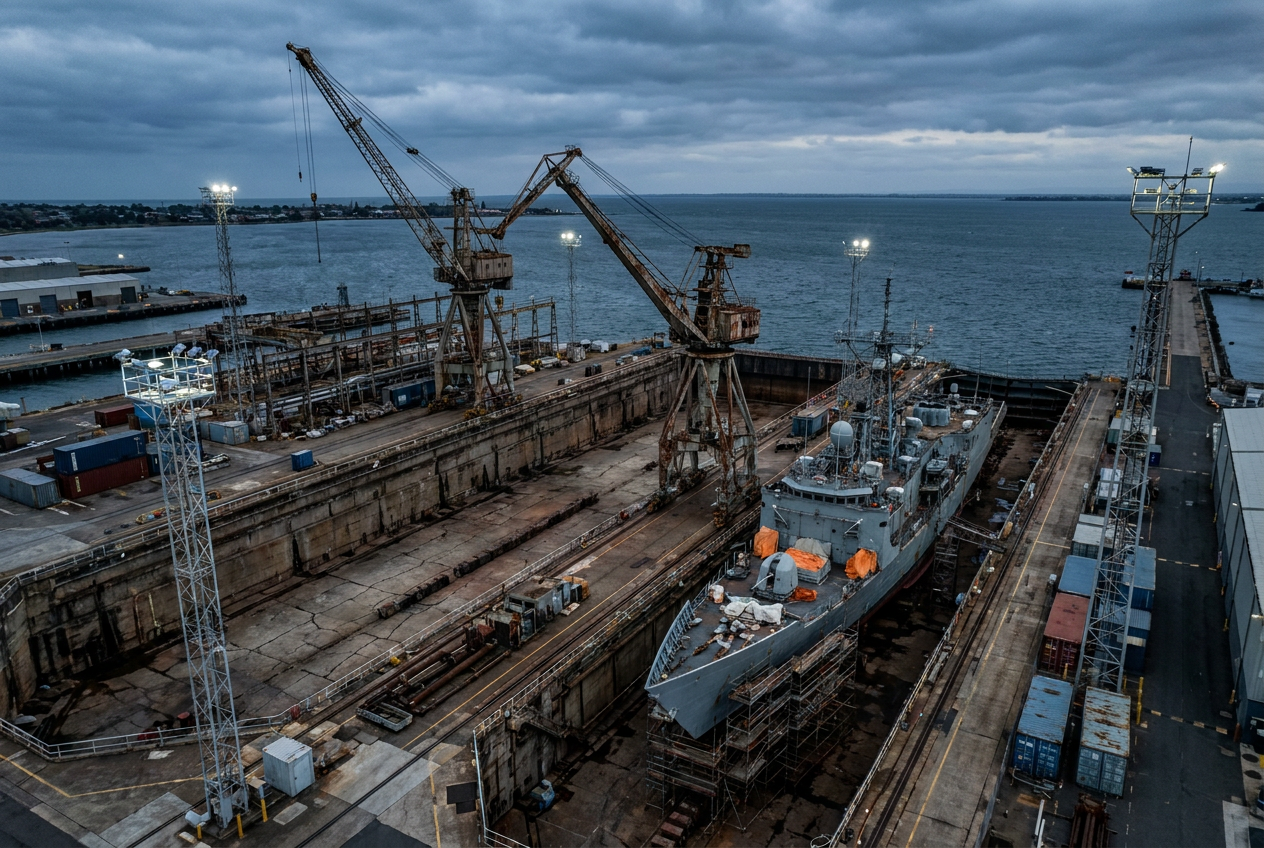
BAE Systems is moving to sell its long-idled Williamstown shipyard near Melbourne, a 17-hectare waterfront industrial site that has been inactive since around 2017 after the company’s local work pipeline thinned. The proposed buyer, EMKC3, is a property developer with partial ownership linked to a Hong Kong-based Chinese group, and reports suggest the purchase price is below the roughly A$200 million valuation often attached to the land. Williamstown is historically important to Australia’s naval construction base, having built ANZAC-class frigates and supported work on HMAS Canberra and HMAS Adelaide. Although state rules are said to restrict the site to marine engineering or industrial purposes, the sale still requires both federal and state approval and has prompted scrutiny because only a small number of Australian yards can handle major naval shipbuilding.
What it means for owners
For shipowners and operators, the core issue is not ownership optics alone; it is the continued attrition of waterfront heavy-industrial capability in a region already struggling with constrained yard access. Across the Asia-Pacific, repair demand has become harder to place due to fuller drydock schedules, tighter environmental compliance windows, aging fleets needing more steel renewal, and the concentration of complex work in a limited number of facilities. Even though Williamstown has been inactive for years, once a strategically located large-yard site leaves the practical maritime ecosystem, the probability of returning it to full productive use generally falls. That matters because capacity is not just a question of available coastline. It depends on workforce continuity, cranage, fabrication infrastructure, class-approved processes, supply-chain density and port-side logistics. When those elements disperse, the replacement cost is far higher than the nominal land valuation.
The commercial consequences can be indirect but material. Operators planning docking cycles in Australia and nearby markets increasingly need optionality: a vessel delayed waiting for a repair slot can trigger cascading off-hire exposure, charter-party friction and repositioning costs that erase any headline yard-price advantage elsewhere. In that context, every lost or underutilized industrial waterfront asset in a major trading economy reduces system flexibility. A dormant naval yard can, in the right policy setting, become surge capacity for complex conversion, emergency repair, defense sustainment or specialist offshore work. If instead it becomes an industrial real-estate holding with limited maritime utility, the regional repair map tightens further, pushing more work into already busy hubs such as Singapore, parts of Northeast Asia and selected Southeast Asian yards.
There is also a geopolitical layer that fleet planners can no longer treat as abstract. The Asia-Pacific repair and maintenance market now sits at the intersection of trade security, sanctions compliance, industrial policy and foreign investment screening. The comparison being drawn in Australia with the long-running Port of Darwin controversy reflects a broader shift: governments are increasingly reluctant to separate strategic maritime infrastructure from national resilience. For commercial operators, this means repair planning must account not only for cost and technical capability, but also for the political durability of access. A facility caught in ownership disputes, regulatory reviews or strategic controversy can become a planning risk even before any formal operating restriction appears. In practical terms, geopolitical friction is becoming another variable in docking strategy, much like labor availability or steel prices.
MaritimeNG — critical view
That said, some caution is warranted before treating this sale as automatic evidence of strategic failure. Williamstown has not been an active shipbuilding center for nearly a decade, and preserving land for marine-industrial use on paper is not the same as preserving a functioning yard. Reopening a dormant facility for serious naval or commercial work would require orders, capital, management commitment and a skilled labor pool that cannot simply be switched back on. It is therefore possible that concern over foreign-linked ownership is obscuring a more uncomfortable domestic reality: Australia has struggled to maintain continuous workload across parts of its maritime industrial base, and idle assets often become financially unsustainable regardless of who buys them.
Equally, the assumption that any Chinese-linked participation in waterfront infrastructure necessarily translates into strategic compromise should be examined carefully and case by case. Governance arrangements, operational controls, tenancy structures and use restrictions matter. The more relevant test is whether the transaction preserves or weakens real maritime capability. If the result is productive marine engineering activity under robust regulation, the industrial outcome may differ from the political symbolism. If, however, the site remains nominally industrial while drifting further from ship repair and construction relevance, then the concern will prove justified for reasons that extend beyond ownership nationality.
Verdict
The Williamstown case is ultimately a test of whether Australia values maritime industrial land as a strategic capability or merely as an asset class. For shipowners and operators, the lesson is straightforward: repair planning in the Asia-Pacific must now weigh yard access, sovereign industrial resilience and policy risk together—an area where disciplined market intelligence, of the kind MaritimeNG emphasizes, is becoming increasingly important.
Fundamental basis
The economic mechanics behind the facts above, grounded in Martin Stopford’s Maritime Economics. Reference only — not investment advice.
Facing a similar situation on your vessel? Model the numbers before you commit.
Open the off-hire & deviation calculatorsSource Attribution
This analytical review is based on publicly available facts originally reported by The Maritime Executive. MaritimeNG does not claim authorship of the underlying facts. Read the original publication
© 2026 MaritimeNG — Independent analytical commentary. All analysis, opinions, and forward-looking assessments are original work by MaritimeNG Editorial and may differ from those of the parties mentioned or the cited source. Factual data is restated in our own words based on publicly available information. All trademarks and trade names belong to their respective owners. This content does not constitute legal, technical, or investment advice.