What Damen’s Dakar Entry Could Change for West African Repair Capacity
Damen’s joint venture in Dakar is more than a yard reopening story: it has the potential to alter maintenance planning for vessels operating along the West African coast. The real significance lies in whether the facility can convert strategic geography and sizeable infrastructure into reliable execution, shorter off-hire, and credible regional support for offshore energy fleets.
What happened
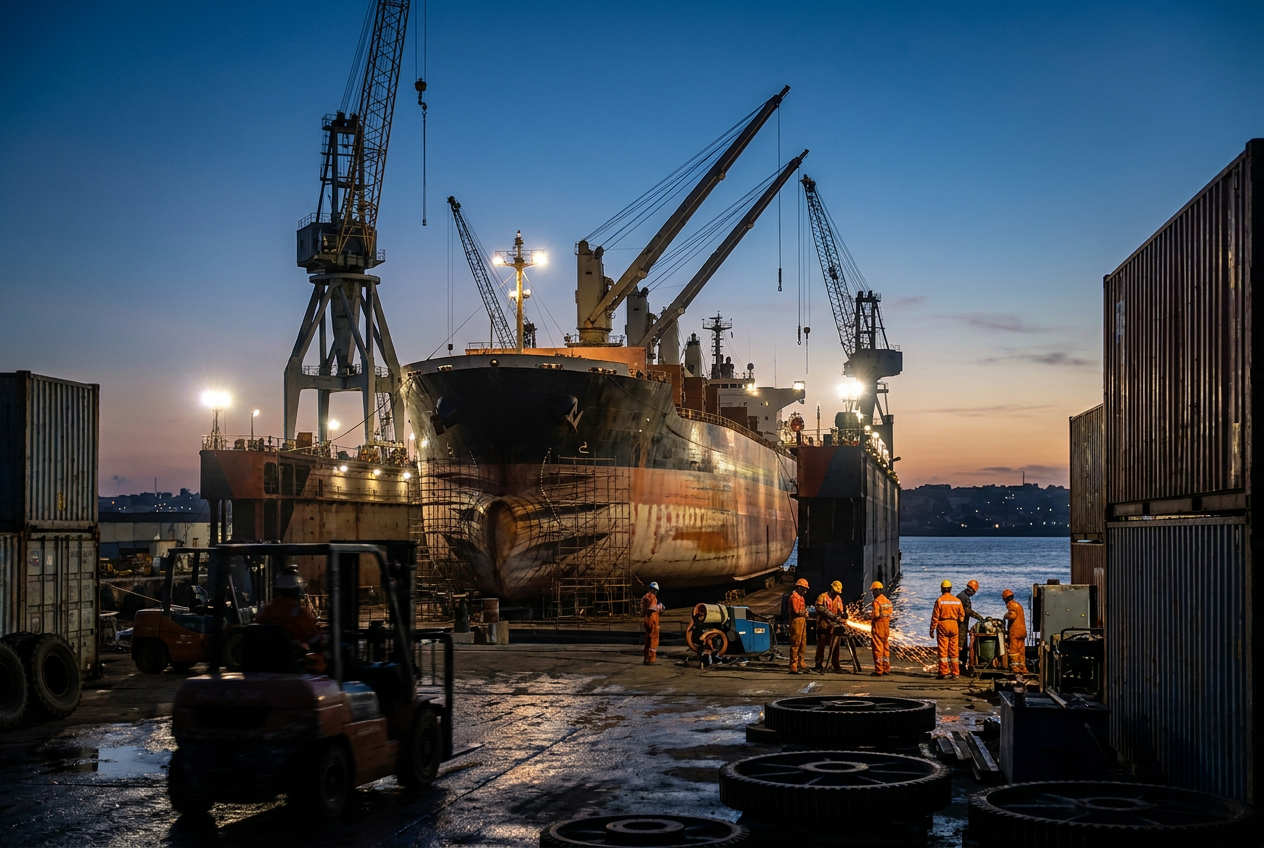
Damen Shipyards Group has partnered with Senegal’s state-backed SIRN to run Damen Shiprepair Dakar, marking the start of repair operations under a joint-venture structure. The site offers a 191 x 25 metre graving dock, a 235 x 38 metre floating dock, a 63 x 15 metre Syncrolift rated at 1,200 tonnes with four cradles, and 500 metres of quay at 9 metres draft. The yard employs more than 300 people, is intended to support regional offshore activity, and is being brought into Damen’s operating framework for safety, quality systems, IT, and human resources, backed by planned capital spending, a new training centre, and an eventual aim to restart shipbuilding.
What it means for owners
For shipowners and technical managers, the immediate question is not ownership structure but whether Dakar can become a dependable alternative to sending vessels north to the Mediterranean, south to Namibia or South Africa, or repositioning elsewhere for planned works. On West African rotations, every extra sea day to a repair yard carries a cost in bunkers, charter disruption, crew planning, and lost earning time. A capable yard in Senegal could materially reduce deviation for tankers, offshore support vessels, fishing fleets, workboats, and general cargo tonnage trading between the Strait of Gibraltar and the Gulf of Guinea. In practical terms, that means operators with regular Atlantic and West Africa exposure may soon have a more credible option for intermediate repairs, steel renewal, propulsion work, afloat repairs, and selected class-related docking windows closer to their trading pattern.
The timing also matters because yard access has become a commercial issue, not just a technical one. Global repair markets have been periodically tight, and owners have had to book docking slots earlier while balancing survey cycles, ballast water treatment retrofits, emissions-related upgrades, and routine lifecycle maintenance. In that environment, additional capacity on the West African seaboard is strategically useful even before the yard reaches full maturity. If Damen can make Dakar predictable in planning, procurement, supervision, and HSEQ performance, operators may be able to shorten maintenance chains for vessels that would otherwise leave the region for drydocking. That has direct implications for off-hire economics: a yard that is geographically closer but operationally inconsistent is of limited value, while a yard that is slightly less comprehensive than European alternatives but reliably delivers on schedule can be highly competitive.
There is also a broader fleet-efficiency angle. As CII pressure continues to push owners toward tighter fuel discipline, hull condition, propeller performance, coating strategy, and machinery reliability are becoming more closely linked to commercial performance. Vessels trading long periods in warm waters, variable port conditions, and offshore support environments often need disciplined maintenance to avoid efficiency drift. A functioning Dakar repair base could allow operators to integrate hull cleaning, coating renewal, damage repairs, and efficiency-related maintenance into West Africa trading schedules with less repositioning. That would be particularly relevant for offshore energy support tonnage as regional upstream projects continue to generate demand for PSV, AHTS, construction support, and shuttle-linked auxiliary fleets. If the yard develops the right technical depth, it could become part of the operating infrastructure that supports energy logistics in the eastern Atlantic rather than merely a local ship repair site.
MaritimeNG — critical view
That said, the market should avoid assuming that a strong international brand automatically translates into immediate yard performance. Joint ventures between global operators and state-linked local entities can unlock access, legitimacy, and policy support, but they can also introduce governance complexity, slower decision-making, and differing expectations on investment pacing, procurement discipline, and labour practices. The announcement points to systems alignment and capital expenditure, which is encouraging, but these are early-stage indicators rather than proof of execution. Owners will judge Dakar on quotation quality, schedule adherence, steel and mechanical workmanship, class-interface competence, and the availability of parts and subcontractor capability under real project pressure.
There is also the question of timeline. Reaching what owners regard as international standard is usually less about dock dimensions than about process maturity: planning offices, digital work control, QA/QC routines, safety culture, vendor management, and the ability to handle emergent work without cost and time slippage. Damen has a track record of standardising operations across diverse repair environments, but each location has its own labour market, supply chain constraints, and institutional realities. The ambition to revive newbuilding may eventually broaden the industrial base, yet it should be viewed as a long-range objective; in the near term, the market will be looking for repeatable repair delivery, not expansion narratives. The first 12 to 24 months will likely determine whether Dakar becomes a true regional maintenance node or remains a yard with attractive assets but uneven market confidence.
Verdict
This is a strategically important development for West African maritime infrastructure, with real potential to improve docking options for vessels exposed to Atlantic and regional trades. But the commercial value will depend on execution discipline more than dock size; operators should monitor early project performance closely and, as always, pair opportunity with careful maintenance planning and regional market intelligence of the kind MaritimeNG tracks closely.
Fundamental basis
The economic mechanics behind the facts above, grounded in Martin Stopford’s Maritime Economics. Reference only — not investment advice.
Facing a similar situation on your vessel? Model the numbers before you commit.
Open the off-hire & deviation calculatorsSource Attribution
This analytical review is based on publicly available facts originally reported by Drydock Magazine. MaritimeNG does not claim authorship of the underlying facts. Read the original publication
© 2026 MaritimeNG — Independent analytical commentary. All analysis, opinions, and forward-looking assessments are original work by MaritimeNG Editorial and may differ from those of the parties mentioned or the cited source. Factual data is restated in our own words based on publicly available information. All trademarks and trade names belong to their respective owners. This content does not constitute legal, technical, or investment advice.