VLCC Asset Pricing Has Detached From Age—and That Carries Real Risk
The VLCC market is sending an unusual signal: immediate earning power is outweighing vessel age, with older ships changing hands at levels once reserved for modern tonnage. For owners and operators, this is profitable in the short term but strategically complex once regulation, repair exposure, and yard access are factored in.
What happened
Recent tanker transactions and broker assessments show a sharp repricing of VLCCs across all age groups, to the point where some secondhand units are valued at or above comparable newbuildings. In only a few weeks during mid-2026, benchmark values for 5-, 10-, and 15-year-old VLCCs jumped steeply, while spot earnings on key routes surged to extraordinary levels, including Middle East Gulf–China returns breaching seven figures on a daily equivalent basis. Reported sales of both very modern and much older VLCCs indicate that buyers are paying heavily for ships that can trade now rather than waiting for yard delivery slots.
What it means for owners
For shipowners, the message is straightforward: in a freight market this strong, time has become more valuable than technical youth. When a trading VLCC can capture earnings measured in several hundred thousand dollars per day—and at points materially more—the market naturally assigns a premium to immediate availability. That is why older units can temporarily outrun the replacement-cost logic that usually anchors asset prices. A buyer is not merely acquiring steel; they are buying prompt exposure to a revenue window that may be impossible to replicate through a newbuilding order with delivery years away. In practical terms, the spread between buying a vessel today and contracting one for later delivery is now being justified by foregone earnings during the waiting period.
However, owners should resist interpreting this as a full reset of fleet economics. The regulatory burden on older VLCCs is intensifying, not easing. CII thresholds are tightening through the second half of the decade, and older ships with less efficient propulsion, poorer fuel curves, or suboptimal hull and propeller performance will face growing difficulty maintaining commercially acceptable ratings without intervention. That intervention is not cheap. Energy-saving devices, engine tuning, propeller upgrades, hull treatment strategies, voyage optimization systems, and speed management can all help, but each comes with capital cost, technical risk, and varying payback periods. For ships in the 12- to 17-year bracket, the question is no longer just whether they can still trade, but whether they can do so without operational restrictions, charterer discrimination, or reduced marketability.
EU ETS and FuelEU Maritime add another layer. Older VLCCs typically consume more fuel per tonne-mile than the latest eco tonnage, which means they are structurally more exposed to carbon costs and greenhouse-gas intensity penalties on relevant trades. Even where charter-party mechanisms pass through some of that burden, commercial reality matters: charterers increasingly compare all-in voyage economics, not just headline hire. A less efficient vessel may remain employable in a tight market, but it can still be commercially disadvantaged once carbon cost is embedded in voyage selection and routing decisions. The implication is that today’s premium for older ships may be monetizing current scarcity while discounting future compliance friction.
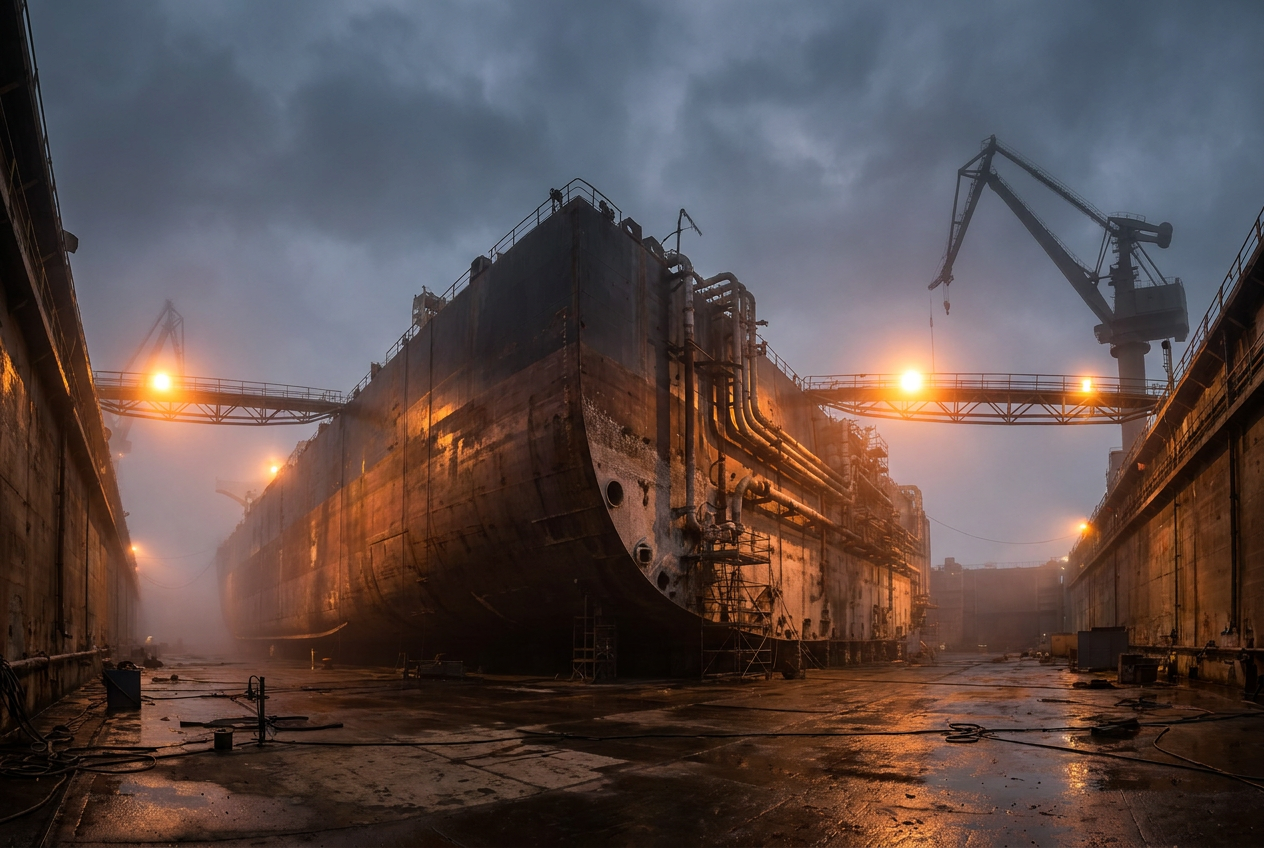
This becomes especially important when drydocking economics are considered. In a normal market, a 15-year-old VLCC heading into special survey would be assessed against residual life, steel renewal exposure, coating condition, machinery reliability, and likely charter prospects after redelivery. In the present market, the calculus is distorted by opportunity cost. Taking a ship off-hire for several weeks when spot earnings are above $700,000 per day can destroy tens of millions in foregone revenue before repair invoices are even counted. That pushes owners to defer non-essential work where class allows, compress repair scope, or seek highly disciplined planning to shorten yard stays. Yet deferral has limits: as vessels age, the probability of findings during survey rises, and compressed yard windows can turn into expensive overruns if steel, machinery, or cargo system issues emerge.
The strategic trade-off, then, is between harvesting the current market and preserving medium-term operability. Investing in a 15-year-old ship can still make sense if the vessel has strong technical pedigree, favorable maintenance history, acceptable emissions performance after upgrades, and a realistic path to profitable employment over the next three to five years. But that is very different from assuming all older VLCCs deserve modern-asset pricing. The quality spread inside the older fleet will widen. Ships with scrubbers, strong class records, recent drydock completion, and credible efficiency improvements should continue to command a relative premium. Ships carrying latent capex, uncertain coating condition, or weak emissions performance may discover that headline market optimism does not survive technical due diligence.
Yard capacity is the final piece of the puzzle. Newbuild slots remain constrained by competing demand from other segments and by a forward orderbook that limits prompt delivery availability. That bottleneck supports secondhand values because owners cannot readily solve fleet replacement needs through the yard system. In effect, the resale market is being used as the only near-term source of transport capacity. As long as that queue persists, prompt tonnage should retain scarcity value. But scarcity value is not the same as long-term intrinsic value, particularly in a segment where environmental compliance and aging-hull maintenance can alter economics very quickly.
MaritimeNG — critical view
The current valuation inversion should be treated as a freight-cycle distortion rather than proof that age no longer matters. Exceptional earnings can make almost any operating asset look young for a while because cash generation overwhelms concerns that would dominate in a weaker market. But the VLCC sector has seen this movie before: scarcity and urgency pull values sharply upward, then normalization exposes which purchases were backed by durable economics and which were justified mainly by momentum. Paying newbuilding-equivalent money for a mid-life or older tanker may still work if the buyer captures enough of the current rate environment quickly, but that is a timing bet as much as an asset thesis.
There is also a risk that buyers are underestimating the compounding effect of regulation and maintenance. CII requirements will not loosen, and commercially acceptable performance standards are likely to become stricter even beyond formal regulation as cargo interests and financiers continue to favor better-rated tonnage. Meanwhile, an older hull can hide substantial future cost in steel renewals, machinery deterioration, cargo system work, ballast tank condition, and unplanned repairs. Those liabilities remain manageable in a booming freight market; they become far less forgiving when rates retreat. If spot returns normalize sharply, the market could reprice older VLCCs downward faster than today’s buyers expect, leaving them with expensive assets facing both capex needs and weaker earnings.
Verdict
For owners and operators, the lesson is not that vessel age has ceased to matter, but that immediate earnings have temporarily overwhelmed conventional depreciation logic. This is a market where disciplined technical screening, realistic compliance budgeting, and tightly managed drydock timing matter more than ever—and where careful repair planning can be as important as freight exposure itself.
Fundamental basis
The economic mechanics behind the facts above, grounded in Martin Stopford’s Maritime Economics. Reference only — not investment advice.
Facing a similar situation on your vessel? Model the numbers before you commit.
Open the off-hire & deviation calculatorsSource Attribution
This analytical review is based on publicly available facts originally reported by gCaptain. MaritimeNG does not claim authorship of the underlying facts. Read the original publication
© 2026 MaritimeNG — Independent analytical commentary. All analysis, opinions, and forward-looking assessments are original work by MaritimeNG Editorial and may differ from those of the parties mentioned or the cited source. Factual data is restated in our own words based on publicly available information. All trademarks and trade names belong to their respective owners. This content does not constitute legal, technical, or investment advice.