US Submarine Yard Delays Show the Strategic Cost of Repair Capacity Shortfalls
A US government audit has quantified how maintenance bottlenecks are sidelining nuclear attack submarines for extended periods, turning repair capacity into a direct readiness and cost issue. For commercial shipping stakeholders, the findings are a stark reminder that constrained yard access, poor schedule reliability, and workforce shortages now carry strategic as well as financial consequences.
What happened
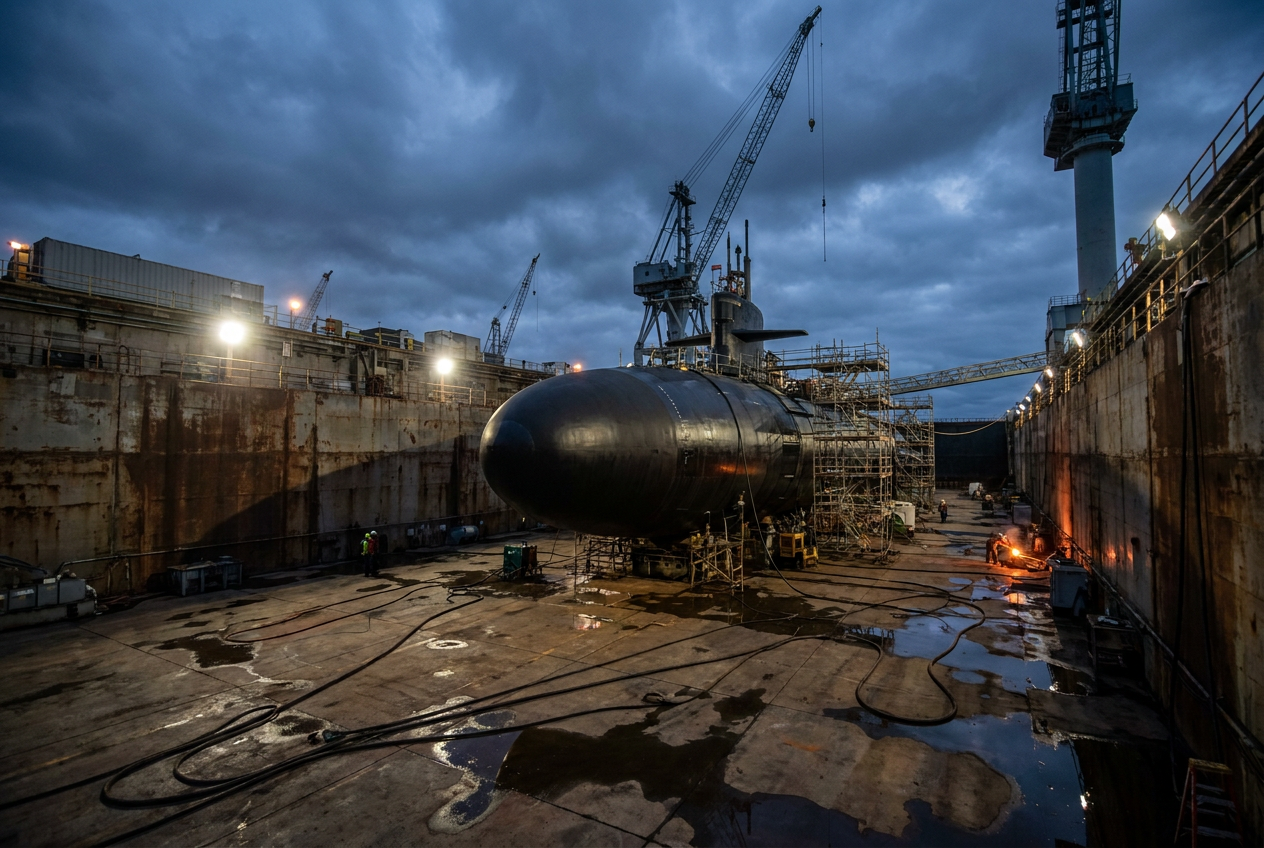
A report from the US Government Accountability Office has challenged the Navy’s handling of attack-submarine maintenance and inactivation, pointing to a repair system that is unable to move assets through public and private yards on schedule. The fleet currently includes 44 attack submarines, but delayed work packages and weak planning have resulted in more than 15,000 lost operating days over roughly ten years and billions of dollars in inefficient spending. The audit also highlighted a growing backlog for submarines awaiting decommissioning work, including vessels kept crewed while inactive for years before a shipyard slot becomes available, and warned that the cost exposure will rise sharply unless alternative disposal pathways and formal inactivation plans are adopted.
What it means for owners
For shipowners and technical managers outside the naval sector, the main takeaway is not the military context but the economics of constrained repair infrastructure. When on-time completion at key public yards is running at roughly one in nine projects, the problem is no longer ordinary schedule slippage; it is a structural capacity failure. Commercial operators face the same risk pattern in different form: drydock slots are tighter, skilled labor is harder to secure, and complex work scopes now routinely collide with steel renewal, emissions retrofits, propulsion upgrades, and class-driven surveys. In practical terms, a vessel delayed in yard by even 10-20 days can erase the financial logic of a carefully timed docking, especially where charter commitments, repositioning costs, and bunker exposure are already under pressure.
The commercial implications are increasingly linked to regulation. Owners cannot treat yard access as a standalone maintenance issue when CII improvement measures, hull and propeller performance work, shaft-generator installations, alternative-fuel readiness studies, ballast water compliance, and digital monitoring upgrades all compete for the same repair windows. In Europe, EU ETS and FuelEU Maritime add another layer: a vessel that misses a fuel-efficiency retrofit window or remains in an inferior operating condition longer than planned can face higher allowance costs and compliance penalties indirectly through poorer energy performance. For a large deepsea vessel, small percentage changes in fuel burn over a year can translate into six- or seven-figure cost differences once fuel, carbon, and commercial speed impacts are combined. Yard unreliability therefore turns into a regulatory cost amplifier, not just a technical nuisance.
There is also an asset-management lesson in the GAO numbers. More than 15,000 lost operating days and billions in wasted expenditure illustrate how deferred maintenance and poor slot planning destroy productive asset time. In commercial shipping, the equivalent is off-hire creep: ships waiting for dockings, waiting for riding squads, waiting for OEM attendance, or leaving the yard with unresolved defects that trigger return visits. Fleet managers should read this as evidence that maintenance resilience now depends on multi-yard sourcing, earlier work-scope freeze dates, better long-lead procurement, and more rigorous decision-making on whether to extend, retrofit, convert, or recycle older tonnage. If a 20-year-old vessel is likely to require major steel, machinery, and efficiency capex but yard certainty is weak, the correct question is no longer only technical feasibility; it is whether the opportunity cost of asset downtime still supports the investment case.
MaritimeNG — critical view
That said, the naval case cannot be mapped directly onto merchant shipping without caution. Nuclear submarines are among the most specialized assets in the maritime economy, with security controls, radiological protocols, and a very limited industrial base. Their maintenance cadence, certification burden, and decommissioning complexity are unlike those of conventional commercial vessels. A public-yard completion rate of around 11% on time is alarming, but it reflects a segment where substituting capacity is exceptionally difficult. Merchant owners typically retain more flexibility across geography, yard type, and work-scope packaging than the Navy does.
The deeper concern may actually be broader than the report suggests. The industry often focuses on physical dock capacity, but labor productivity, planning discipline, and supply-chain reliability are now equally binding constraints. Adding berths or expanding yard footprints will not by itself solve schedule failure if engineering change orders, late material arrivals, and specialist-trade shortages remain unresolved. Another underappreciated issue is the cost of keeping crews and support structures tied to inactive assets. The submarine example is extreme, yet commercial owners also absorb hidden overhead when tonnage sits idle awaiting surveys, repairs, sanctions-related approvals, or retrofit components. Those indirect costs are still too often excluded from investment appraisals.
Verdict
The GAO findings reinforce a hard reality across maritime markets: repair capacity and schedule certainty are now strategic variables, not background operational issues. Owners that treat docking access, supplier resilience, and retrofit sequencing as core commercial risks will be better placed to control off-hire, compliance cost, and asset value—and platforms such as MaritimeNG are most useful when they help shorten the path to credible yards and service partners.
Fundamental basis
The economic mechanics behind the facts above, grounded in Martin Stopford’s Maritime Economics. Reference only — not investment advice.
Facing a similar situation on your vessel? Model the numbers before you commit.
Open the off-hire & deviation calculatorsSource Attribution
This analytical review is based on publicly available facts originally reported by The Maritime Executive. MaritimeNG does not claim authorship of the underlying facts. Read the original publication
© 2026 MaritimeNG — Independent analytical commentary. All analysis, opinions, and forward-looking assessments are original work by MaritimeNG Editorial and may differ from those of the parties mentioned or the cited source. Factual data is restated in our own words based on publicly available information. All trademarks and trade names belong to their respective owners. This content does not constitute legal, technical, or investment advice.