US Naval Yard Overruns Signal Tighter Repair Capacity for Commercial Owners
A major escalation in the US Navy’s yard modernization budget and schedule points to prolonged infrastructure strain in a market already short of complex repair capacity. For commercial owners and operators, the implications extend beyond defense spending into docking availability, off-hire risk, and future maintenance planning.
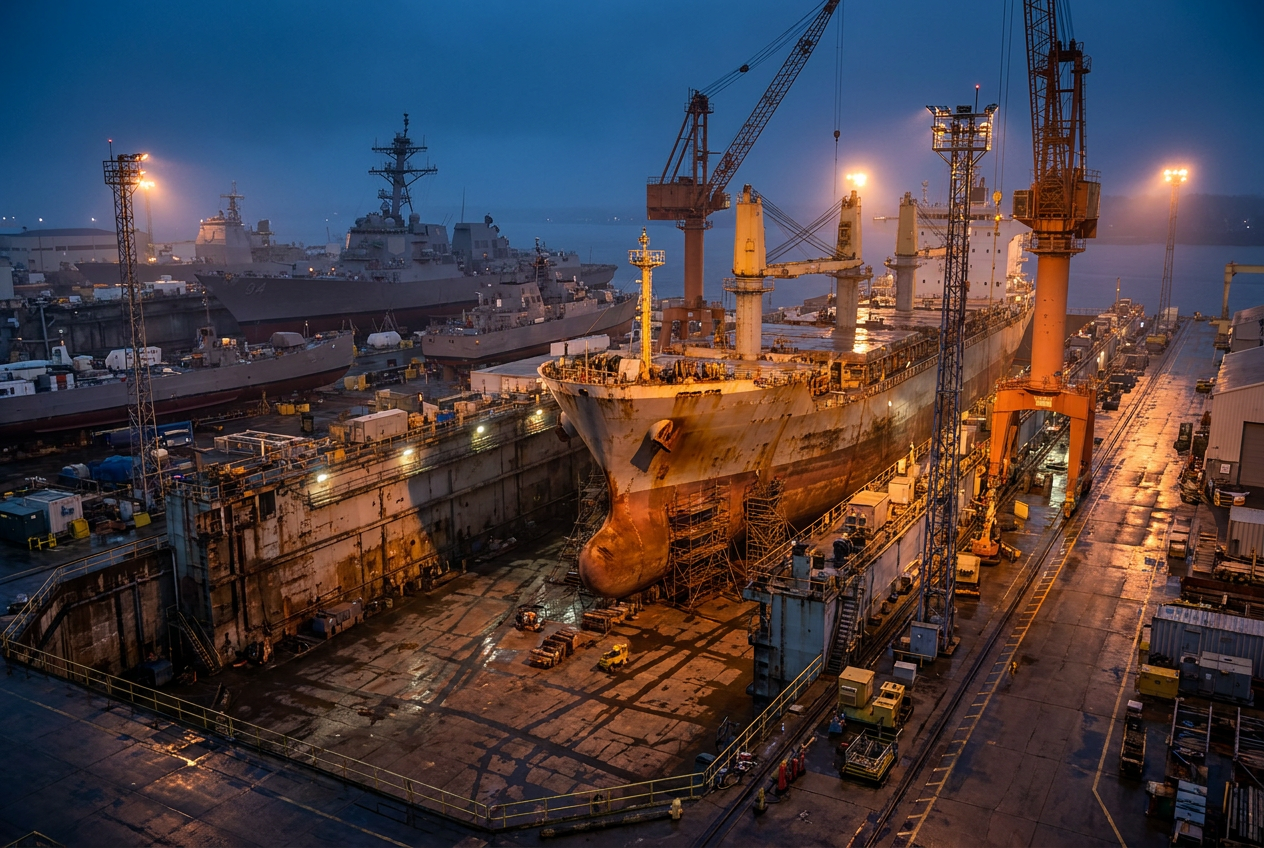
What happened
A US government review has concluded that the Navy’s long-running effort to upgrade its four core public shipyards has grown far beyond its initial scope, with projected spending now near $200 billion and completion extending to around 2080 rather than within the original two-decade horizon set in 2018. The affected facilities are Norfolk, Pearl Harbor, Portsmouth and Puget Sound, with Portsmouth alone now carrying a projected bill of $41.6 billion in one completed yard study. New dry docks are being developed at Portsmouth and Pearl Harbor, while Puget Sound’s scheme is still in design, and these dock projects together are valued at about $21.7 billion. The review also highlighted environmental complications, unresolved program approvals, and continuing operational friction as submarines are moved through active construction areas amid existing maintenance backlogs.
What it means for owners
For the commercial shipping market, the most important takeaway is not simply that a naval infrastructure program is more expensive than expected. It is that high-end repair and docking capacity in the United States will remain structurally constrained for decades, with public naval yards consumed by modernization works at the same time that fleet maintenance demand is becoming more technically demanding. That matters because naval and commercial repair markets are not isolated ecosystems. They draw on many of the same skilled trades, specialist subcontractors, engineering firms, fabrication shops, environmental compliance services and heavy-lift support. When a naval program of this scale stretches over several decades, it can absorb labor and industrial bandwidth far beyond the fence line of the four state-owned yards.
Commercial owners operating in the US market should expect second-order effects in slot availability, pricing and scheduling reliability at private yards with naval exposure. Even where a private ship repair yard is not directly competing for the same dock as a Navy vessel, it may still face tighter labor supply for welders, pipefitters, planners, electricians and nuclear-adjacent engineering talent. This can lengthen repair windows, increase overtime dependence and raise the probability of scope growth once vessels enter dock. For operators, that translates into more volatile off-hire economics. A drydocking delay is no longer only a technical issue; it can undermine charter performance, ballast voyage planning, cargo commitments and crewing rotations. In a softer freight market, delayed return-to-service can erase voyage margin quickly. In a firmer market, missing a charter window can be even more expensive.
There is also a regulatory timing issue. Owners are under pressure to improve fuel efficiency and reduce carbon intensity, whether through hull and propeller upgrades, energy-saving devices, coating work, shaft-related efficiency improvements or broader retrofit packages. These interventions increasingly compete for the same dock time as mandatory class work. If repair capacity tightens and yard lead times lengthen, CII improvement projects may be deferred, but that deferral has a cost. Poorer operational efficiency can worsen annual carbon intensity ratings, while in Europe the EU ETS continues to convert fuel inefficiency into a direct cash burden through higher emissions exposure. In practical terms, a vessel that cannot access a yard in time for efficiency upgrades may face a dual penalty: higher fuel consumption and higher compliance costs.
The likely market response is earlier booking behavior and a stronger premium on yard optionality. Owners with US trading patterns may need to secure slots further ahead, build broader repair geography into technical planning and evaluate whether work can be split between mandatory docking and voyage repairs elsewhere. This should also sharpen interest in data-led yard selection: not only headline day rates, but actual schedule adherence, labor stability, subcontractor depth and environmental permitting risk. The wider point is that an overstretched naval yard system can tighten commercial repair conditions without ever taking a single merchant vessel into its docks, because labor, suppliers and regional industrial capacity are shared across both markets.
MaritimeNG — critical view
The headline cost inflation is striking, but the deeper concern is governance. If a program can expand so materially in cost and duration while still lacking a fully approved plan years after launch, industry should question whether current estimates are final or merely another waypoint. Long-range modernization programs are vulnerable to optimism bias, changing technical requirements and inflation in skilled labor. That means the commercial market should treat present numbers as directional rather than definitive.
It is also worth challenging the assumption that more spending automatically leads to more usable capacity in the near or medium term. Large construction activity inside operating yards often reduces productivity before it improves it, especially when vessel movements must be coordinated through work zones. Owners and operators should therefore watch not just federal budget approvals, but practical indicators: subcontractor availability, regional wage escalation, project sequencing, environmental permitting delays and whether private yards begin repricing risk more aggressively on fixed-window repair contracts.
Verdict
For commercial shipowners, the message is clear: US naval yard modernization is becoming a long-duration capacity story with real implications for repair planning, pricing and off-hire exposure. The prudent response is earlier technical scheduling, wider yard benchmarking and a more strategic approach to docking options—areas where transparent market visibility, including platforms such as MaritimeNG, can support better decisions.
Fundamental basis
The economic mechanics behind the facts above, grounded in Martin Stopford’s Maritime Economics. Reference only — not investment advice.
Facing a similar situation on your vessel? Model the numbers before you commit.
Open the off-hire & deviation calculatorsSource Attribution
This analytical review is based on publicly available facts originally reported by The Maritime Executive. MaritimeNG does not claim authorship of the underlying facts. Read the original publication
© 2026 MaritimeNG — Independent analytical commentary. All analysis, opinions, and forward-looking assessments are original work by MaritimeNG Editorial and may differ from those of the parties mentioned or the cited source. Factual data is restated in our own words based on publicly available information. All trademarks and trade names belong to their respective owners. This content does not constitute legal, technical, or investment advice.