Uljanik Sale Signals New Repair and Retrofit Capacity in the Adriatic
The transfer of Uljanik to Turkey’s Kuzey Star is more than a distressed-asset transaction: it could reopen strategically useful repair and conversion capacity in the northern Adriatic. For shipowners facing tighter emissions rules, drydock congestion and rising off-hire costs, the outcome matters well beyond Croatia.
What happened
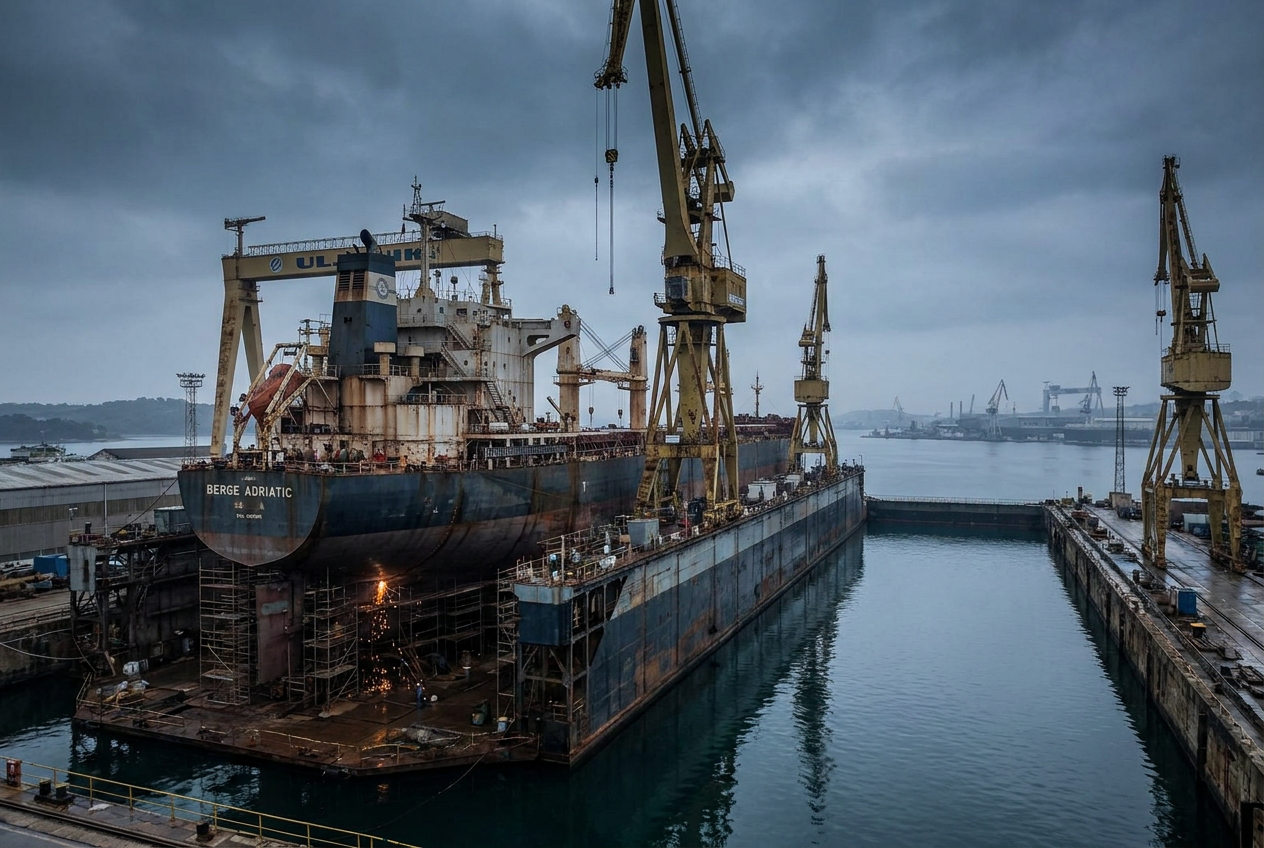
Croatia’s state restructuring body finalized the disposal of Uljanik Brodogradnja 1856 in Pula to Turkish shipyard group Kuzey Star on October 14, 2026, for €12.05 million. The Pula yard, once a major industrial employer, had been struggling for years and now operates with a much smaller workforce supplemented by subcontract labor. The buyer has pledged to continue core yard activities, including newbuilding-related work, ship repair and overhaul. The transaction followed a limited tender process in which only one compliant offer remained. Croatia kept ownership of the underlying land in Pula Bay, while the purchaser obtained the facilities and associated operating rights after foreign investment review.
What it means for owners
For shipowners and technical managers, the significance of this deal lies less in the purchase price and more in whether Uljanik can re-enter the market as dependable repair and retrofit capacity in a region where suitable slots are increasingly strategic. Europe’s compliance burden is changing drydock demand patterns. CII performance management, EU ETS exposure and FuelEU Maritime are pushing owners to bring forward technical interventions that would previously have been deferred or split across multiple dockings. Hull and propeller efficiency work, energy-saving device installation, shaft generator upgrades, alternative-fuel readiness modifications and accommodation of digital monitoring systems now compete for the same yard windows as routine special surveys, steel renewal and machinery overhauls. Any credible yard reactivation in the Adriatic therefore has implications for scheduling flexibility, voyage deviation and off-hire economics.
That matters because the economics of docking are no longer confined to yard invoice rates. For many operators, especially in tramp, short-sea and regional liner trades, the true cost driver is the all-in downtime associated with getting a vessel to a compliant and technically capable facility. If Uljanik can be restored as a functioning repair platform with class-approved processes, reliable subcontractor availability and manageable lead times, it could reduce ballast legs into overstretched North European or Turkish yards for certain vessel segments trading in the Mediterranean, Adriatic and Black Sea corridors. In practical terms, a closer yard option can preserve earnings days, lower bunkers consumed on deviation, reduce voyage disruption and allow technical departments to sequence survey, repair and efficiency upgrades in a more integrated way. That is particularly relevant for aging fleets trying to balance CII trajectory management against limited retrofit capex.
There is also a supply-chain dimension. Owners are confronting a market where retrofit demand is lumpy and often regulation-led. Scrubber work has already consumed capacity in prior cycles; next-wave projects may include shore power readiness, methane-slip mitigation on gas-fueled tonnage, hybridization for auxiliaries, and efficiency packages aimed at maintaining commercial attractiveness under charterer emissions scrutiny. Yards able to package steel work, mechanical scope and emissions-related upgrades under one project management structure are likely to gain pricing power. Kuzey Star’s existing footprint in Turkey and prior operating familiarity with Uljanik could create a cross-border production model in which engineering, procurement and labor are flexed across facilities. If executed well, that could improve slot utilization and reduce execution risk for owners compared with a standalone distressed-yard restart.
For EPC contractors and marine equipment suppliers, the transaction may also reopen a procurement channel in an EU-adjacent location with established maritime labor traditions. That could support mid-sized repair and conversion projects that do not fit efficiently into premium-priced northern yards or heavily booked mega-yard environments. In the wider context, the Uljanik sale suggests that distressed European industrial assets are being reevaluated through the lens of repair resilience rather than only newbuilding competitiveness. Owners should read this as an early sign that regional yard geography is being reshaped by decarbonization compliance, not just by conventional labor-cost arbitrage.
MaritimeNG — critical view
The optimistic interpretation should be tempered by execution risk. Buying a yard at a modest price is one thing; restoring commercial credibility is another. Shipowners do not book drydock slots on sentiment or political symbolism. They need certainty on delivery dates, class interface, subcontractor depth, HSE standards, procurement lead times and claims handling. Uljanik’s long financial decline means the harder challenge is operational reconstitution: workforce rebuilding, quality control, supplier confidence and working-capital discipline. Until those fundamentals are visible, many owners will still treat the yard as a second-wave option rather than a first-choice docking destination.
There is also a structural question about what kind of capacity Uljanik can realistically offer. Retaining shipbuilding, repair and overhaul sounds strategically broad, but mixed-use yard models can become unfocused if management does not prioritize the most bankable segments. In today’s market, repair and retrofit revenue can be attractive, but only if turnaround times and project governance are strong. The fact that the Croatian state kept land ownership while granting operational rights may be entirely workable, yet investors and customers will still want clarity on concession duration, capex obligations and long-term expansion flexibility. A revival narrative is plausible, but it is not yet proven.
Verdict
The Uljanik transaction is best understood as a potentially important capacity event for European repair and retrofit markets, not merely a privatization milestone. If Kuzey Star can restore execution reliability and position Pula as a practical Adriatic docking option, shipowners could gain a valuable lever against congestion, compliance-driven downtime and rising lifecycle costs. But the market will reserve judgment until the yard demonstrates repeatable performance, transparent slot availability and commercially credible project delivery. Platforms that aggregate yard capacity data and repair cost benchmarks will become more useful as such revived facilities re-enter owner shortlists.
Fundamental basis
The economic mechanics behind the facts above, grounded in Martin Stopford’s Maritime Economics. Reference only — not investment advice.
Facing a similar situation on your vessel? Model the numbers before you commit.
Open the off-hire & deviation calculatorsSource Attribution
This analytical review is based on publicly available facts originally reported by The Maritime Executive. MaritimeNG does not claim authorship of the underlying facts. Read the original publication
© 2026 MaritimeNG — Independent analytical commentary. All analysis, opinions, and forward-looking assessments are original work by MaritimeNG Editorial and may differ from those of the parties mentioned or the cited source. Factual data is restated in our own words based on publicly available information. All trademarks and trade names belong to their respective owners. This content does not constitute legal, technical, or investment advice.