Truman Overhaul Tests Yard Throughput and Incentive Contracting
The start of USS Harry S. Truman’s mid-life overhaul is more than a naval milestone; it is a major signal for long-cycle marine engineering demand, yard loading, and risk-sharing contract models. For the repair and EPC market, the programme highlights how scarce heavy-industrial capacity is becoming a strategic asset in its own right.
What happened
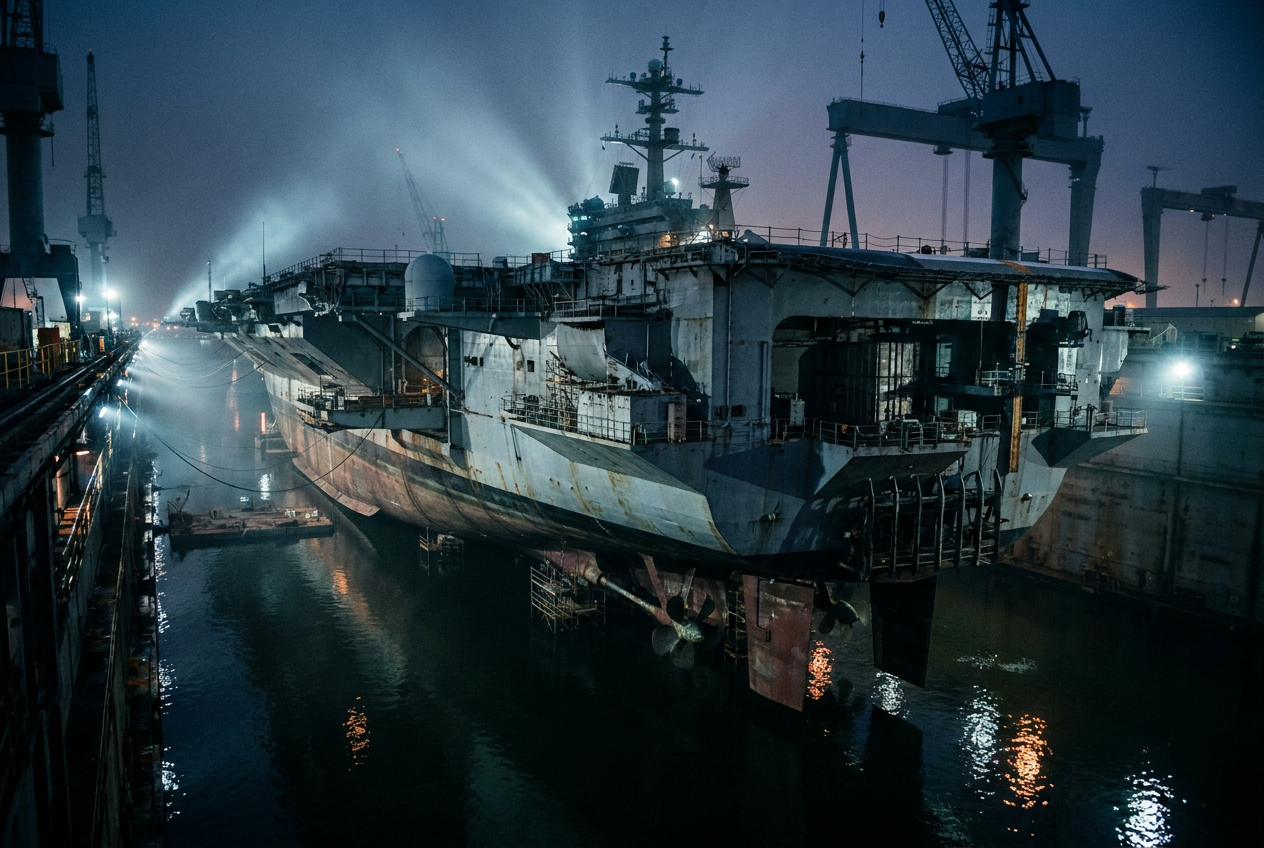
USS Harry S. Truman has moved from Norfolk to HII’s Newport News Shipbuilding to begin its Refueling and Complex Overhaul, a multi-year mid-life programme for the Nimitz-class carrier. The base contract is valued at about $5.1 billion, with potential additions taking the total above $5.18 billion. Truman entered preparatory work in late 2025, and the ship, commissioned in 1998, is the eighth vessel of its class to undergo this life-extension process. Newport News is also wrapping up the same type of overhaul on USS John C. Stennis, which entered the yard in 2021.
What it means for owners
For shipyards and marine EPC contractors, this award underlines the economics of highly specialized sustainment work: once a platform reaches this level of complexity, lifecycle intervention becomes a strategic industry segment rather than a routine maintenance event. A carrier mid-life overhaul combines nuclear work, propulsion renewal, combat-system integration, structural remediation, hotel-services renewal, and configuration management across an enormous asset base. That makes schedule control exceptionally difficult, but it also creates a deep pipeline for precision fabrication, systems engineering, digital planning, heavy-lift coordination, and long-lead equipment supply. In practical terms, programmes of this type can absorb critical dry dock and skilled-labor capacity for years, limiting yard flexibility for other naval and commercial opportunities.
The contract structure is equally notable. A fixed-ceiling incentive approach suggests the Navy is trying to shift away from open-ended cost growth while still acknowledging the uncertainty inherent in legacy-platform modernization. That matters well beyond defense. Commercial owners, offshore operators, and state-backed fleet managers are all watching how risk is apportioned on technically dense refit packages where scope discovery continues after opening up the vessel. If the model improves cost discipline without provoking excessive claims behavior, it may strengthen the case for more hybrid contracting in large conversion and life-extension work. If not, it will reinforce the view that some projects remain too uncertain for harder pricing mechanisms.
There is also a yard-capacity message here. Newport News is simultaneously finalizing one carrier overhaul while advancing a new-build carrier toward delivery, which illustrates both the scale and fragility of concentrated national capability. In broader market terms, this is a reminder that sovereign fleets depend on a narrow set of industrial bottlenecks: nuclear-certified trades, combat-system integrators, advanced welders, planners, and suppliers able to support obsolete or bespoke components. Where those resources are tight, overruns do not just affect one hull; they ripple through fleet readiness, dry-dock availability, supplier lead times, and workforce retention plans.
MaritimeNG — critical view
The central risk is execution congestion. Running overlapping carrier programmes at one yard may be rational from a capability standpoint, but it increases exposure to labor shortages, sequencing conflicts, and supply-chain slippage in specialist equipment. The parallel completion of another carrier overhaul offers useful continuity, yet it also reduces the margin for error. If the outgoing project has already experienced schedule pressure, the market should assume lessons learned are valuable but not automatically transferable; every aging vessel reveals different conditions once intrusive work begins.
Another underappreciated issue is opportunity cost. A $5 billion-plus life-extension investment reflects confidence that retaining an existing capital ship is preferable to losing force structure during an already stretched procurement cycle. But this also ties up funding, industrial bandwidth, and management attention that could otherwise support distributed maintenance networks, subsystem refresh programmes, or accelerated supplier-base expansion. The real policy test is not whether Truman can be overhauled, but whether the industrial system can execute such mega-projects while improving resilience across the wider naval repair enterprise. That is the kind of capacity question MaritimeNG will keep tracking closely.
Verdict
Truman’s overhaul is a case study in how strategic fleets increasingly compete for finite engineering capacity, not just budget. If delivery discipline improves under the current contract model, it could influence how future high-complexity refits are procured across both defense and adjacent marine sectors.
Fundamental basis
The economic mechanics behind the facts above, grounded in Martin Stopford’s Maritime Economics. Reference only — not investment advice.
Facing a similar situation on your vessel? Model the numbers before you commit.
Open the off-hire & deviation calculatorsSource Attribution
This analytical review is based on publicly available facts originally reported by The Maritime Executive. MaritimeNG does not claim authorship of the underlying facts. Read the original publication
© 2026 MaritimeNG — Independent analytical commentary. All analysis, opinions, and forward-looking assessments are original work by MaritimeNG Editorial and may differ from those of the parties mentioned or the cited source. Factual data is restated in our own words based on publicly available information. All trademarks and trade names belong to their respective owners. This content does not constitute legal, technical, or investment advice.