Spain Drydocking Move Signals a New Naval Repair Geography
The U.S. Navy’s decision to place a Rota-based destroyer into drydock at Navantia marks more than a one-off yard booking. From a MaritimeNG perspective, it indicates a deeper shift toward regionalized sustainment models that could reshape demand for high-complexity naval repair capacity in Europe.
What happened
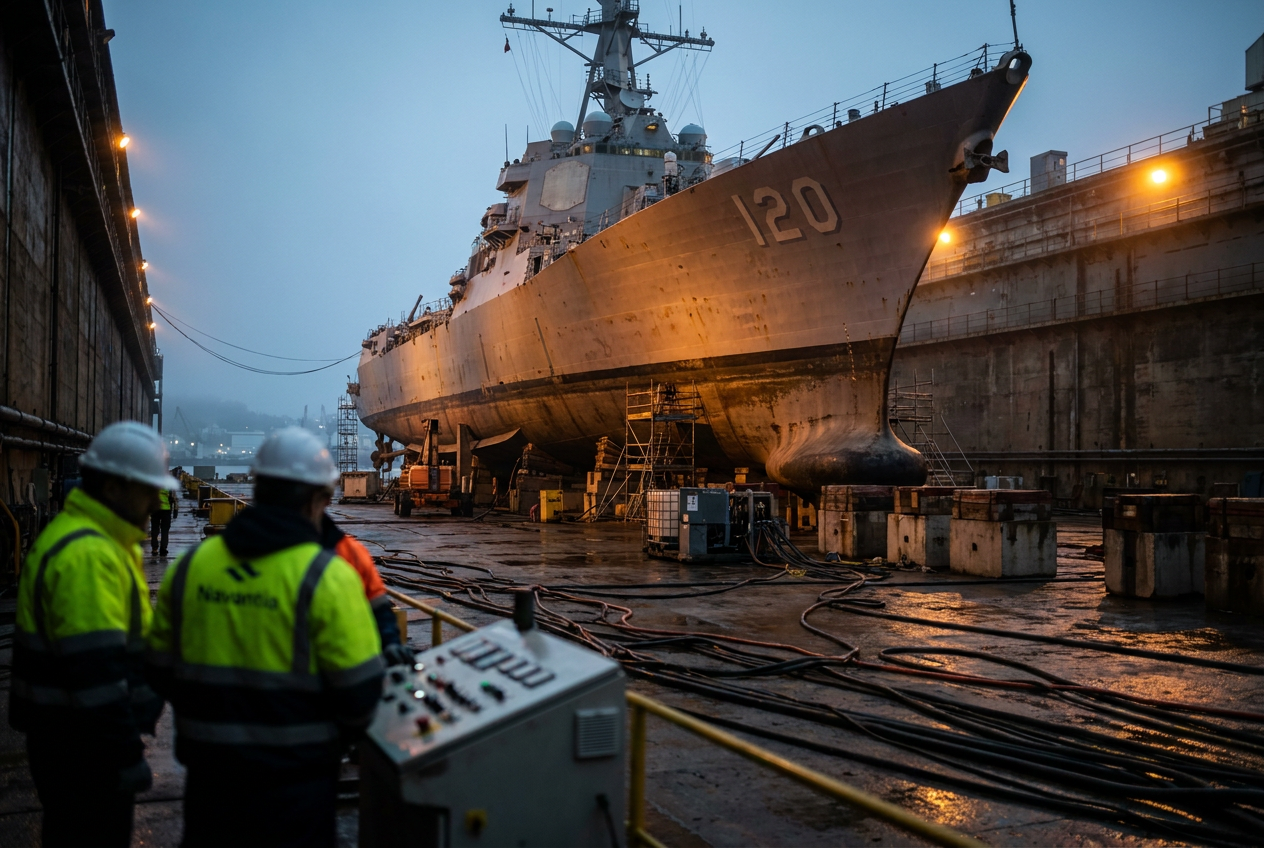
A U.S. Navy guided-missile destroyer assigned to Rota entered drydock at Navantia’s Cadiz facility in early October 2026. The vessel is USS Arleigh Burke, commissioned in 1991 and serving with the U.S. 6th Fleet. The Navy says this is the first instance of a forward-deployed warship in Europe undergoing this type of yard maintenance locally under its overseas sustainment model. The ship is one of five destroyers currently based in Rota, and the U.S. has already announced plans to expand that force further.
What it means for owners
For shipowners and operators outside the naval segment, the immediate significance is not the individual docking itself but the operating logic behind it. Major navies are increasingly treating maintenance location as a readiness variable, not just a procurement afterthought. When a front-line combatant can be drydocked near its theater of operations instead of cycling back to home-country yards, the gains are measured in higher mission availability, reduced transit burden, and tighter alignment between operational tempo and technical upkeep. That logic has clear spillover effects for the wider repair market: yards positioned near strategic hubs with security credentials, drydock access, combat-system integration capability, and disciplined schedule performance will become more valuable than yards competing mainly on labor cost.
For the EPC and modernization sector, this development points to a more distributed naval sustainment architecture in Europe. Navantia’s role is particularly notable because drydocking a complex destroyer is not simply steel renewal and coatings work; it requires coordination around class-specific systems, compliance protocols, government oversight, and modernization interfaces that commercial yards do not automatically possess. If the Rota destroyer force rises from five toward six as planned, and if each hull requires periodic docking and selected upgrades within theater, Cadiz and adjacent Spanish industrial capacity could see a steady pipeline of naval work over the next decade. Even a conservative cycle of one substantial availability every few years per ship implies recurring demand for underwater hull work, propulsion support, hotel services renewal, and selected combat-adjacent installations. In market terms, that begins to resemble a durable sustainment program rather than opportunistic yard utilization.
There is also a competitive dimension. European repair groups, particularly those with sovereign defense relationships and large-dock infrastructure, will read this as a signal that the U.S. is willing to internationalize portions of depot-level maintenance if trust, capacity, and alliance alignment are in place. That raises the bar for yards in Italy, Greece, the UK, and Northern Europe that may seek similar roles for NATO-associated fleets or allied auxiliaries. Over time, the differentiator will not be berth space alone but the ability to manage secure data flows, controlled technical documentation, specialist subcontractor chains, and compressed availability windows without compromising naval certification requirements.
MaritimeNG — critical view
The strategic upside is evident, but the model is not frictionless. Forward maintenance works best when planning discipline is unusually strong; otherwise, overseas availabilities can become vulnerable to parts delays, export-control bottlenecks, labor scarcity, and scope growth once hull access reveals deferred defects. A destroyer commissioned in the early 1990s carries aging-platform risk, and older surface combatants often generate more uncertainty during docking than pre-availability plans suggest. If the Navy expands this approach without matching it with robust spares positioning and integrated project controls, the readiness benefit could be diluted by schedule overrun.
There is also the question of capacity crowding. Commercial yards taking on more naval work must balance defense commitments with cruise, offshore, merchant, and ferry demand, especially in the Mediterranean and Atlantic repair corridor where dock slots are already contested. That creates a pricing and prioritization challenge for the EPC market: naval work is sticky and prestigious, but it can disrupt throughput if security procedures and customer oversight consume more yard resources than initially budgeted. The source event highlights the opportunity, but the harder issue is whether Europe’s repair base can absorb sustained military demand without tightening lead times for commercial clients.
Verdict
This Spanish docking is best understood as an early marker of a broader shift in fleet support strategy. If execution in Cadiz is timely and repeatable, Europe could become a more permanent node in U.S. naval sustainment planning—a trend MaritimeNG will be tracking closely for its impact on repair capacity, EPC positioning, and cross-market yard competition.
Fundamental basis
The economic mechanics behind the facts above, grounded in Martin Stopford’s Maritime Economics. Reference only — not investment advice.
Facing a similar situation on your vessel? Model the numbers before you commit.
Open the off-hire & deviation calculatorsSource Attribution
This analytical review is based on publicly available facts originally reported by The Maritime Executive. MaritimeNG does not claim authorship of the underlying facts. Read the original publication
© 2026 MaritimeNG — Independent analytical commentary. All analysis, opinions, and forward-looking assessments are original work by MaritimeNG Editorial and may differ from those of the parties mentioned or the cited source. Factual data is restated in our own words based on publicly available information. All trademarks and trade names belong to their respective owners. This content does not constitute legal, technical, or investment advice.