Safeen’s New Floating Dock Strengthens Abu Dhabi’s Repair Market Position
Safeen Drydocks’ installation of a 230-metre floating dock in Abu Dhabi materially increases heavy repair capability in the UAE. For shipowners and offshore operators, the move matters less as a headline about scale and more as a sign of tighter regional turnaround options, reduced positioning risk and greater scheduling choice.
What happened
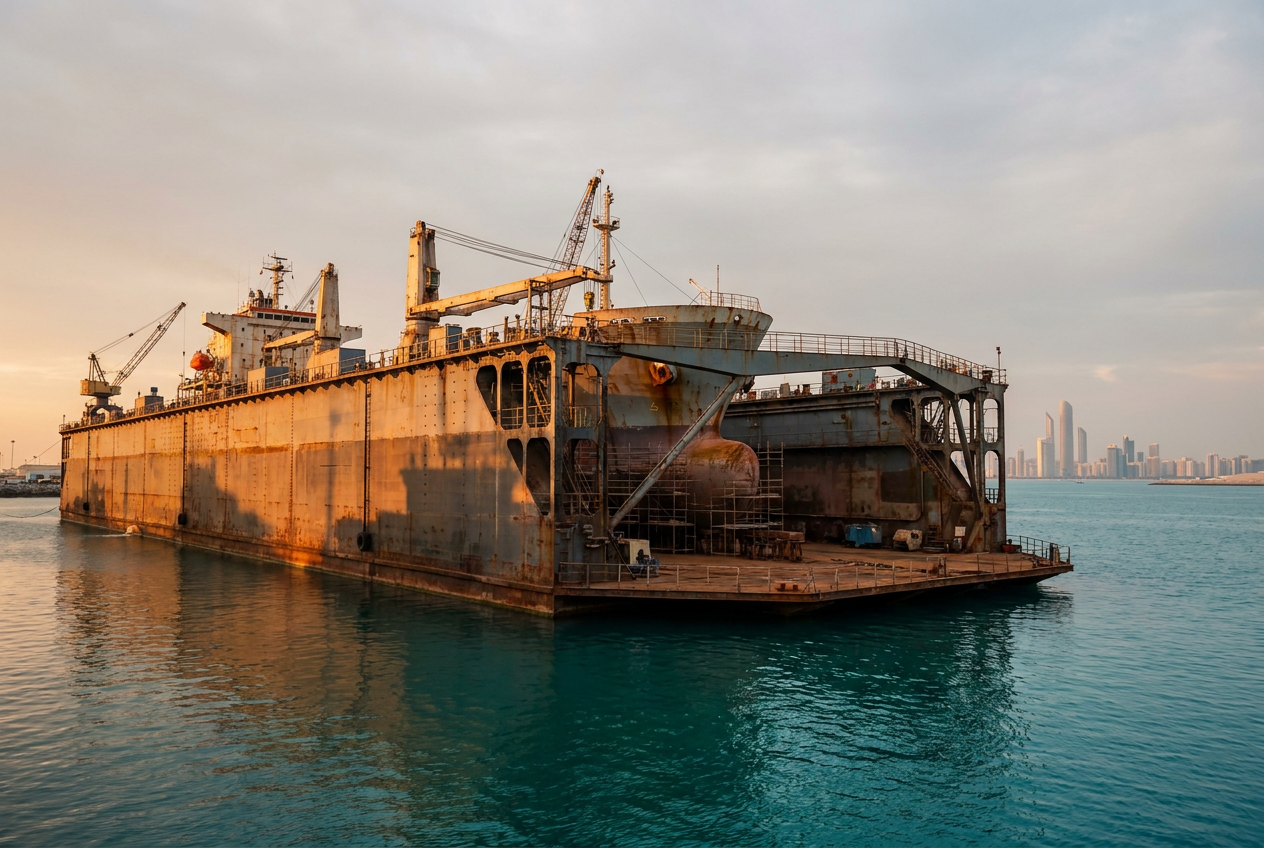
Safeen Drydocks has commissioned a 230-metre floating dock at Zayed Port in Abu Dhabi with a 21,000-tonne lifting limit, making it the largest unit of its kind in the UAE. The asset sits beside 1,000 metres of berth space and is intended for work on seagoing merchant ships and offshore drilling units. Safeen Drydocks, jointly owned by AD Ports Group and Premier Marine Engineering Services, now operates more than 170,000 square metres of yard infrastructure across Khalifa Port and Zayed Port. The dock is also expected to support servicing requirements for Noatum Maritime’s deep-sea fleet, while the company’s recent purchase of Balenciaga Shipyard in Spain broadens its international repair footprint.
What it means for owners
For shipowners, the significance of this investment lies in capacity quality rather than capacity headlines. A large floating dock in Abu Dhabi gives operators another credible option in a market where repair slots have become harder to secure at short notice, particularly for larger merchant vessels that cannot easily be accommodated at smaller regional facilities. Over the last several years, repair demand has been shaped by a difficult mix of compliance work, ageing fleets, volatile trading patterns and periodic congestion at established yards. In that context, additional docking availability in the Gulf can directly affect off-hire economics. Every extra day spent waiting for a berth, shifting to a more distant yard or sequencing steel, propulsion and class work across multiple locations increases cost exposure. A dock of this size does not solve every bottleneck, but it gives fleet managers a better chance of aligning survey windows, technical repairs and commercial schedules in one regional call.
The Abu Dhabi location also matters strategically. The Middle East has been moving from a waypoint for bunkering and logistics into a more complete maritime services ecosystem, and ship repair is a central part of that transition. Operators trading through the Arabian Gulf, Indian subcontinent, Red Sea and East Africa increasingly value repair access that avoids a long ballast leg to South Asia, the Mediterranean or East Asia. That is especially relevant for owners under pressure to protect earnings in weak freight cycles while still meeting class, charterer and safety obligations. If Safeen can consistently convert this hardware into dependable turnaround times, it could strengthen Abu Dhabi’s role as a practical repair hub rather than simply an alternative when other yards are full. The stated link to Noatum Maritime’s deep-sea fleet is notable here: captive or affiliated demand can help underpin utilisation, but it can also demonstrate operational confidence to third-party customers if execution is strong.
There is a second, equally important angle in offshore energy support. A dock intended for both commercial ships and offshore rigs gives Safeen exposure to a maintenance segment that often behaves differently from mainstream merchant repair. Offshore units typically require more complex work scopes, tighter engineering coordination and more demanding HSE performance, but they can also offer higher-value projects when upstream spending is healthy. With Gulf energy activity still generating sustained service demand, the ability to accommodate offshore assets alongside conventional shipping work could diversify yard revenues and smooth utilisation across cycles. Combined with Safeen’s wider footprint in Abu Dhabi and its acquisition in Spain, the company appears to be building a networked model: local capacity for regional execution, plus a European base that may support specialised fabrication, engineering transfer or customer relationships across trade lanes. For operators, that raises the possibility of more flexible planning across fleets that move between Europe, the Mediterranean, West Africa and the Gulf.
MaritimeNG — critical view
The main caution is that adding a large dock is only the first step; commercial credibility in ship repair is ultimately built on execution discipline. Owners will judge the yard on waiting time, labour productivity, subcontractor control, steel renewal quality, coating performance, procurement reliability and its ability to deliver redelivery dates with minimal drift. A new or expanded facility can attract attention quickly, but market confidence comes more slowly, especially for technically demanding repair packages. If the dock becomes heavily committed to affiliated fleets or if supporting workshop, cranage, riding squad and project management resources do not scale at the same pace, nominal capacity may not translate into practical availability for third-party customers.
There are also market questions around segmentation and competitive positioning. A 21,000-tonne lift opens meaningful opportunities, but not the full universe of larger vessel classes and heavier offshore units that some operators may seek to dock in the region. Much will depend on beam, draft, work type and quay-side logistics, not just the headline lifting figure. In addition, the Gulf repair market remains competitive, with operators comparing Abu Dhabi not only against nearby yards but against long-established options in Bahrain, Oman, Dubai, India and beyond. Safeen’s Spain acquisition is strategically interesting, yet cross-border ownership does not automatically create operational synergies. The open question is whether the company can convert geographic expansion into a clearly differentiated service proposition for owners who are making decisions based on total downtime, certainty and technical outcome rather than yard branding.
Verdict
This is a consequential addition to the UAE repair landscape because it improves real optionality for commercial shipping and offshore maintenance in a region where time alongside increasingly has economic value of its own. If Safeen backs the new dock with reliable execution, Abu Dhabi will become harder for fleet technical managers to overlook when mapping repair strategies across the wider Middle East.
Fundamental basis
The economic mechanics behind the facts above, grounded in Martin Stopford’s Maritime Economics. Reference only — not investment advice.
Facing a similar situation on your vessel? Model the numbers before you commit.
Open the off-hire & deviation calculatorsSource Attribution
This analytical review is based on publicly available facts originally reported by Ship & Offshore. MaritimeNG does not claim authorship of the underlying facts. Read the original publication
© 2026 MaritimeNG — Independent analytical commentary. All analysis, opinions, and forward-looking assessments are original work by MaritimeNG Editorial and may differ from those of the parties mentioned or the cited source. Factual data is restated in our own words based on publicly available information. All trademarks and trade names belong to their respective owners. This content does not constitute legal, technical, or investment advice.