Rheinmetall’s Mangalia move reshapes Black Sea yard capacity and naval-industrial strategy
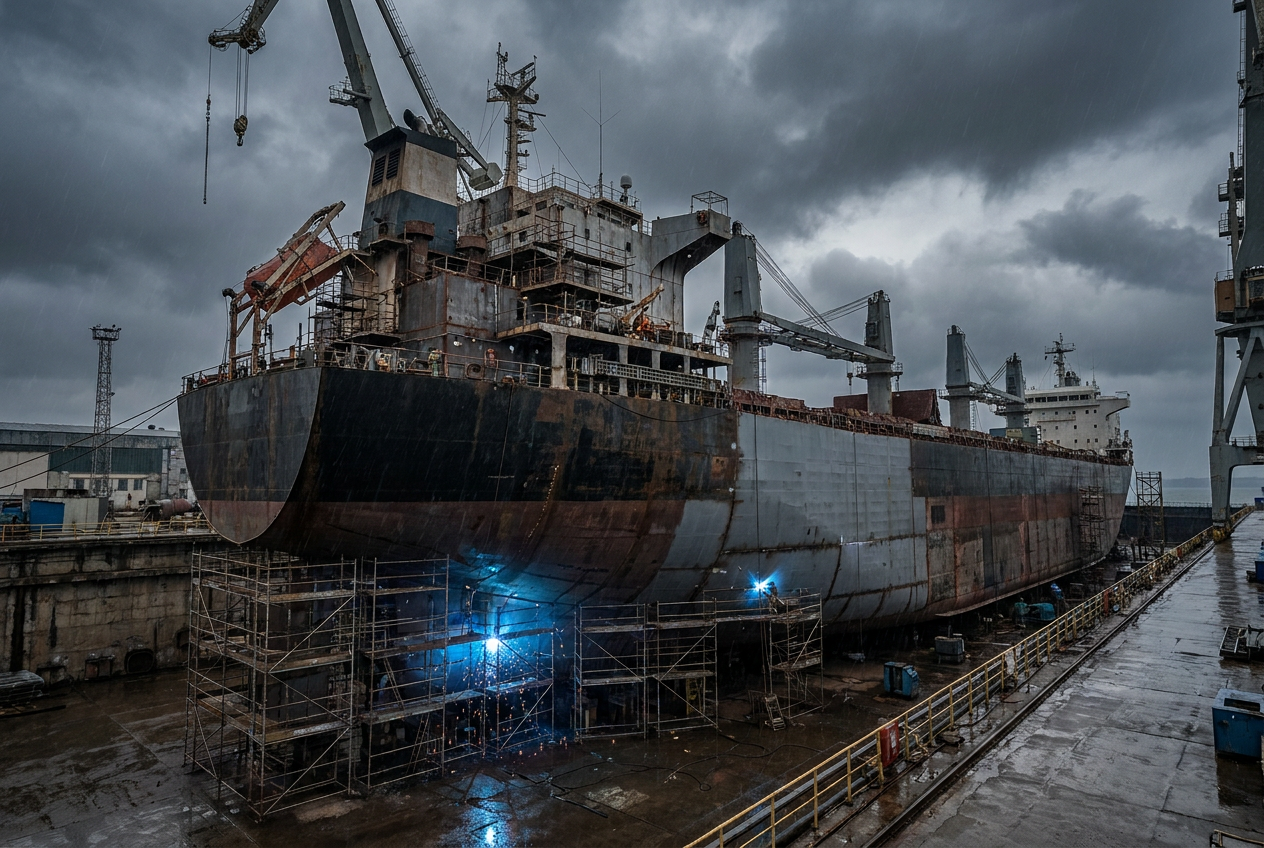
Rheinmetall’s purchase of Mangalia Shipyard is more than a distressed-asset deal: it signals a push to rebuild large-scale shipbuilding and maintenance capacity on the Black Sea under a defense-led industrial model. For commercial owners and operators, the transaction matters because regional repair slots, retrofit capability and future pricing power in Europe remain under acute pressure.
What happened
Rheinmetall has acquired Romania’s Mangalia Shipyard for €138 million after the facility went through insolvency and bankruptcy proceedings. The yard had operated under a Damen-Romanian state partnership since 2018, but the venture deteriorated after regulatory changes affecting private management, leading to Damen’s insolvency filing in 2024. With liabilities reported at about €190 million and asset values assessed well below the starting auction level, the first three sale attempts failed before Rheinmetall secured the yard at a reduced price. The acquisition follows Rheinmetall’s recent expansion into naval shipbuilding and comes after it won a major EU-backed contract to construct four vessels for the Romanian Navy.
What it means for owners
For the maritime market, the strategic relevance of Mangalia lies less in the headline acquisition price and more in what the yard could become if Rheinmetall succeeds in restoring throughput, workforce depth and technical credibility. Europe’s repair and conversion ecosystem is already operating under structural strain: owners face tightening decarbonisation deadlines, class-driven renewal cycles, and rising compliance costs under EU ETS and FuelEU Maritime. That combination is pushing more vessels into yards for energy-efficiency retrofits, propulsion upgrades, hull and coating work, shaft generator installations, shore-power readiness and digital performance packages. At the same time, off-hire economics remain brutal. Every additional day alongside can erode voyage economics, charter commitments and emissions performance assumptions. In that context, any credible addition of large-scale yard capacity in Europe is commercially meaningful.
Mangalia’s geography is also important. A functioning, well-capitalised Black Sea yard offers owners and operators another regional option for repair, maintenance and selected conversion work without forcing all demand toward the already congested yard clusters in Northwest Europe, the Mediterranean and parts of Türkiye. For operators trading into the Danube-Black Sea corridor, Eastern Mediterranean or wider European short-sea network, proximity can translate directly into lower ballast days, less schedule disruption and reduced compliance risk. This matters particularly for fleets trying to improve CII trajectories through operational discipline while simultaneously planning technical interventions. Owners increasingly need drydocking decisions to support both survey windows and carbon-intensity strategy; a yard that can combine routine maintenance with efficiency upgrades becomes more valuable than a yard that only offers steelwork and conventional repairs.
There is also a broader market signal in Rheinmetall’s sequencing. The company first moved into naval construction capability in Germany and then secured an EU-supported Romanian naval program before taking control of Mangalia. That suggests a deliberate effort to align sovereign defense demand with industrial site recovery. If that model works, commercial shipping may benefit indirectly from better-utilised infrastructure, shared supply chains and a reactivated skilled labor base. MSC’s stated interest in using the site for merchant vessel maintenance and construction further reinforces the possibility of a dual-use yard model in which naval demand underwrites baseline investment while commercial work improves utilisation. For shipowners, that could eventually mean more optionality in Europe for planned docking, life-extension projects and medium-complexity retrofit packages at a time when lead times and yard slot scarcity are distorting maintenance planning across the region.
MaritimeNG — critical view
The opportunity, however, should not be overstated. Mangalia is not instantly restored by a change in ownership, especially after insolvency, bankruptcy and repeated failed auction rounds. A yard with legacy debt issues, disrupted management history and a diminished workforce cannot be assumed to return quickly to reliable delivery performance. The fact pattern points to a large industrial site with strategic potential, but also one that will likely require substantial recapitalisation, supplier confidence rebuilding, labor reassembly and governance discipline before commercial owners treat it as a dependable scheduling option.
There is also a real risk that defense work dominates berth allocation and investment priorities. From a national and EU industrial policy perspective, that may be entirely rational. But from a merchant shipping perspective, a yard marketed as a mixed-use facility can still become effectively unavailable during naval program peaks. Owners and technical managers will therefore watch practical indicators rather than announcements: class acceptance, subcontractor depth, steel and machinery procurement reliability, actual docking turnaround times, and whether the yard can execute emissions-related retrofits without scope creep or schedule slippage. In a market where decarbonisation compliance and off-hire costs are tightly linked, credibility will matter more than strategic rhetoric.
Verdict
Rheinmetall’s acquisition gives Mangalia a plausible path back into the European yard map, with implications that extend beyond naval shipbuilding into repair, maintenance and retrofit capacity. The deal is strategically significant, but its real value to owners will depend on execution, slot availability and whether the yard can become a dependable answer to Europe’s growing compliance-driven docking demand; that is precisely the kind of capacity shift operators will need to track closely through specialist yard-intelligence platforms such as MaritimeNG.
Fundamental basis
The economic mechanics behind the facts above, grounded in Martin Stopford’s Maritime Economics. Reference only — not investment advice.
Facing a similar situation on your vessel? Model the numbers before you commit.
Open the off-hire & deviation calculatorsSource Attribution
This analytical review is based on publicly available facts originally reported by The Maritime Executive. MaritimeNG does not claim authorship of the underlying facts. Read the original publication
© 2026 MaritimeNG — Independent analytical commentary. All analysis, opinions, and forward-looking assessments are original work by MaritimeNG Editorial and may differ from those of the parties mentioned or the cited source. Factual data is restated in our own words based on publicly available information. All trademarks and trade names belong to their respective owners. This content does not constitute legal, technical, or investment advice.