Puget Sound Upgrade Signals Longer-Term Tightness in U.S. Yard Capacity
The U.S. Navy’s move toward procuring a $15 billion modernization of its Bremerton yard is more than a defense infrastructure story. For commercial operators, it is another indication that strategic repair capacity on the U.S. West Coast will remain constrained, specialized and increasingly contested for years.
What happened
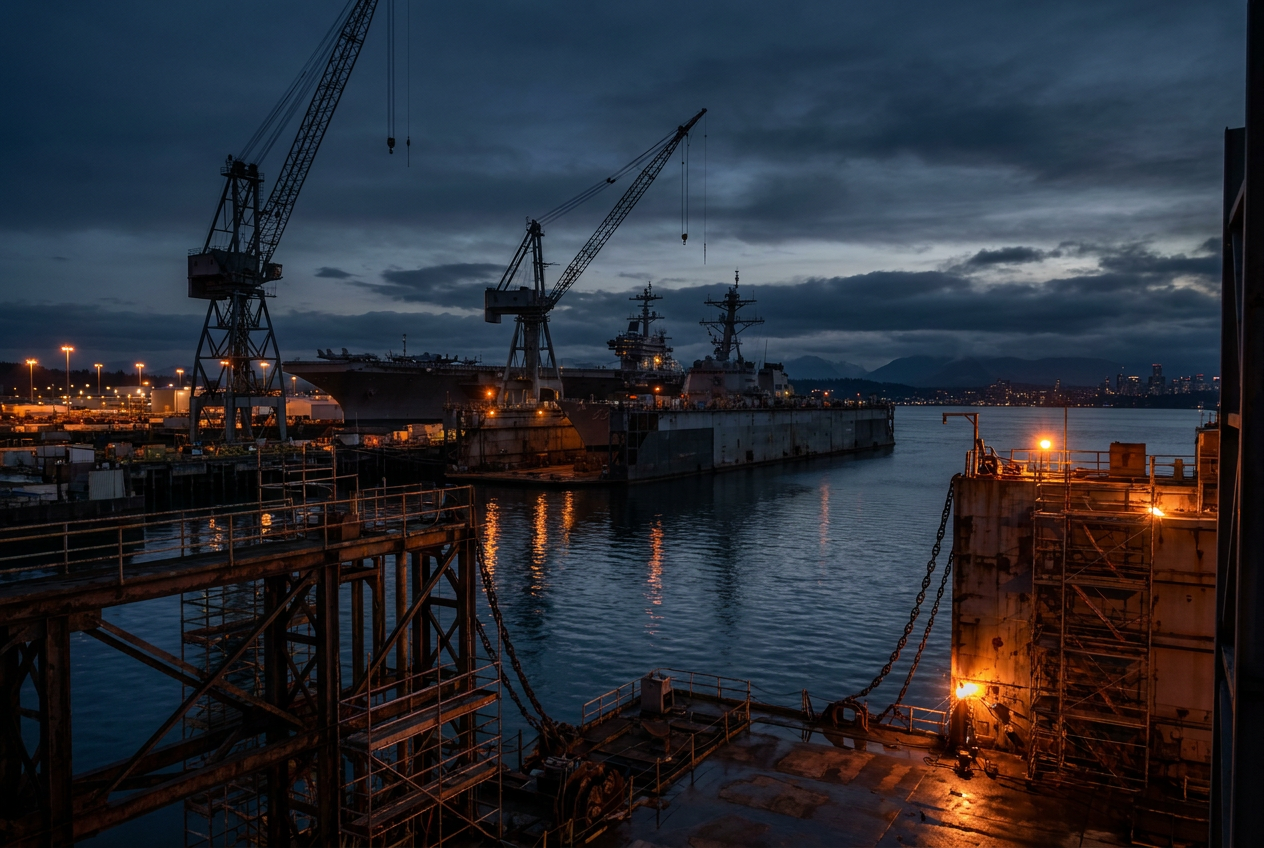
The Navy has started the market process for a large-scale redevelopment of the Puget Sound naval shipyard at Bremerton, Washington, including a new dock sized for aircraft carriers and major supporting infrastructure ashore. The work is expected to be divided among several prime contractors under a multi-award structure, with bids due in late 2026, selections likely in 2027 and on-site construction potentially beginning around 2030; the broader public-yard renewal effort across the U.S. naval system is projected by government auditors to run for decades at very high cost.
What it means for owners
For commercial shipowners and technical managers, the practical importance of this program lies less in the headline project value than in what it reveals about repair capacity economics. A yard that remains indispensable for nuclear carrier work is being rebuilt because legacy infrastructure has become a bottleneck to naval readiness. That same reality matters to merchant operators: when strategic state demand absorbs engineering talent, fabrication capacity, cranes, electrical specialists and waterfront construction resources, the commercial market usually feels the pressure through longer lead times, firmer pricing and less schedule flexibility. Even though military and merchant drydocking are not directly interchangeable in every segment, they draw from overlapping pools of contractors, designers, steelwork capability, automation expertise and heavy civil capacity.
That matters at a time when operators are already trying to choreograph increasingly complex docking decisions. CII performance pressure is forcing owners to combine statutory surveys with efficiency retrofits, hull and propeller optimization, energy-saving devices, shaft generator upgrades, air lubrication trials and onboard monitoring packages. In Europe-linked trades, EU ETS and FuelEU Maritime have changed the economics of delay: every additional day of off-hire is not merely lost revenue, but can also distort voyage planning, fuel consumption patterns and compliance costs across the remainder of the year. A vessel entering drydock late because yard slots are scarce may miss an optimal weather or trading window; a vessel staying longer than planned can face cascading charter-party consequences, repositioning inefficiencies and higher emissions exposure. The result is that repair planning is now inseparable from carbon-cost management.
The Bremerton program also reinforces a broader lesson about specialized yards: critical infrastructure renewal takes far longer than most fleet plans assume. If work starts around 2030 and the Navy-wide modernization horizon stretches across multiple decades, owners should not expect a near-term easing in North American repair tightness. That is relevant for class-driven maintenance, especially for vessels needing steel renewals, ballast water system work, exhaust gas equipment service or electrical upgrades that cannot be safely compressed into very short yard stays. Operators trading on the Pacific side may need to widen their repair geography, book slots earlier, bundle class and efficiency work more aggressively, and stress-test off-hire assumptions against a market in which public-sector requirements and commercial decarbonization projects compete for the same industrial base. In effect, the Navy’s infrastructure backlog is another data point confirming that yard access is becoming a strategic planning variable rather than a routine technical matter.
MaritimeNG — critical view
There is, however, a risk of overstating the direct commercial spillover. Naval infrastructure projects are heavily regulated, security-sensitive and technically distinct; not every dollar committed at Bremerton translates into reduced access for merchant tonnage. Some contractors will see the program as a stable long-cycle source of work that justifies hiring, apprenticeship expansion and capital investment, which could strengthen the regional industrial base over time. If managed well, public spending of this scale can improve construction methods, subcontractor depth and engineering capability that later benefits adjacent maritime sectors.
The harder question is execution discipline. A program measured in tens of billions and decades invites cost growth, changing specifications, labor shortages and political reprioritization. Multi-award contracting can spread risk, but it can also complicate interfaces among civil works, waterfront systems and operational continuity at an active naval site. For outside observers, the most important uncertainty is timing: the commercial market often responds not to announced budgets but to actual mobilization schedules, procurement sequencing and how much regional labor gets pulled into the work at once. Until those details sharpen, shipowners should treat this as a structural warning sign rather than a precise predictor of repair-market outcomes.
Verdict
The Bremerton modernization is primarily a naval readiness project, but it also underlines a commercial truth: repair infrastructure is aging, replacement is slow, and competition for capable yard resources is intensifying. For operators, earlier planning, sharper off-hire modeling and better integration of class and decarbonization workstreams will matter more than ever; that is exactly the kind of operational intelligence MaritimeNG will continue to track closely.
Fundamental basis
The economic mechanics behind the facts above, grounded in Martin Stopford’s Maritime Economics. Reference only — not investment advice.
Facing a similar situation on your vessel? Model the numbers before you commit.
Open the off-hire & deviation calculatorsSource Attribution
This analytical review is based on publicly available facts originally reported by The Maritime Executive. MaritimeNG does not claim authorship of the underlying facts. Read the original publication
© 2026 MaritimeNG — Independent analytical commentary. All analysis, opinions, and forward-looking assessments are original work by MaritimeNG Editorial and may differ from those of the parties mentioned or the cited source. Factual data is restated in our own words based on publicly available information. All trademarks and trade names belong to their respective owners. This content does not constitute legal, technical, or investment advice.