Propulsion Retrofits Gain Weight in Shipping’s Decarbonization Toolkit
Berg Propulsion’s recent retrofit results strengthen the commercial case for propulsion upgrades as a near-term decarbonization measure. For owners running vessels well below original service speed, machinery re-optimization is becoming a practical response to emissions rules, fuel costs and tightening charter performance expectations.
What happened
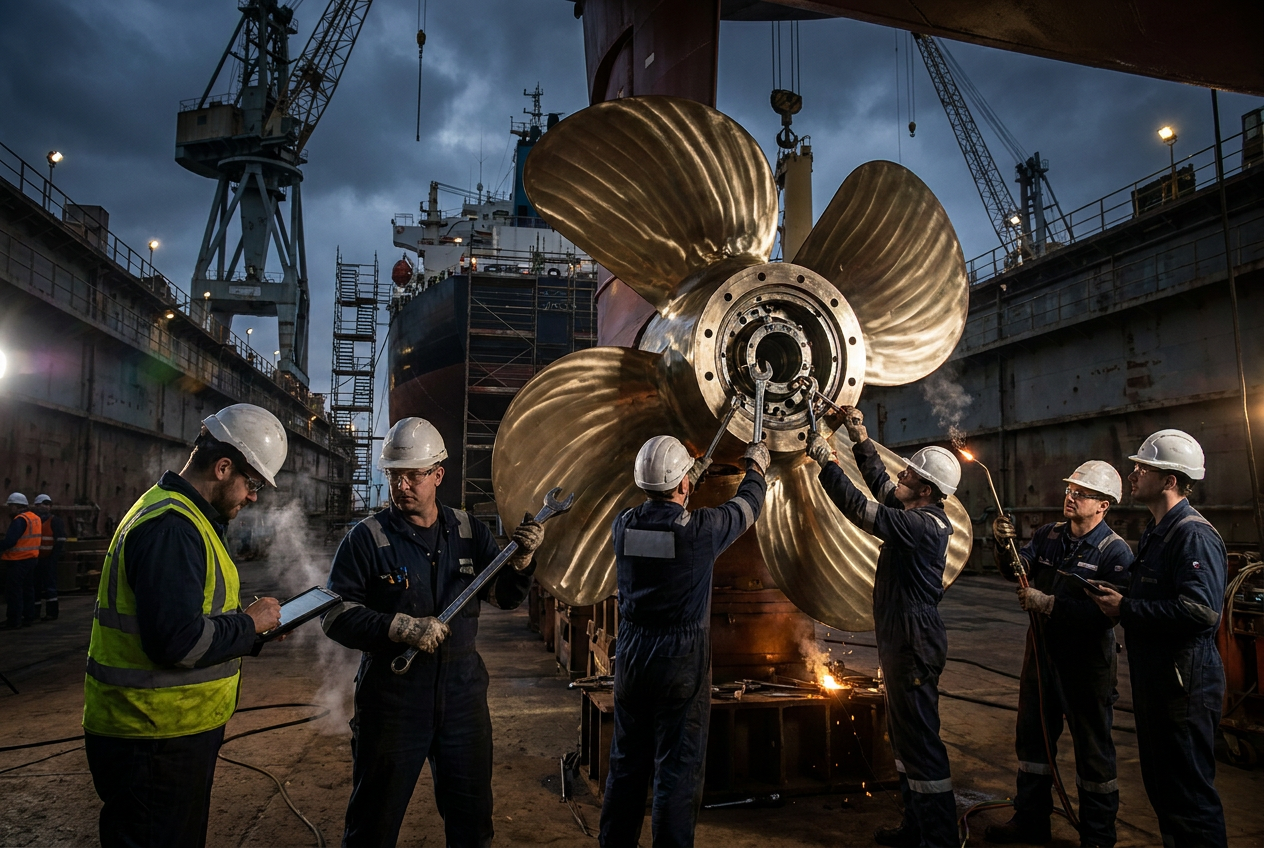
Berg Propulsion says it upgraded 70 ships from 2022 to 2026, including 38 completed in the latest 12-month period to May 2026, with independently confirmed emissions cuts totaling about 114,000 tonnes of CO2 equivalent each year. The work focused on vessels whose operating profile has shifted to lower speeds, combining redesigned controllable-pitch propeller blades, lower engine revolutions, shaft-generator frequency stabilization, hydrodynamic appendages, control-system improvements, digital monitoring and, in some cases, battery integration to improve efficiency and emissions performance.
What it means for owners
For shipowners, the significance is less about one supplier’s orderbook and more about what it says regarding the next phase of compliance economics. A large share of the world fleet was designed around service speeds that no longer reflect commercial reality. Slow steaming, weather routing, demand volatility and fuel-cost management have pushed many vessels into operating envelopes where original propulsion configurations are simply no longer ideal. That mismatch now matters more because efficiency is no longer just a bunker issue; it directly affects CII performance, charter-party competitiveness, EU ETS exposure and, for relevant trades, FuelEU Maritime penalties. If a vessel’s propulsion train is inefficient at lower loads, owners effectively pay twice: first through higher fuel consumption per voyage, then again through weaker carbon metrics and compliance costs. In that context, retrofitting is moving from a technical optimization project to a financial and regulatory decision.
The technical logic is credible. Ships built for faster operation can suffer from poor propeller loading and suboptimal engine behavior when held permanently below design speed. Re-matching blade geometry to the vessel’s true operating profile, while reducing engine RPM and maintaining electrical stability for the shaft generator, addresses a practical pain point many operators know well. Stable onboard power matters because slow-speed inefficiency is not confined to thrust generation; it can ripple into auxiliary consumption, machinery reliability and operational flexibility. Add-ons such as nozzles, hub fairing cones, upgraded control logic and sensor-based performance tracking suggest a systems approach rather than a single-component fix. That is important because modern efficiency gains typically come from cumulative improvements across propulsor, controls, energy management and voyage profile, not from a single silver bullet.
Commercially, however, the strongest implication may be timing. Owners face a narrowing window to improve existing tonnage before compliance pressure and market stratification deepen. A vessel with persistently poor CII can face operational restrictions, while charterers are increasingly selective on fuel performance and emissions reporting. Yet newbuild replacement is expensive, yard slots are constrained, and financing remains uneven across owner segments. Well-scoped retrofits therefore offer a middle path: lower capex than fleet renewal, shorter implementation lead times than major fuel-conversion projects, and a measurable route to preserving asset utility. The catch is execution. Retrofit capex must compete with ballast water, scrubber maintenance, class renewal works, cargo-system investments and normal lifecycle repairs. Owners will want confidence in payback periods, compatibility with class requirements, and drydock integration that avoids extended off-hire. In practical terms, the winners will be operators that treat propulsion retrofits as part of a broader maintenance-and-compliance package, scheduling them alongside planned docking and steel, coating or machinery works to reduce total downtime and capture the full economic value of the intervention.
MaritimeNG — critical view
The headline emissions figure is encouraging, but shipowners should resist broad generalization. Retrofit performance is highly vessel-specific: hull form, draft pattern, propeller condition, trading profile, engine type, hotel load and maintenance discipline all shape the outcome. A ship that spends long periods near its original design condition may see very different returns from one that is structurally trapped in permanent slow steaming. Verified fleet-wide savings are useful, but investment decisions still need route-by-route and vessel-by-vessel modeling, ideally backed by sea trials, digital baselines and independent post-retrofit measurement.
Scalability is another question. The global fleet is large, but not every candidate vessel justifies intervention once remaining asset life, charter employment, financing cost and docking opportunity are considered. Yard capacity, engineering bandwidth, class approvals and supply-chain timing can all dilute rollout speed. There is also a risk that owners overestimate retrofit value if hull fouling, trim management, engine tuning and operational discipline are not kept under control. In short, propulsion retrofits can be powerful, but they are not a substitute for rigorous technical due diligence or for broader fleet-efficiency management.
Verdict
The strategic takeaway is clear: for ships operating materially below their original speed assumptions, propulsion retrofit work is becoming one of the more bankable decarbonization options available today. The real challenge is not proving that savings are possible, but identifying which vessels, docking windows and capex structures will turn technical potential into durable commercial advantage—a decision area where disciplined repair and retrofit intelligence is increasingly valuable.
Fundamental basis
The economic mechanics behind the facts above, grounded in Martin Stopford’s Maritime Economics. Reference only — not investment advice.
Facing a similar situation on your vessel? Model the numbers before you commit.
Open the off-hire & deviation calculatorsSource Attribution
This analytical review is based on publicly available facts originally reported by MarineLink. MaritimeNG does not claim authorship of the underlying facts. Read the original publication
© 2026 MaritimeNG — Independent analytical commentary. All analysis, opinions, and forward-looking assessments are original work by MaritimeNG Editorial and may differ from those of the parties mentioned or the cited source. Factual data is restated in our own words based on publicly available information. All trademarks and trade names belong to their respective owners. This content does not constitute legal, technical, or investment advice.