Persian Gulf Delays Are Creating a Hidden Hull Cost for Owners
Prolonged vessel inactivity in the Persian Gulf is turning a security and disruption problem into a technical and commercial one. For shipowners, the resulting hull fouling risk now has direct implications for fuel bills, emissions exposure, drydocking decisions and port-entry compliance.
What happened
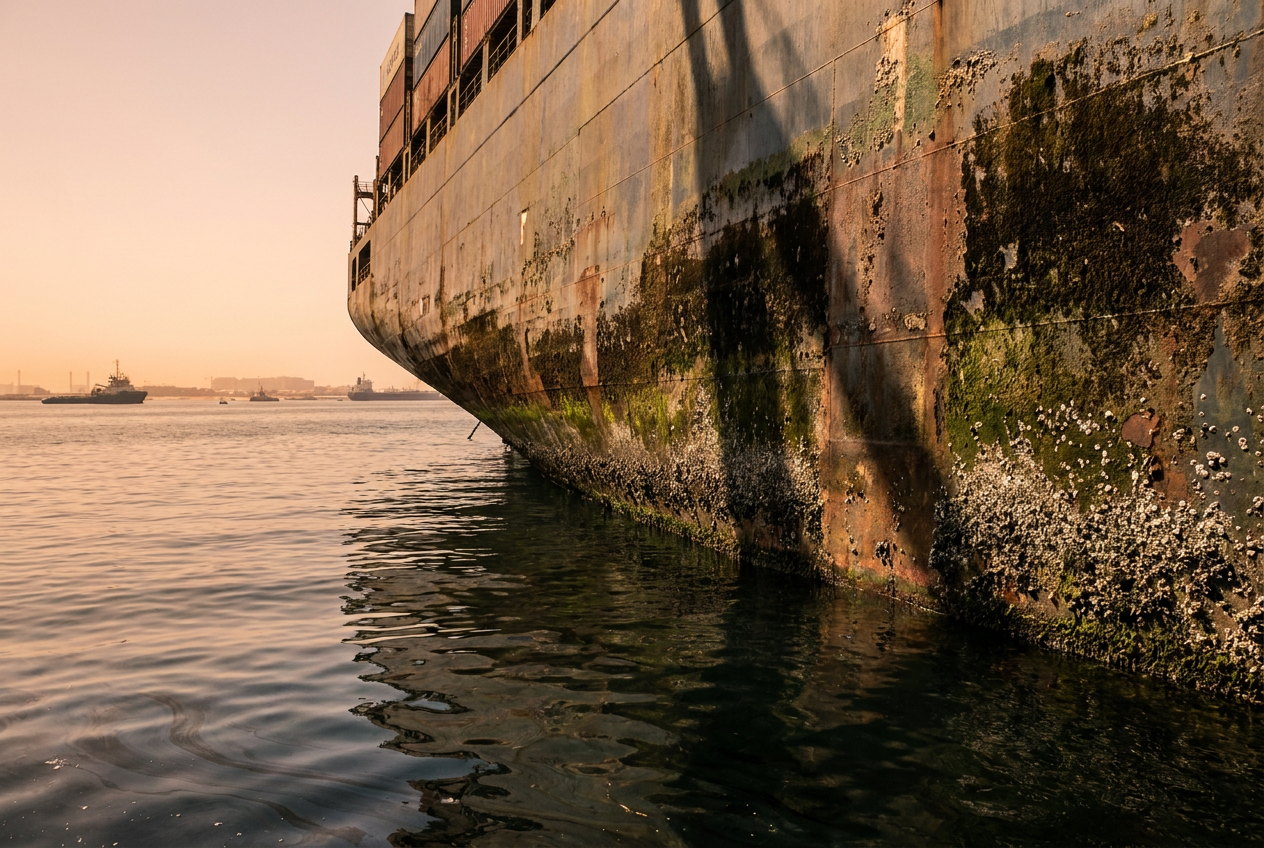
Shipping disruption in the Persian Gulf has left a large number of vessels stationary for extended periods, according to AIS-based tracking cited by Drydock Magazine: by mid-June 2026, 958 ships were held up in the region, including 602 delayed for more than 100 days. In these conditions, marine organisms begin attaching to submerged surfaces almost immediately and can develop into heavier accumulations over time, especially where vessels remain idle. The Gulf presents an especially aggressive environment because of warm, saline waters, nutrient availability and long anchorage periods that reduce the effectiveness of antifouling systems designed for moving ships. Owners are therefore exposed to higher fuel use, speed loss, emissions and even security concerns, including the possibility of illicit items being fixed to underwater hull areas. Several jurisdictions, including Australia, New Zealand, California and Brazil, now enforce stricter biofouling controls.
What it means for owners
For owners and operators, the core issue is that a delayed ship does not simply resume service in the same technical state in which it stopped. Extended anchorage in warm Gulf waters can materially alter hull condition, and that changes voyage economics from the first laden leg after release. Even a moderate rise in hull roughness can increase resistance enough to lift daily fuel consumption, reduce achievable speed, or force engines to work harder to maintain schedules. That directly affects Carbon Intensity Indicator performance because CII is driven by transport work relative to fuel burned. A vessel re-entering trade with a fouled underwater profile may see its annual score deteriorate quickly, particularly if it is already operating near a rating threshold. Owners with older tonnage or ships on tighter service commitments face a compounded problem: the vessel may need more power to recover timetable reliability, yet that same response worsens fuel burn and carbon performance.
The commercial knock-on effect extends beyond CII into carbon cost exposure. For ships trading into Europe or otherwise exposed to emissions-linked compliance regimes, additional fuel use translates into higher EU ETS liability. That means biofouling is no longer just a maintenance inefficiency; it becomes a measurable cash cost with regulatory consequences. Owners should therefore evaluate the off-hire economics with more discipline than is typical after disruption events. A cleaning campaign, diver inspection or repair-slot booking may appear expensive when looked at in isolation, but the alternative can be months of degraded earnings through higher bunker consumption, slower turnarounds and avoidable emissions costs. In many cases, a short off-hire period for inspection and hull cleaning before full commercial redeployment will be cheaper than carrying a fouled hull through an entire trading quarter.
There is also a capacity planning dimension the market may be underestimating. If a large portion of delayed Gulf tonnage returns to service within a compressed period, demand for underwater inspections, class-attended cleaning, coating assessment and docking slots could rise sharply. That would tighten availability at repair yards and among diving and ROV contractors, potentially increasing rates and waiting times. Owners that move early can sequence inspection, cleaning and compliance documentation in a controlled way; owners that wait for performance claims to emerge may find themselves in a queue. The compliance overlay matters as well. Countries such as Australia and New Zealand already apply strict entry expectations around hull cleanliness, while California and Brazil have formal management requirements or thresholds. A vessel leaving prolonged anchorage and proceeding into these jurisdictions without updated records, inspection evidence or remedial action may face delays, additional inspection costs or restrictions. The practical lesson is to treat hull condition as a voyage-readiness issue, not a routine maintenance item, and to align inspection timing with the vessel's next intended trading pattern rather than its last port stay.
MaritimeNG — critical view
The industry has long understood that idle time encourages marine growth, but preparedness remains uneven because many operators still frame biofouling as a secondary technical matter rather than a board-level earnings risk. That mindset is increasingly outdated. When geopolitical disruption strands hundreds of ships in one high-fouling region, the result is not a series of isolated maintenance cases but a systemic fleet-efficiency problem with consequences for emissions compliance, schedule reliability and port access.
What owners should be doing now is straightforward but often delayed in practice: identify affected vessels, review anchorage duration against coating type and age, schedule underwater inspections before voyage orders are fixed, and compare immediate cleaning costs with projected fuel and carbon penalties. What too many will do instead is wait until speed loss, bunker overconsumption or destination-country scrutiny forces action. In the current regulatory environment, that reactive approach is more expensive than it used to be.
Verdict
Persian Gulf delays are creating a deferred maintenance bill that will surface in fuel costs, carbon metrics and compliance friction once ships re-enter trade. Owners that act early on inspections, cleaning and yard planning will be better placed to protect earnings, and MaritimeNG's networked visibility across repair and technical service options can help inform that response.
Fundamental basis
The economic mechanics behind the facts above, grounded in Martin Stopford’s Maritime Economics. Reference only — not investment advice.
Facing a similar situation on your vessel? Model the numbers before you commit.
Open the off-hire & deviation calculatorsSource Attribution
This analytical review is based on publicly available facts originally reported by Drydock Magazine. MaritimeNG does not claim authorship of the underlying facts. Read the original publication
© 2026 MaritimeNG — Independent analytical commentary. All analysis, opinions, and forward-looking assessments are original work by MaritimeNG Editorial and may differ from those of the parties mentioned or the cited source. Factual data is restated in our own words based on publicly available information. All trademarks and trade names belong to their respective owners. This content does not constitute legal, technical, or investment advice.