Paris MoU Ban on MV Lira Signals Tighter Limits for Aging Tonnage
The exclusion of MV Lira from European ports is more than an isolated compliance case. It highlights how commercial, regulatory, and technical pressures are rapidly narrowing the operating space for elderly, marginally maintained vessels in Europe.
What happened
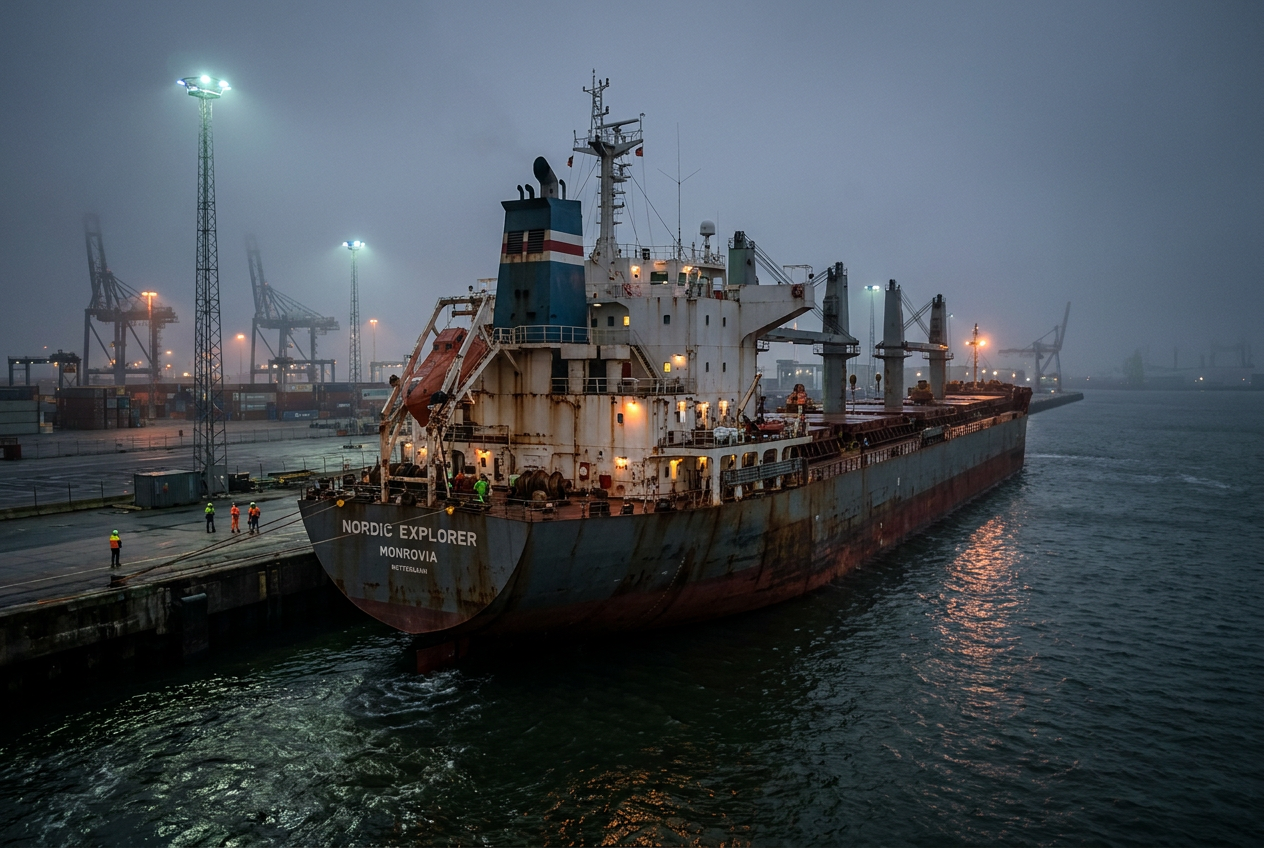
MV Lira, an 89-meter general cargo ship built in 1985 and registered under the Tanzanian flag, has been barred from European ports after failing to follow a release condition imposed in Italy. After detention in Olbia, the vessel was allowed to sail only for repairs in Piraeus, but authorities later confirmed it never reached the designated yard and no arrival information was provided. The action was taken within the Paris MoU regime, which annually inspects more than 17,000 foreign ships and applies stricter scrutiny to ships associated with high-risk flag performance.
What it means for owners
For owners and operators, this case is a reminder that vessel age alone is not what triggers market exclusion; it is age combined with weak maintenance execution, poor documentary discipline, and inability to demonstrate credible corrective action. European port state control has become less tolerant of promises that are not backed by verifiable follow-through. A release-to-repair-yard arrangement is effectively a final opportunity to preserve market access. If that undertaking is ignored, the consequence is no longer just another detention but a direct hit to trading optionality, charterability, and financing credibility. Once a ship falls into the category of repeated non-compliance, every subsequent voyage becomes harder to insure, fix, and schedule.
The economics behind such decisions are increasingly harsh. Owners of older general cargo ships are already absorbing a difficult mix of rising steel renewal costs, expensive machinery repairs, tighter class expectations, and weaker earnings visibility in many short-sea and regional cargo segments. At the same time, Europe’s regulatory stack is making substandard tonnage less commercially defensible. CII performance can deteriorate sharply on older ships with dated propulsion systems and operational inefficiencies. Add the cost exposure from EU ETS and the fuel compliance implications of FuelEU Maritime, and the business case for postponing drydock work becomes even weaker. What may appear to be a cash-saving delay can quickly turn into prolonged off-hire, detention-related losses, voyage disruption, and exclusion from a premium trading region. In that sense, deferred maintenance is no longer merely a technical gamble; it is a commercial strategy with shrinking odds of success.
There is also a capacity and planning dimension that should not be overlooked. Many owners have struggled with yard availability, rising repair quotations, and longer lead times for specialist parts. Those pressures are real, especially for smaller operators with limited balance-sheet flexibility. But regulators are showing little interest in treating yard congestion as an excuse where vessel condition already raises concern. If an operator cannot secure and execute repair commitments reliably, the market increasingly interprets that as a management failure rather than a logistics problem. The Paris MoU’s risk-based inspection model reinforces this trend: ships under high-risk flags face more frequent scrutiny, which means less room to trade around defects and less time between regulatory interventions. For older vessels in particular, the industry is moving toward a point where a missed yard date is not an administrative lapse but a sign that the asset may no longer be viable within mainstream European trade.
MaritimeNG — critical view
This episode also exposes a broader structural problem in shipping’s lower-value segments: too much aging tonnage remains active because replacement economics are unattractive, while enforcement still occurs one ship at a time. Small general cargo operators often serve trades that larger fleets have little interest in, yet many do so with assets that are technically fragile and commercially squeezed. When freight markets are inconsistent and capital access is limited, owners can drift into a cycle of patch repairs, delayed surveys, and reactive compliance. The result is a class of vessels that remain employed until a regulator, casualty, or charterer finally draws a line.
The industry should be careful not to frame every such case simply as individual misconduct. There is a systemic element: decarbonization costs, compliance complexity, and tighter port state enforcement are accelerating the exit of older ships, but the replacement pipeline for some cargo niches is still inadequate. That does not excuse non-compliance, and a port ban is entirely understandable where authorities are ignored. But it does suggest that Europe’s enforcement actions are also functioning as a market-clearing mechanism, pushing out operators that cannot finance safe maintenance and credible regulatory performance.
Verdict
The ban on MV Lira is best read as a signal that European access is becoming conditional on provable maintenance discipline, not just paperwork and intent. For owners of older tonnage, repair planning, class compliance, and transparent execution are now strategic requirements rather than technical back-office tasks—a reality that makes reliable yard and service support increasingly decisive across the MaritimeNG ecosystem.
Fundamental basis
The economic mechanics behind the facts above, grounded in Martin Stopford’s Maritime Economics. Reference only — not investment advice.
Facing a similar situation on your vessel? Model the numbers before you commit.
Open the off-hire & deviation calculatorsSource Attribution
This analytical review is based on publicly available facts originally reported by The Maritime Executive. MaritimeNG does not claim authorship of the underlying facts. Read the original publication
© 2026 MaritimeNG — Independent analytical commentary. All analysis, opinions, and forward-looking assessments are original work by MaritimeNG Editorial and may differ from those of the parties mentioned or the cited source. Factual data is restated in our own words based on publicly available information. All trademarks and trade names belong to their respective owners. This content does not constitute legal, technical, or investment advice.