Navy Yard Overhaul Signals a Multi-Decade EPC Surge
GAO’s latest assessment suggests the U.S. Navy’s yard renewal effort has moved from a large capital program to a generational infrastructure campaign. For maritime EPC players and naval sustainment planners, the real issue is no longer whether the work proceeds, but how schedule, operational continuity, and industrial capacity are managed over decades.
What happened
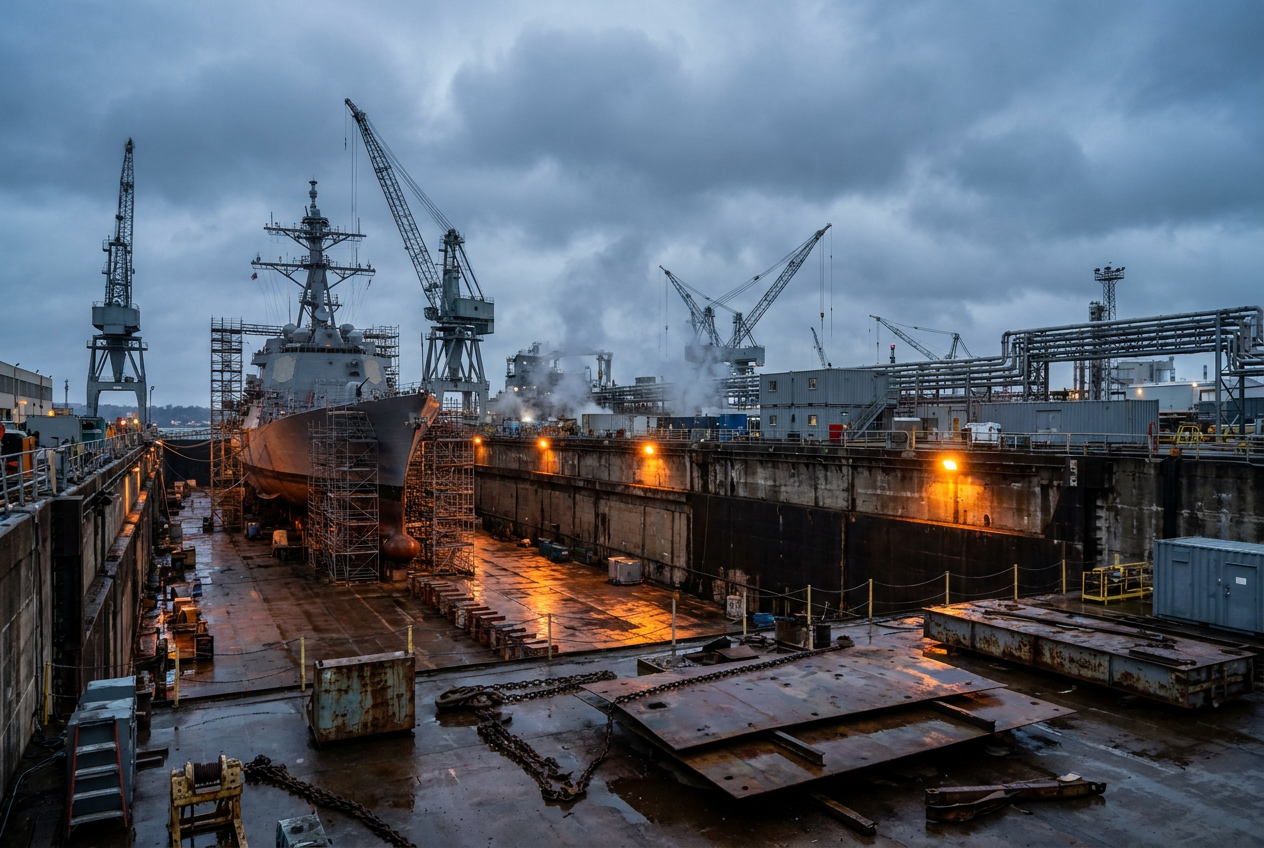
The GAO estimates that modernization of the U.S. Navy’s four public shipyards could require roughly $200 billion and run through 2080. The Navy’s 2018 Shipyard Infrastructure Optimization Program had projected about $21 billion over 20 years for Norfolk, Pearl Harbor, Portsmouth, and Puget Sound. These yards support maintenance and upgrade work for aircraft carriers and nuclear-powered submarines, and the program includes dry dock expansion, facility renewal, equipment upgrades, demolition, and relocation. GAO said planning has taken longer than expected, environmental requirements have added scope, and the dry dock projects already underway or in advanced design at Portsmouth, Pearl Harbor, and Puget Sound together are estimated at about $21.7 billion.
What it means for owners
For shipowners and operators observing from the commercial side, the headline figure matters less than the structural lesson: brownfield maritime infrastructure is being repriced upward across the board. If one of the most strategically protected ship repair systems in the world now carries a cost profile nearly an order of magnitude above early estimates, private-sector port, terminal, and yard developers should assume tighter scrutiny on contingency, phasing, utilities relocation, environmental remediation, and interface risk. In practical terms, this will influence how lenders, boards, and government customers assess schedule credibility for any complex waterfront rebuild executed inside a live operating environment.
For the naval sector, the fleet consequence is potentially more significant than the budget headline. These four yards are central to the availability of nuclear submarines and carriers, so prolonged construction sequencing can translate into longer maintenance queues, lower surge readiness, and heavier dependence on precise dry dock scheduling. If even a small percentage of planned docking windows slip because civil works and fleet sustainment must coexist, the downstream effect on force generation could be material. For EPC contractors, this changes the opportunity set: the premium will not simply be on heavy construction capacity, but on program integration, temporary works design, utility continuity, digital staging, and operating-yard logistics. Firms with experience in defense brownfields, radiological controls adjacency, and phased marine civil construction will likely command the strongest positions as the work matures from concept into executable packages.
MaritimeNG — critical view
The most underappreciated risk is industrial concentration. A program of this scale will compete for many of the same inputs already under pressure in U.S. infrastructure and defense markets: specialty labor, waterfront engineering talent, concrete and steel fabrication capacity, electrical integration expertise, and long-lead mechanical systems. Cost growth may therefore remain persistent even after scopes are better defined, especially if inflation in defense construction outpaces general construction benchmarks. The result could be a recurring cycle in which each updated estimate is overtaken by market reality before execution catches up.
There is also a governance question. Annual reporting to Congress would improve transparency, but reporting alone does not solve the core delivery challenge: a modernization plan stretched across changing administrations, fleet architectures, environmental standards, and technology baselines. Historical precedent from other long-horizon defense infrastructure efforts suggests that requirements drift can be as damaging as underbudgeting. A more resilient model may require modular packaging, earlier enabling works, and sharper separation between must-have readiness investments and desirable efficiency upgrades. That distinction will determine whether the program improves throughput soon enough to matter operationally, rather than merely producing a larger long-term capital ledger.
Verdict
This is no longer a conventional recapitalization effort; it is a national maritime works program with major implications for naval readiness and EPC market capacity through mid-century and beyond. The winners will be organizations able to quantify interface risk early and sequence construction around live operations with unusual discipline—an area where MaritimeNG will keep close watch.
Fundamental basis
The economic mechanics behind the facts above, grounded in Martin Stopford’s Maritime Economics. Reference only — not investment advice.
Facing a similar situation on your vessel? Model the numbers before you commit.
Open the off-hire & deviation calculatorsSource Attribution
This analytical review is based on publicly available facts originally reported by The Maritime Executive. MaritimeNG does not claim authorship of the underlying facts. Read the original publication
© 2026 MaritimeNG — Independent analytical commentary. All analysis, opinions, and forward-looking assessments are original work by MaritimeNG Editorial and may differ from those of the parties mentioned or the cited source. Factual data is restated in our own words based on publicly available information. All trademarks and trade names belong to their respective owners. This content does not constitute legal, technical, or investment advice.