Navalshore 2026: Brazil's Largest Naval & Offshore Exhibition Returns to Rio with 164+ Exhibitors
South America's premier maritime industry event, Navalshore 2026, will gather over 164 exhibitors at ExpoMag Rio de Janeiro on August 18–20. From shipyard giants to classification societies, the exhibition reflects Brazil's booming naval sector fueled by Petrobras's multi-billion-dollar fleet renewal programs.
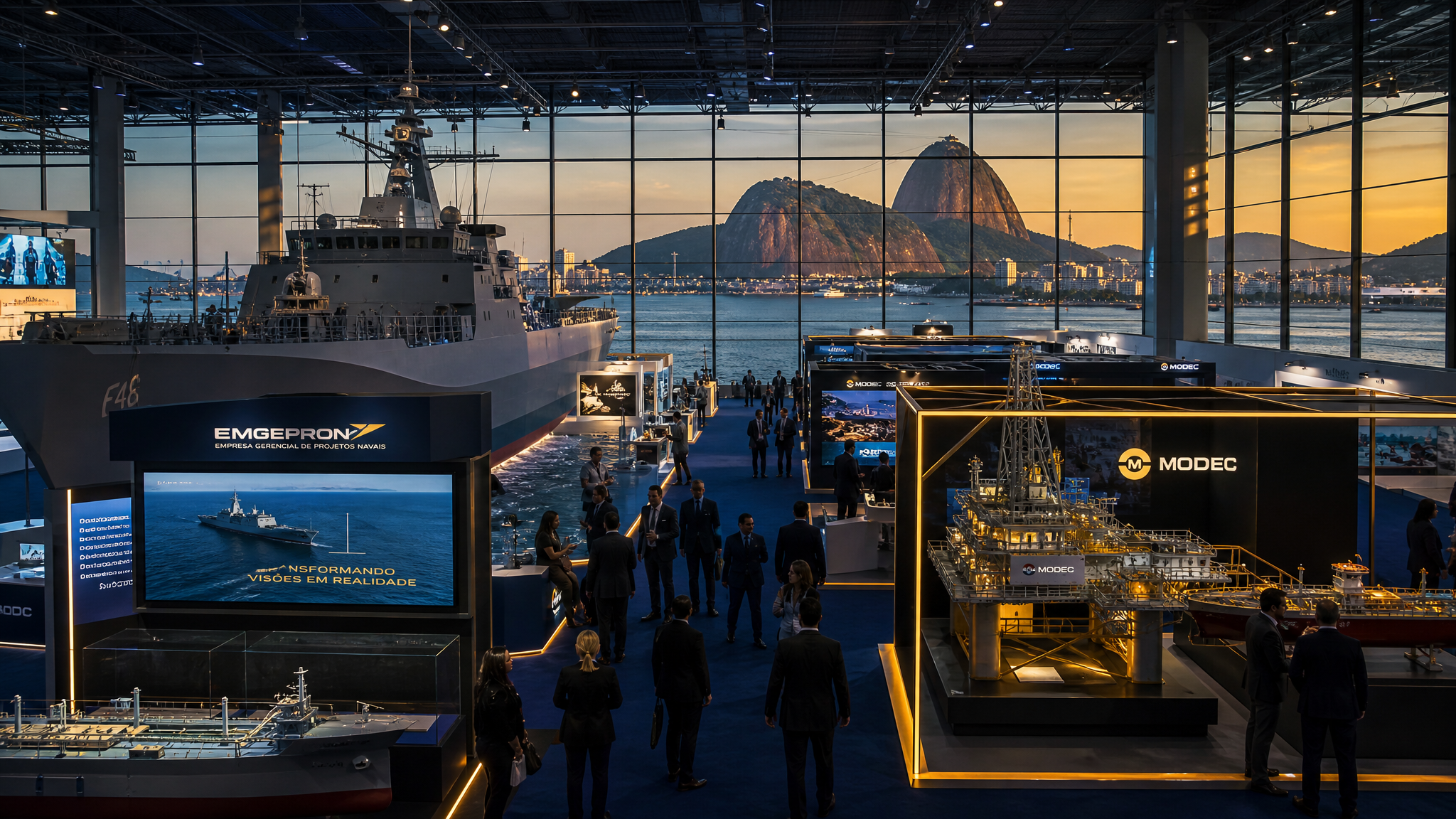
What happened
Navalshore 2026 — officially titled "12th International Naval and Offshore Industry Fair" — will take place August 18–20, 2026 at ExpoMag (Cidade Nova), Rio de Janeiro, Brazil. Organized by UBM Brazil (Informa Markets), it is the largest dedicated naval and offshore exhibition in Latin America.
The event has confirmed over 164 exhibitors spanning virtually every segment of the maritime value chain: classification societies (DNV, Bureau Veritas, Lloyd's Register), propulsion and power (Rolls-Royce, Wärtsilä, MAN Energy Solutions, Schottel, Kongsberg Maritime), electrical and automation (ABB Marine, Siemens Energy, WEG, Schneider Electric), coatings and corrosion (Jotun, Hempel, International Paint / AkzoNobel), crane and deck machinery (Liebherr Maritime, MacGregor), safety and navigation (Furuno, Damen, Alphatron Marine), as well as leading Brazilian yards — Estaleiro Atlântico Sul (EAS), Estaleiro Jurong Aracruz, BrasFELS / Sembcorp Marine, Estaleiro Enseada, Vard Promar (Fincantieri).
Key thematic halls focus on: offshore platform construction, FPSO conversion, ship repair & drydocking, green shipping & decarbonization technology, and digital transformation / maritime AI solutions.
The exhibition runs in parallel with a three-day technical conference featuring panels on Brazil's National Maritime Modernization Programme, Petrobras's new-build tender pipeline, BNDES financing mechanisms for local content compliance, and environmental regulation updates from IBAMA and the Brazilian Navy (DPC).
What it means for owners
For international shipowners and EPC contractors, Navalshore 2026 is the most efficient single point of access to Brazil's rapidly expanding maritime supply chain. After years of post-Lava Jato stagnation, the sector is in full resurgence: Petrobras alone has committed to 28 new FPSO units through its 2024–2028 strategic plan, with a combined CAPEX exceeding USD 70 billion, of which roughly 40% must be sourced locally under ANP local content regulations.
This creates tangible opportunities across the repair, conversion and new-build segments. Yards that were running at 30–40% capacity utilization as recently as 2022 are now booking into 2028–2029. EAS and Jurong Aracruz have resumed FPSO integration work; BrasFELS in Angra dos Reis handles both conversion and new-build; smaller specialized yards are expanding into topside module fabrication.
For classification and equipment suppliers, the event offers direct procurement meetings with Petrobras, Transpetro, and the Brazilian Navy — all of whom maintain active tender calendars. MaritimeNG analysis indicates that early engagement at events like Navalshore significantly shortens sales cycles in Brazil's relationship-driven procurement environment.
MaritimeNG — critical view
MaritimeNG views Navalshore 2026 as a barometer of Brazil's naval ambitions versus actual delivery capacity. While the exhibitor list is impressive and the Petrobras pipeline is real, several structural risks remain:
First, Brazil's shipyard workforce has not fully recovered from the 2015–2020 downturn. Skilled welders, pipe-fitters and project managers are in short supply, and wage inflation in the Rio–Niterói shipyard corridor is running 15–20% year-on-year.
Second, local content rules, while politically popular, continue to add 20–30% cost premiums and 6–12 month schedule delays compared to Asian benchmarks. International OEMs exhibiting at Navalshore often discover that "local content compliance" requires establishing in-country assembly or warehousing operations — a significant barrier for mid-size suppliers.
Third, Brazil's port and logistics infrastructure around the main shipyard clusters (Niterói, Angra dos Reis, Suape, Açu) still lags — crane capacity, berth availability, and intermodal connectivity are genuine bottlenecks that no exhibition can fix.
That said, the sheer scale of the Petrobras programme makes Brazil impossible to ignore. The question is not whether the market is real, but whether participants can navigate the regulatory, labour and logistical complexity profitably.
Verdict
Navalshore 2026 is a must-watch event for any company with Brazilian maritime ambitions. With 164+ exhibitors, high-level Petrobras and Navy participation, and a technical programme covering the full FPSO and ship-repair lifecycle, it offers unmatched networking density.
MaritimeNG will be providing comprehensive coverage of Navalshore 2026 — including exhibitor analytics, key contract announcements, and post-event market intelligence — through our dedicated Brazil & Argentina regional hub. Stay tuned to our Insights Digest for real-time updates.
For shipowners and managers considering Brazilian repair options, our Off-Hire & Deviation Calculators can help model whether a Brazilian drydocking or repair stop makes economic sense versus alternatives in the Caribbean, West Africa or Southeast Asia.
Fundamental basis
The economic mechanics behind the facts above, grounded in Martin Stopford’s Maritime Economics. Reference only — not investment advice.
Facing a similar situation on your vessel? Model the numbers before you commit.
Open the off-hire & deviation calculatorsSource Attribution
This analytical review is based on publicly available facts originally reported by Navalshore / UBM Brazil. MaritimeNG does not claim authorship of the underlying facts. Read the original publication
© 2026 MaritimeNG — Independent analytical commentary. All analysis, opinions, and forward-looking assessments are original work by MaritimeNG Editorial and may differ from those of the parties mentioned or the cited source. Factual data is restated in our own words based on publicly available information. All trademarks and trade names belong to their respective owners. This content does not constitute legal, technical, or investment advice.