Maria Topic Retrofit Signals Growing Maturity for Wind-Assisted Bulk Carrier Upgrades
The return of Maria Topic after a wingsail retrofit is a notable data point for owners weighing practical decarbonisation measures for existing bulk tonnage. More importantly, it tests whether wind-assist can be installed within normal docking windows without undermining vessel availability or commercial flexibility.
What happened
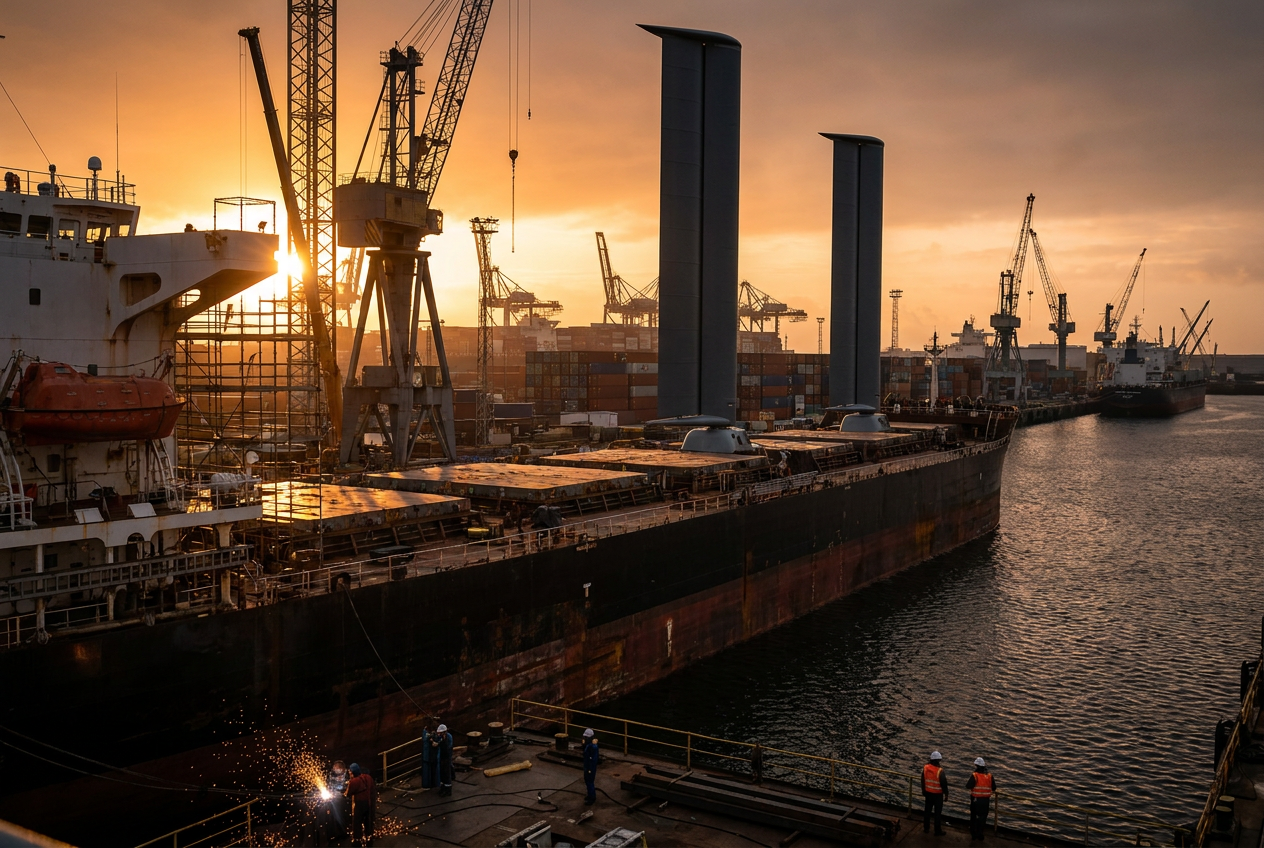
Maria Topic, an Ultramax bulker under the Maltese flag, has resumed trading after being retrofitted with OceanWings rigid sails at Tsuneishi Shipbuilding in Japan. The installation involved Topic, its technical manager Marfin Management, the yard and the technology supplier, and follows an earlier fitting on sister vessel Paolo Topic. The work was carried out during a planned drydocking, with support from the EU-backed WHISPER initiative, and early performance results are due to be shared publicly at SMM Hamburg.
What it means for owners
For shipowners, the significance of this project is less about novelty and more about execution risk. Wind-assisted propulsion has moved beyond concept-stage discussion into the harder territory of repeatable installation, class acceptance, and integration with routine maintenance planning. Completing a retrofit during a scheduled docking matters because off-hire remains one of the biggest barriers to decarbonisation upgrades on trading bulkers. Even when a technology promises fuel savings, owners still have to absorb lost earnings, yard delays, engineering uncertainty and the knock-on effect on charter commitments. A retrofit that can be inserted into an already-planned drydock improves the business case materially, especially in volatile freight markets where time out of service can quickly erase expected efficiency gains.
The regulatory backdrop also makes these projects more commercially relevant than they would have been even three years ago. Bulk carrier operators are now managing CII exposure on one side and the rising cost of carbon and fuel compliance on the other. For ships calling in Europe, EU ETS adds a direct financial penalty to emissions, while FuelEU Maritime increases pressure to improve the greenhouse gas intensity of energy used onboard. In that context, wind-assist is attractive because it reduces fuel burn without requiring a complete fuel-system conversion or long-term dependence on still-maturing bunkering infrastructure for alternative fuels. For mid-life and younger conventional bulkers, that creates a potential bridge strategy: preserve asset competitiveness, defend CII ratings, and moderate exposure to fuel and carbon costs while the future fuel landscape remains unsettled.
There is also a ship repair and conversion angle that should not be overlooked. Yard capacity for retrofits is tightening globally, not only because of scrubbers, ballast water treatment follow-up work and efficiency upgrades, but also because many yards are balancing repair demand against newbuilding programmes. If Tsuneishi and other capable yards can demonstrate standardised engineering pathways for wind-assist installations, owners may gain confidence that these projects are becoming industrialised rather than bespoke. That matters for lenders, insurers and technical managers, all of whom want predictable schedules, known class requirements, and clear OPEX implications. The fact that this is the second vessel in the same ownership group fitted with the technology suggests a transition from pilot curiosity toward fleet-level learning. If performance data shows reliable savings across realistic trading patterns, more operators in the handy and Ultramax segments are likely to revisit retrofit economics with greater seriousness.
MaritimeNG — critical view
That said, owners should be careful not to treat a successful installation as proof of universally compelling returns. Wind-assist performance is route-dependent, weather-dependent and operationally sensitive. Savings achieved on paper or on a favourable voyage profile may not translate evenly across tramp bulk operations, where cargo trades, ballast legs and port rotations are rarely stable enough to support neat forecasting. Deck space, visibility, loading constraints, maintenance routines and crew familiarisation also introduce practical complications that can narrow the net benefit.
There is a financing and measurement challenge as well. The industry still lacks broad, independently benchmarked datasets across vessel classes and trade patterns, which means some boards may hesitate before committing capital beyond demonstration scale. Class approval may be manageable, but structural reinforcement, stability assessment, control-system integration and lifecycle maintenance are not cost-free. If savings underperform expectations, the payback period can stretch uncomfortably, especially for assets approaching the second half of their commercial life. In other words, the strategic logic is strengthening, but the investment case still depends on disciplined vessel selection rather than enthusiasm for decarbonisation branding.
Verdict
Maria Topic’s return to service is a meaningful indicator that wind-assist retrofits are becoming more operationally credible for mainstream bulk carriers. The next milestone is not installation itself but transparent in-service performance data, because owners and repair planners need evidence on savings, downtime and integration complexity before this moves from promising niche to bankable retrofit pathway.
Fundamental basis
The economic mechanics behind the facts above, grounded in Martin Stopford’s Maritime Economics. Reference only — not investment advice.
Facing a similar situation on your vessel? Model the numbers before you commit.
Open the off-hire & deviation calculatorsSource Attribution
This analytical review is based on publicly available facts originally reported by Ship & Offshore. MaritimeNG does not claim authorship of the underlying facts. Read the original publication
© 2026 MaritimeNG — Independent analytical commentary. All analysis, opinions, and forward-looking assessments are original work by MaritimeNG Editorial and may differ from those of the parties mentioned or the cited source. Factual data is restated in our own words based on publicly available information. All trademarks and trade names belong to their respective owners. This content does not constitute legal, technical, or investment advice.