Margaritaville's Belfast Refit Signals Stronger Demand for Cruise Conversions
Margaritaville at Sea has again chosen Belfast for a major cruise-ship conversion, while also securing a future operating slot in Galveston. For shipowners and technical managers, the decision highlights how midlife refurbishment, yard access, and deployment planning are becoming tightly linked commercial levers.
What happened
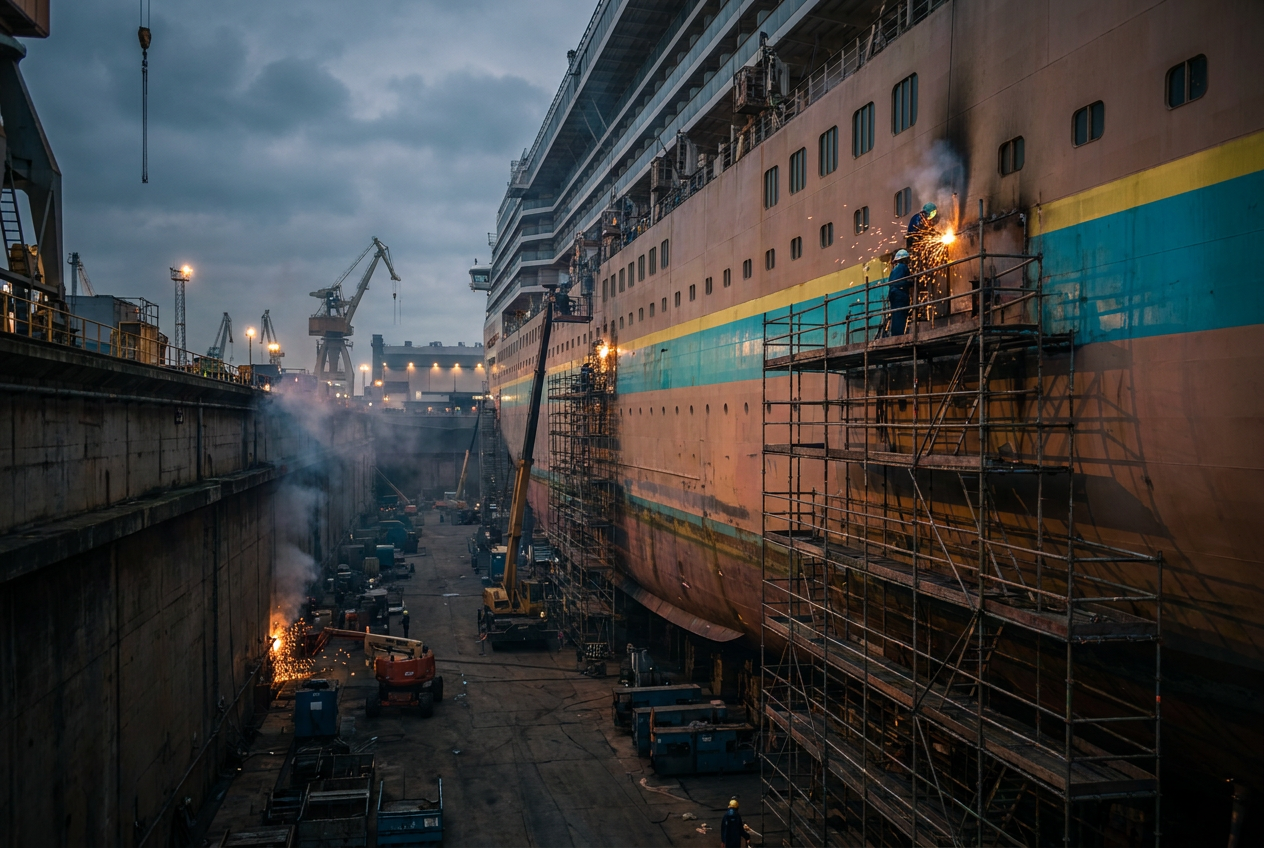
Margaritaville at Sea has awarded Harland & Wolff's Belfast facility, now under Navantia Group ownership, the refit of its third vessel, the former Costa Fortuna. The 2003-built, roughly 102,600-GT ship will undergo a 12-week drydock program led with Northern Ireland contractors MJM Marine and Mivan before re-entering service in early 2027 from Miami as Margaritaville at Sea Beachcomber. Separately, Galveston's port authority has approved the brand for weekly calls beginning in October 2027 under an initial one-year arrangement with extension options.
What it means for owners
For owners and operators, this award is less about a single cruise brand and more about what it says regarding fleet strategy in an expensive and capacity-constrained market. Cruise companies continue to face a difficult allocation decision: whether to commit to highly priced newbuild slots with long lead times, or extend and reposition existing tonnage through conversion. A 2003-built vessel of this size remains commercially useful if the hotel product can be reset to match a differentiated brand proposition. In that context, conversion CAPEX can be materially more attractive than a newbuild, especially for operators aiming to add capacity on a compressed schedule. The commercial logic improves further when a refit is tied to a clearly defined deployment plan, as seen here with Miami relaunch timing and a subsequent Galveston operating pathway already taking shape.
The yard selection is equally revealing. European repair and conversion slots for large passenger vessels remain tight, particularly where owners need substantial hotel works, coatings, steel treatment, and public-space redesign within one integrated package. Belfast's appeal is not only its physical scale, including large drydock and berth capability, but its ability to package cruise-focused interior specialists with core marine repair functions. For technical superintendents, that integration matters because schedule certainty is often worth more than a nominally lower bid from a fragmented supply chain. Every extra day in dock has an off-hire cost, but in cruise it also carries lost booking revenue, disrupted marketing windows, and knock-on deployment effects across an entire season.
Navantia's role deserves close attention from maritime procurement teams. The group is clearly positioning itself more aggressively in commercial repair and conversion, building on a substantial annual repair throughput and an established cruise track record in Spain. Bringing Belfast into that network expands its access to the North Atlantic and Northern European market while giving owners another option at a time when premium yard capacity is scarce. Strategically, that matters because Western Europe remains one of the few regions able to execute large-scale cruise refurbishments to brand standard. If Navantia can coordinate procurement, engineering, and labor planning across its facilities, it could become a more influential competitor for midlife passenger-vessel work and potentially for adjacent RoPax and ferry projects as well.
The Galveston dimension adds another layer. Homeport growth in the Gulf is creating downstream demand for vessels that can be introduced quickly without waiting for a newbuilding cycle. For operators, secondary and growth homeports are increasingly being served by repurposed tonnage rather than fresh-delivery ships. That favors conversion yards able to compress schedules and support brand repositioning. In practical terms, the combination of yard access, manageable conversion CAPEX, and near-term route deployment is becoming a decisive formula for operators trying to grow without taking on the full financing and lead-time burden of new tonnage.
MaritimeNG — critical view
There are, however, execution risks that should not be understated. A 12-week drydock window for a 102,000-GT cruise vessel undergoing broad hotel refurbishment, coatings work, blasting, and multiple venue upgrades is achievable only with rigorous scope control and disciplined owner decision-making. Late design changes, supply-chain slippage on interiors, or discoveries during opening-up can quickly compress commissioning time. For procurement and technical teams, the key issue is not whether the schedule looks competitive on paper, but how much contingency exists once inevitable change orders emerge.
There is also a broader strategic question around concentration risk. Repeating awards to the same yard can create efficiencies in brand understanding and execution, but it can also expose an operator if labor availability tightens or if post-acquisition integration creates friction between legacy yard practices and new group processes. Belfast's physical infrastructure is compelling, yet workforce depth, subcontractor coordination, and management integration under Navantia will determine whether the facility consistently converts headline capacity into reliable delivery performance.
Verdict
This contract underlines a broader market truth: conversion-led growth is becoming a practical alternative to newbuilding for operators targeting fast deployment into expanding cruise regions. For maritime decision-makers, the lesson is clear—yard access, execution certainty, and lifecycle economics now matter as much as vessel acquisition itself, themes MaritimeNG will continue to track across repair and retrofit markets.
Fundamental basis
The economic mechanics behind the facts above, grounded in Martin Stopford’s Maritime Economics. Reference only — not investment advice.
Facing a similar situation on your vessel? Model the numbers before you commit.
Open the off-hire & deviation calculatorsSource Attribution
This analytical review is based on publicly available facts originally reported by The Maritime Executive. MaritimeNG does not claim authorship of the underlying facts. Read the original publication
© 2026 MaritimeNG — Independent analytical commentary. All analysis, opinions, and forward-looking assessments are original work by MaritimeNG Editorial and may differ from those of the parties mentioned or the cited source. Factual data is restated in our own words based on publicly available information. All trademarks and trade names belong to their respective owners. This content does not constitute legal, technical, or investment advice.