Kawasaki’s Climbing Robot Signals a New Phase in Shipyard Automation
Kawasaki Heavy Industries’ climb-capable inspection and welding robot is more than a robotics demonstration; it points to how major yards may respond to labor scarcity, tighter decarbonisation schedules, and mounting pressure to reduce vessel downtime. For shipowners and repair buyers, the strategic issue is whether automation can improve slot availability, execution quality, and turnaround certainty in an increasingly constrained yard market.
What happened
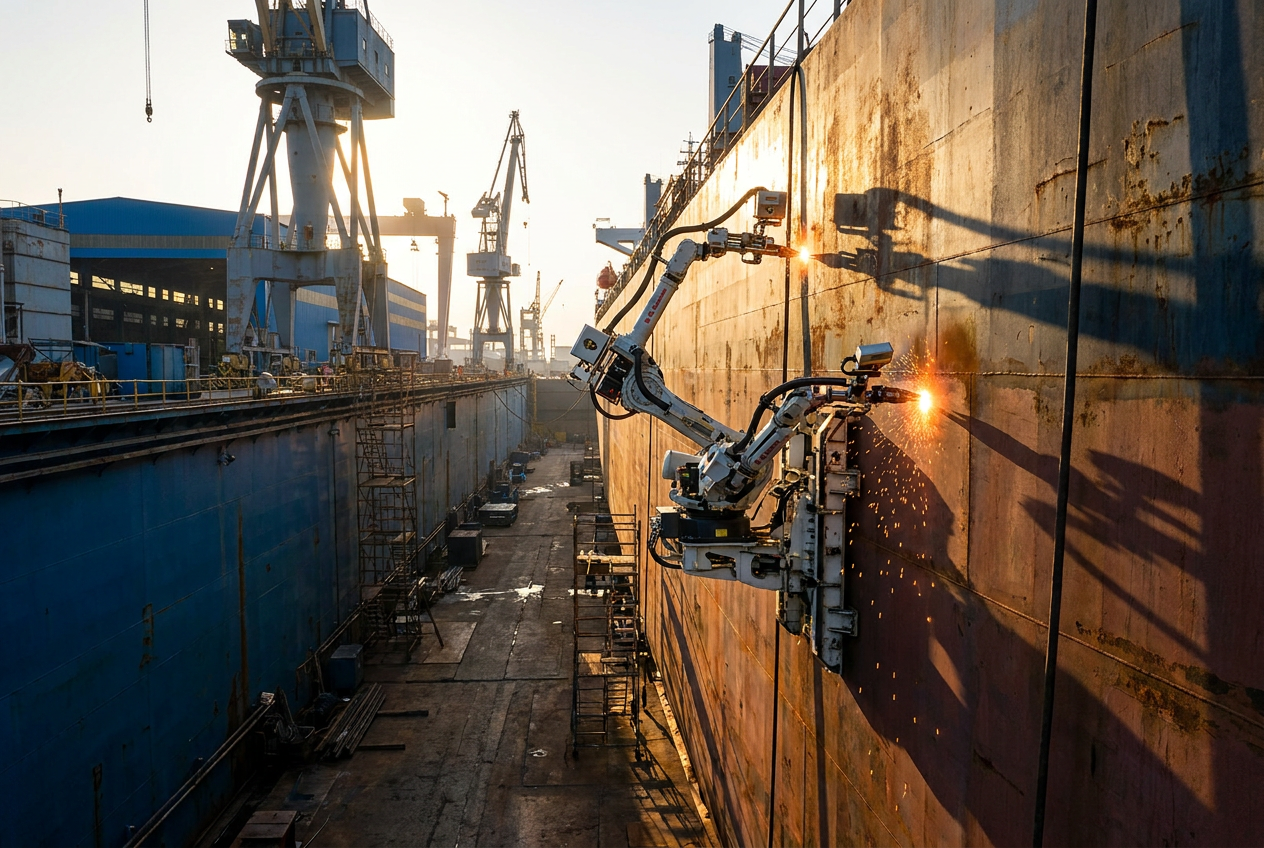
Kawasaki Heavy Industries has introduced a compact prototype robot fitted with magnetic traction and AI-based control, designed to move along steel structures and access confined areas in shipyard settings. The current unit is about two feet long, and the company’s longer-term ambition is a mature version that can carry out welding tasks or inspect welds on vertical surfaces without relying on scaffolding or other elevated access equipment. Trials are underway at Kawasaki’s Sakaide yard in Kagawa Prefecture, supported by the group’s in-house robotics capability. The launch sits within a broader corporate plan to spend $3.5 billion over four years on AI and manufacturing upgrades, alongside a wider “physical AI” program and a stated objective of deploying a general-purpose humanoid robot by 2030.
What it means for owners
For the ship repair and retrofit market, the significance of this development lies less in the prototype itself and more in what it says about future yard operating models. Owners are entering a period in which technical interventions are becoming more frequent and less discretionary. Energy-saving device retrofits, hull and appendage modifications, alternative-fuel readiness work, carbon-capture pilots, and efficiency upgrades tied to CII improvement plans are all competing for finite dock space and specialist labor. At the same time, EU ETS exposure and FuelEU Maritime compliance costs are sharpening the commercial penalty of operational inefficiency. Every additional day in yard now carries a more visible opportunity cost: off-hire, lost charter revenue, schedule disruption, and delayed emissions-performance gains. If robotic systems can reduce dependence on high-reach arrangements, speed up repetitive vertical-surface work, and improve inspection consistency, they could materially affect project economics even before full autonomy is achieved.
This matters particularly in Asia-Pacific, where yard capability remains central to the global repair and conversion supply chain. Japanese shipyards have been under pressure from workforce demographics for years, and tighter migration policy raises the risk that labor shortages become structural rather than cyclical. In that context, Kawasaki’s internal robotics competency is strategically important because it may allow faster iteration between production pain points and automation solutions than yards that must rely entirely on external vendors. South Korean builders have already established a stronger profile in robotic welding during block construction, so Kawasaki’s move can also be read as a competitive response: not simply to automate for productivity’s sake, but to protect execution capability in a market where labor availability increasingly influences yard selection.
For operators, the practical question is whether automation at the yard level can translate into better planning reliability for special surveys, steel renewals, ballast water system work, scrubber modifications, and efficiency retrofits. In theory, robotic inspection and welding support could help compress critical-path activities, improve quality traceability for class review, and reduce the setup burden around hard-to-access areas. That is especially relevant for older tonnage where condition-based decisions on steel, coating, and structural repair can expand unexpectedly once access is opened. More reliable inspection data and repeatable weld quality could reduce rework and help owners make earlier scope decisions. Over time, yards with successful robotic workflows may also become more attractive for decarbonisation-linked retrofits because they can offer greater certainty on duration, labor allocation, and safety management in congested work environments.
MaritimeNG — critical view
The strategic direction is credible, but the commercial impact should not be overstated at this stage. A two-foot prototype climbing steel surfaces in trials is still far from a production-ready system that can take on safety-critical welding or class-relevant inspection at scale. Ship repair environments are highly variable: coatings, corrosion, geometry, access restrictions, contamination, weather exposure, and interference from parallel trades all complicate robotic deployment. Demonstrating mobility is one challenge; proving repeatable performance across real repair scenarios, while integrating with yard workflows and class acceptance processes, is a much higher bar.
There is also a risk that the industry frames automation as a substitute for labor when, in the near term, it is more likely to be a force multiplier for scarce skilled workers. Welding quality, NDT interpretation, repair-method approval, and final sign-off still depend on trained personnel, supervisors, and surveyors. Unless robotics is matched by digital work packaging, workforce retraining, and class-recognized procedures, gains may remain incremental. Owners should therefore view early yard robotics as a capability differentiator, not yet as a guarantee of shorter docking windows or lower repair bills.
Verdict
Kawasaki’s climbing robot is strategically important because it addresses the real bottleneck in modern ship repair: constrained skilled labor against a rising volume of technically complex yard work. The near-term value is likely to be improved access, inspection consistency, and safer execution rather than a wholesale labor replacement, but that alone could influence how owners assess yard capability for time-sensitive repairs and decarbonisation retrofits. As these tools mature, platforms that help owners compare specialist yard competence and execution readiness will become more useful, not less.
Fundamental basis
The economic mechanics behind the facts above, grounded in Martin Stopford’s Maritime Economics. Reference only — not investment advice.
Facing a similar situation on your vessel? Model the numbers before you commit.
Open the off-hire & deviation calculatorsSource Attribution
This analytical review is based on publicly available facts originally reported by The Maritime Executive. MaritimeNG does not claim authorship of the underlying facts. Read the original publication
© 2026 MaritimeNG — Independent analytical commentary. All analysis, opinions, and forward-looking assessments are original work by MaritimeNG Editorial and may differ from those of the parties mentioned or the cited source. Factual data is restated in our own words based on publicly available information. All trademarks and trade names belong to their respective owners. This content does not constitute legal, technical, or investment advice.