Hydrogen retrofit trial highlights low-offhire route to near-term emissions gains
A successful hydrogen-assisted retrofit voyage suggests shipowners may have a practical interim option for cutting fuel use and emissions on existing diesel tonnage. The commercial relevance lies less in the novelty of hydrogen itself and more in the promise of installation without drydock, lower capex than repowering, and potential compliance support for carbon-cost exposure.
What happened
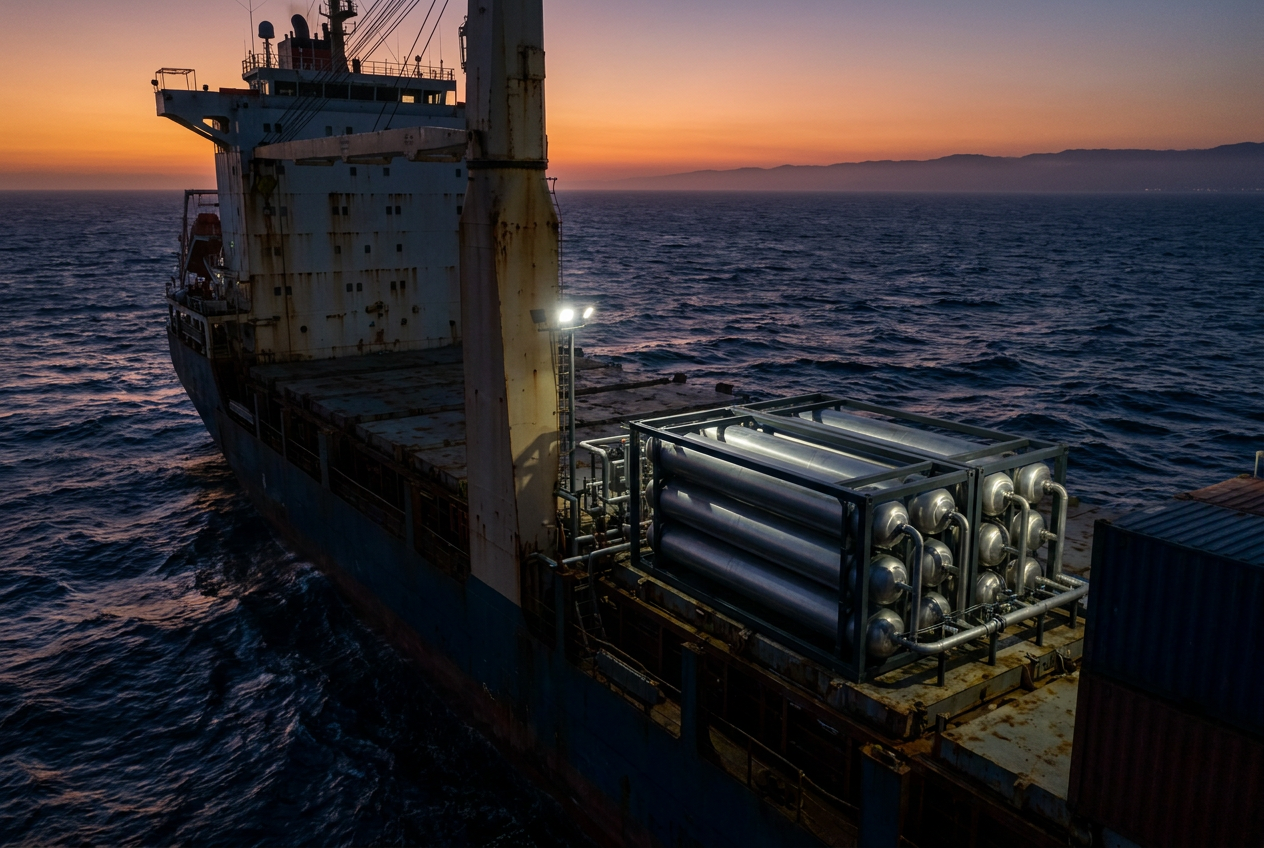
Newlight says its hydrogen injection package has completed an initial commercial voyage on Lomar Shipping’s 57,000-dwt bulk carrier Oslo Trader, sailing from Singapore to Ghana. The system was added to the vessel in under two weeks while afloat and is designed to supplement, rather than replace, a standard diesel engine by metering hydrogen into combustion through a control platform. Reported outcomes from the voyage included lower fuel consumption as well as reduced CO2 and carbon monoxide, with the engine retaining the ability to run solely on diesel when hydrogen supply is not available.
What it means for owners
For owners of mid-life bulkers, tankers and multipurpose ships, the significance of this project is straightforward: it points to a retrofit pathway that may improve carbon intensity without the balance-sheet shock of full engine replacement. That matters because many operators are now trapped between regulatory pressure and capital discipline. CII ratings are already shaping charter attractiveness and operational flexibility, while EU ETS adds a direct cost to emissions exposure on Europe-linked voyages. FuelEU Maritime, although aimed at well-to-wake intensity at the vessel energy level, further increases pressure to show a credible decarbonisation trajectory. If a retrofit can genuinely deliver double-digit fuel savings, the economics become meaningful very quickly. On a geared bulker burning, for illustration, 20-25 tonnes per day at sea, a 24% reduction would imply savings of roughly 4.8-6.0 tonnes per day. At fuel prices of US$550-650/tonne, that equates to approximately US$2,600-3,900 per day before considering any carbon-cost benefit. Add avoided CO2 exposure under EU ETS on relevant legs, and the payback discussion moves from theoretical to boardroom-relevant.
The second major implication is execution risk. Yard slots remain constrained in several repair hubs, and owners are increasingly wary of retrofits that trigger extended off-hire, steelwork complexity, or class approval cascades. A system that can be installed afloat in less than two weeks changes the decision framework. In today’s market, avoiding drydock can be nearly as important as the technology’s fuel effect because lost earnings, scheduling disruption, and berth scarcity can undermine otherwise attractive projects. For operators with vessels facing CII deterioration but not yet candidates for scrapping or full alternative-fuel conversion, a lighter-touch retrofit could become part of a portfolio response alongside weather routing, speed management, hull/propeller optimisation and energy-saving devices. It may be especially relevant for tramp sectors where trading patterns are uncertain and owners do not want to commit to a single-fuel future.
There is also a strategic fleet-management angle. Many owners know that ordering newbuildings on methanol, ammonia or LNG does little for the emissions profile of the existing fleet over the next five to ten years. Most of the world fleet will continue to run conventional engines through the 2030s. A modular hydrogen-assist solution therefore fits the industry’s practical reality: incremental decarbonisation of installed machinery. If class acceptance, crew procedures, bunkering logistics and insurance terms can be standardised, these systems could become one of several “bridge technologies” used to defend CII ratings, lower voyage costs and preserve asset competitiveness until clearer fuel pathways emerge.
MaritimeNG — critical view
The reported performance figures are encouraging, but shipowners should treat them as an early data point rather than a bankable fleet-wide assumption. One voyage on one bulker is not enough to establish repeatability across engine types, load profiles, weather conditions, fuel qualities and crew practices. The headline fuel and emissions reductions are also only one side of the equation; owners will want verified data on hydrogen consumption, total delivered energy cost, maintenance impact, combustion stability, cylinder condition, injector wear, and any effect on NOx performance or lubrication regimes. Without independent verification and a broader operating dataset, commercial underwriting will remain cautious.
Hydrogen logistics are the other major constraint. The ability to revert to diesel is operationally useful, but it also highlights the core question: how often will hydrogen actually be available at the right price and in the right ports? Storage footprint, safety systems, crew training, class notation, flag approval and charterparty allocation of costs all need to be addressed. There is also a regulatory nuance: while onboard CO2 reductions help tank-to-wake metrics, the full decarbonisation value depends on how the hydrogen is produced and accounted for under evolving compliance frameworks. If the hydrogen is expensive, carbon-intensive upstream, or difficult to source consistently, the retrofit’s theoretical advantage could narrow in real trading conditions.
Verdict
This trial suggests hydrogen-assisted retrofits deserve serious attention as a lower-disruption decarbonisation option for conventional tonnage, particularly where owners need near-term CII and carbon-cost relief without major machinery replacement. The next test is not the concept but scale: repeatable performance, class-backed deployment and reliable supply-chain execution across multiple vessels and routes.
Fundamental basis
The economic mechanics behind the facts above, grounded in Martin Stopford’s Maritime Economics. Reference only — not investment advice.
Facing a similar situation on your vessel? Model the numbers before you commit.
Open the off-hire & deviation calculatorsSource Attribution
This analytical review is based on publicly available facts originally reported by Ship & Offshore. MaritimeNG does not claim authorship of the underlying facts. Read the original publication
© 2026 MaritimeNG — Independent analytical commentary. All analysis, opinions, and forward-looking assessments are original work by MaritimeNG Editorial and may differ from those of the parties mentioned or the cited source. Factual data is restated in our own words based on publicly available information. All trademarks and trade names belong to their respective owners. This content does not constitute legal, technical, or investment advice.