HD Hyundai’s Goltens Deal Signals Scale Shift in Marine MRO
HD Hyundai Marine Solution’s planned acquisition of Goltens points to deeper consolidation in the global ship repair and maintenance market. For owners and operators, the significance lies less in the transaction itself than in what it suggests about future access to technical support, decarbonization retrofits, and lifecycle cost control.
What happened
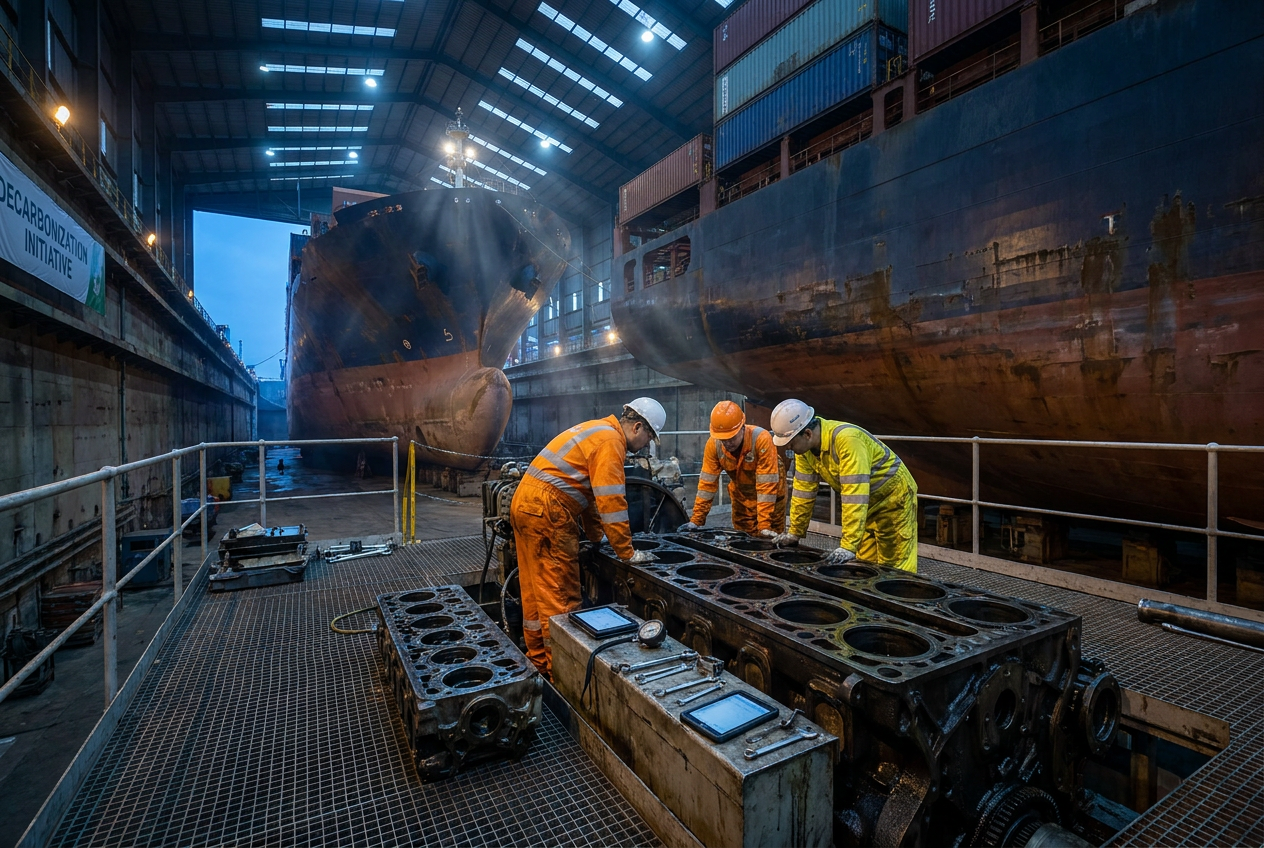
HD Hyundai Marine Solution has reached an agreement to acquire Goltens Worldwide in a deal valued at about $247 million. Goltens serves thousands of customers each year through a broad international footprint and is known for multi-brand engine overhaul and repair work across marine and adjacent industrial markets. The buyer says the combination is intended to widen service reach, strengthen engineering capability, and support emissions-related upgrades, while Goltens is expected to continue operating under its existing market-facing model after closing, which is targeted for late 2026 or early 2027.
What it means for owners
For shipowners, this transaction matters because aftermarket support is becoming a strategic variable rather than a routine procurement line. The commercial environment has shifted: operators are now balancing tightening CII expectations, rising compliance exposure under EU ETS, and the operational implications of FuelEU Maritime. In that context, maintenance quality, response time, and retrofit capability increasingly influence earnings, not just technical reliability. A vessel delayed by an engine issue, turbocharger problem, controls fault, or emissions-related underperformance can quickly lose more money through off-hire, missed laycans, and compliance inefficiency than through the repair invoice itself. A larger HMS-Goltens platform could therefore appeal to owners looking for broader geographic coverage, standardized service delivery, and better access to specialized labor across multiple engine makes.
The engine-angle is particularly important. Much of the world fleet remains dependent on conventional propulsion systems that still require disciplined overhaul planning even as owners explore fuel transitions. Two-stroke and four-stroke maintenance competence across mixed fleets is valuable where operators have diverse tonnage acquired over multiple market cycles. If the combined business can integrate spares planning, onboard diagnostics, workshop repair, riding squads, and retrofit engineering, it may reduce the fragmentation owners often face when dealing separately with OEMs, local workshops, and voyage repair contractors. That could be useful in a market where yard slots remain constrained in some regions, drydock schedules are under pressure, and class-driven maintenance windows leave little room for slippage. Owners increasingly need providers that can complete work afloat, during short port stays, or in conjunction with compliance retrofits to avoid losing revenue days.
There is also a wider MRO market implication. Independent service providers have occupied an important space between OEM control and local repair flexibility, especially for mature fleets where cost discipline matters. By buying a recognized independent specialist, HMS appears to be strengthening its position in lifecycle services rather than relying solely on newbuilding-linked relationships. That reflects where value is moving: fleet age profiles, emissions retrofits, digital performance monitoring, and condition-based maintenance are all pushing service revenue higher up the strategic agenda. For operators, the practical question is whether this kind of consolidation results in more resilient support networks and stronger technical execution, or whether it gradually reduces competitive tension in pricing and service choice. In the near term, the acquisition underscores that maintenance providers with global scale and decarbonization-adjacent engineering are becoming more important as compliance and reliability pressures converge.
MaritimeNG — critical view
The strategic logic is clear, but execution risk should not be understated. Cross-border service acquisitions often promise network benefits that prove difficult to realize at workshop level, where outcomes depend on local talent retention, parts availability, and field-service responsiveness. Goltens’ value has historically rested on its reputation as an independent, practical problem-solver across multiple brands and fleet types. Maintaining that identity under new ownership will be critical. If decision-making becomes more centralized or if customers perceive even subtle bias toward affiliated ecosystems, some of the acquired goodwill could erode.
There is also a broader market concern. Consolidation can improve investment capacity, but it can also narrow the field for owners who rely on independent technical options to benchmark cost and scope against OEM channels. The decarbonization narrative should be viewed carefully as well: stronger service reach does not automatically solve the economics of compliance. Owners still face hard capital allocation choices around retrofit payback, fuel uncertainty, and regulatory volatility. A larger MRO platform helps with execution, but it does not remove the underlying commercial risk of investing in assets whose compliance pathway may still change.
Verdict
This is a meaningful move in the evolution of marine aftermarket services, with potential benefits for owners seeking broader support across maintenance, repair, and emissions-related upgrades. The real test will be whether the enlarged platform delivers faster execution, preserved independence, and measurable lifecycle value in a market where technical downtime and compliance costs are now tightly linked; that is precisely the kind of shift maritime service buyers should monitor closely.
Fundamental basis
The economic mechanics behind the facts above, grounded in Martin Stopford’s Maritime Economics. Reference only — not investment advice.
Facing a similar situation on your vessel? Model the numbers before you commit.
Open the off-hire & deviation calculatorsSource Attribution
This analytical review is based on publicly available facts originally reported by The Maritime Executive. MaritimeNG does not claim authorship of the underlying facts. Read the original publication
© 2026 MaritimeNG — Independent analytical commentary. All analysis, opinions, and forward-looking assessments are original work by MaritimeNG Editorial and may differ from those of the parties mentioned or the cited source. Factual data is restated in our own words based on publicly available information. All trademarks and trade names belong to their respective owners. This content does not constitute legal, technical, or investment advice.