HD Hyundai-Kiewit JV Signals a New Gulf Coast Yard Strategy
A proposed Gulf Coast shipyard backed by HD Hyundai and Kiewit points to a more strategic U.S. industrial play than a simple greenfield expansion. If executed well, it could influence vessel construction capacity, module supply, and eventually the repair ecosystem across the Jones Act and government-linked markets.
What happened
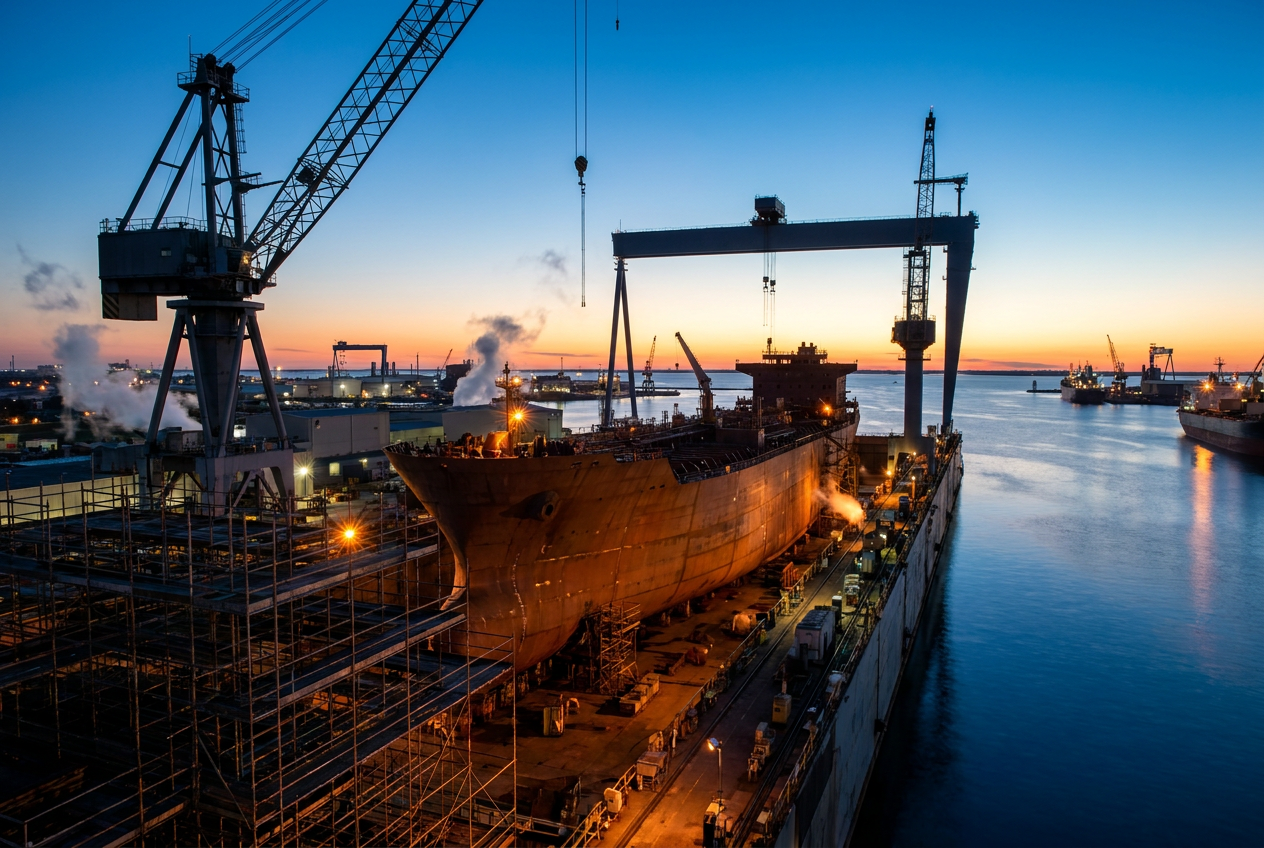
HD Hyundai and Kiewit Maritime have formed a joint venture, HD Kiewit Shipbuilding, to pursue a new shipyard development on an established industrial waterfront site in the U.S. Gulf Coast region. The project is aimed at starting construction in 2027 and reaching full operating status in 2029, with potential employment of roughly 3,000 people. The venture is expected to target naval support vessels, commercial ship opportunities, and block or module production for domestic builders, while applying HD Hyundai’s digitalized shipyard operating model and potentially widening the partnership into broader maritime infrastructure work.
What it means for owners
For shipowners and operators, the most important takeaway is not simply that another U.S. yard may be coming, but that it is being framed around industrial efficiency, modular production, and a likely closer alignment with national shipbuilding priorities. The U.S. market has struggled for years with constrained yard throughput, long lead times, and elevated build and repair costs relative to Asian competitors. Those pressures are especially visible in Jones Act segments, government-chartered tonnage, and specialized work where domestic content rules sharply limit owner choice. A Gulf Coast facility with deepwater access and modern production logic could start to relieve part of that bottleneck, particularly if it becomes a meaningful source of blocks, modules, and pre-outfitted sections for other U.S. builders rather than trying to solve every capacity problem within a single yard footprint.
That matters directly to the repair and maintenance market because newbuild congestion and repair congestion are often linked. When domestic yards are overloaded, owners face harder decisions around docking windows, service life extensions, conversion work, and compliance retrofits. Delayed yard access translates into longer off-hire exposure, higher positioning costs, and in some cases deferred technical work that later becomes more expensive. If the new venture can carve out disciplined production capacity for commercial hulls, naval auxiliaries, or major subassemblies, some existing U.S. yards may be able to rebalance their mix toward repair, sustainment, and emergency work. Even a modest improvement in slot availability can be meaningful in markets where owners are already juggling drydock schedules around charter commitments, crewing constraints, and regulatory deadlines.
The Gulf Coast angle is also significant. This is one of the most commercially active maritime regions in North America, with heavy traffic linked to energy, chemicals, offshore services, inland-coastal trades, and military logistics. A large, technology-led yard in that geography could become a magnet for adjacent services: steel processing, marine systems integration, coatings, automation, propulsion support, and aftermarket engineering. Over time, that can strengthen the regional repair cluster as much as the construction market itself. There is also a policy dimension. Washington has become more focused on industrial resilience, domestic sealift readiness, and rebuilding strategic maritime capacity. In that context, a Hyundai-backed operation is not just another corporate expansion; it is a test of whether global shipbuilding know-how can be localized within U.S. labor, procurement, and security frameworks. If successful, it could sharpen competitive pressure on incumbent domestic yards to modernize workflows, improve schedule reliability, and adopt more data-driven production practices rather than relying on scarcity-driven pricing and long order books.
MaritimeNG — critical view
That said, this announcement should not be mistaken for an immediate solution to U.S. shipyard shortages. A targeted 2029 operating horizon means owners and operators facing today’s repair backlog, retrofit demand, and naval maintenance strain should not expect near-term relief. New yards also tend to encounter the same realities that challenge existing ones: skilled labor shortages, supply-chain variability, inflation in steel and equipment, permitting complexity, and the difficulty of ramping from a promising industrial concept to repeatable on-time delivery. The gap between a well-positioned waterfront site and a fully functioning, high-productivity yard is large.
There is also a strategic question about market focus. Naval auxiliaries, commercial vessels, and module fabrication each require different commercial rhythms, customer relationships, and production disciplines. A yard that tries to cover too much too early can dilute execution. Moreover, importing advanced yard methods from a leading Asian builder is not the same as reproducing Asian cost competitiveness in the United States. Domestic labor structures, regulatory obligations, and localized supply chains will still define the economics. The venture may improve U.S. capability and resilience, but it is unlikely to erase the structural cost gap with top-tier Asian yards.
Verdict
This is a serious industrial move with longer-term implications for U.S. shipbuilding depth, Gulf Coast maritime clustering, and eventually repair-market flexibility. The real measure of success will be whether the venture converts technological ambition into dependable capacity that owners, operators, and service partners can plan around—exactly the kind of market shift MaritimeNG readers should monitor closely.
Fundamental basis
The economic mechanics behind the facts above, grounded in Martin Stopford’s Maritime Economics. Reference only — not investment advice.
Facing a similar situation on your vessel? Model the numbers before you commit.
Open the off-hire & deviation calculatorsSource Attribution
This analytical review is based on publicly available facts originally reported by The Maritime Executive. MaritimeNG does not claim authorship of the underlying facts. Read the original publication
© 2026 MaritimeNG — Independent analytical commentary. All analysis, opinions, and forward-looking assessments are original work by MaritimeNG Editorial and may differ from those of the parties mentioned or the cited source. Factual data is restated in our own words based on publicly available information. All trademarks and trade names belong to their respective owners. This content does not constitute legal, technical, or investment advice.