Hanwha’s Austal USA Bid Signals a New US Naval Yard Consolidation Phase
Hanwha Ocean’s offer for Austal USA is more than a corporate acquisition attempt: it is a test case for how far the United States will welcome foreign-backed capital into strategic shipbuilding. For commercial operators and naval support markets alike, the implications center on repair capacity, schedule reliability and the future geography of high-value yard work.
What happened
Hanwha Ocean has submitted a preliminary proposal to acquire Austal USA from Austal Ltd. for between USD 1.0 billion and USD 1.2 billion, according to a filing in Australia. Austal USA operates from Mobile, Alabama, where it employs more than 3,000 people across a large shipbuilding site, and it also runs a repair operation in San Diego. The business is deeply embedded in US defense work, including contracts tied to submarine modules and other Navy programs. Hanwha already has a foothold in the US through its 2024 purchase of Philly Shipyard, where it has since outlined a USD 5 billion expansion plan. The move follows Hanwha’s unsuccessful attempt in 2024 to buy Austal’s parent company, and it comes just days before a White House directive widened the scope for foreign shipyards to participate in US Navy shipbuilding, a policy shift that lifted investor expectations for Hanwha and other international naval builders.
What it means for owners
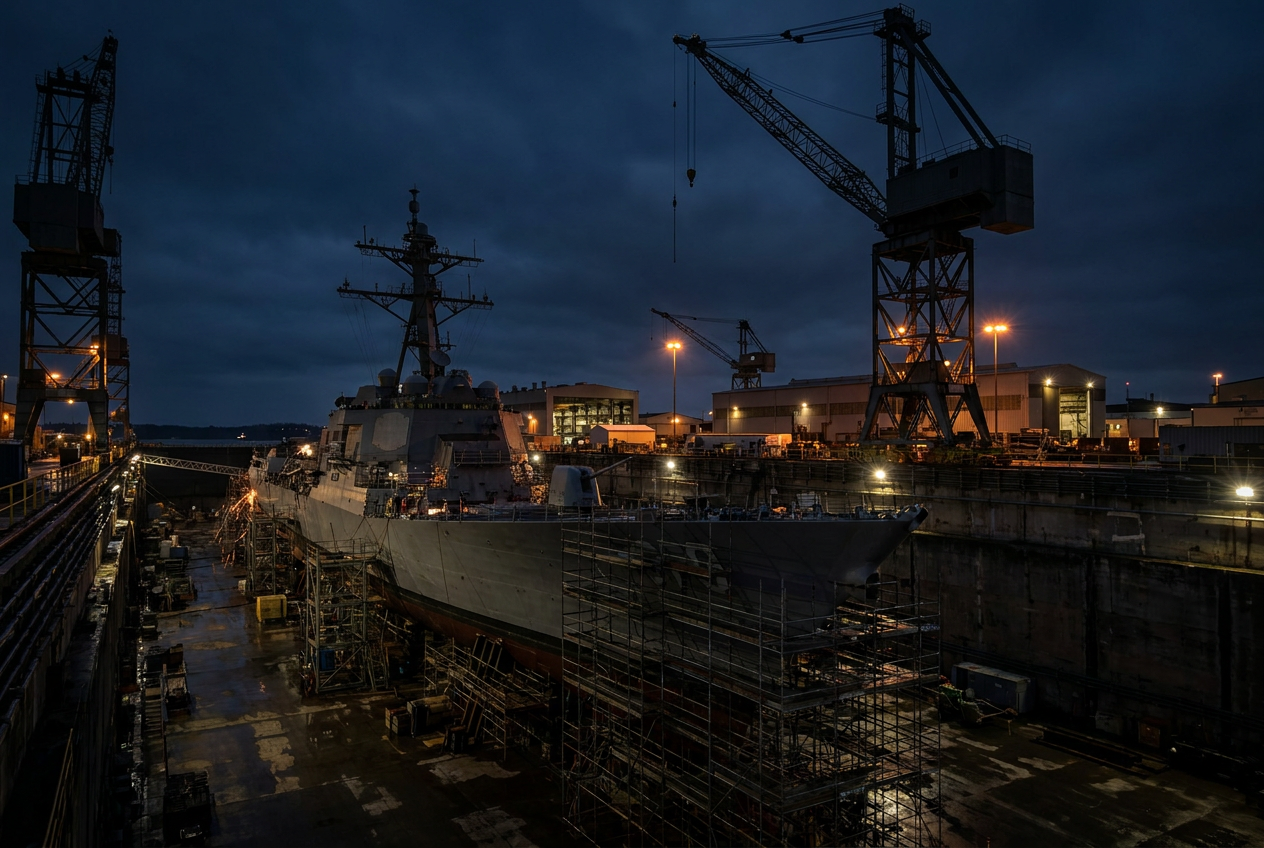
For shipowners and operators, the immediate relevance of this transaction is not the ownership story itself but what it says about the coming shape of US repair and construction capacity. The United States has been operating with a structurally tight yard base for both naval and commercial tonnage, particularly on the repair side where dry-dock access, labor availability and specialist subcontractor bandwidth remain recurring causes of delay. If Hanwha succeeds in adding Austal USA to Philly Shipyard, it would control a broader footprint spanning newbuild, naval work and repair access on both the Gulf and East Coast, with a further service presence in San Diego. That matters because operators increasingly price yard selection through an off-hire lens: every missed slot, prolonged steel renewal and delayed machinery package has a direct earnings consequence. In today’s market, yard reliability can be as commercially important as the headline repair quote.
A larger Hanwha-controlled US platform could, in theory, improve throughput by importing Korean production disciplines, procurement leverage and program management practices into a capacity-constrained US environment. Yet owners should be cautious about assuming this automatically translates into more commercial slots. Austal USA’s defense exposure is substantial, and submarine-related work in particular tends to consume scarce skilled labor, waterfront access and management attention. If US naval demand intensifies under the new policy environment, commercial vessels may still find themselves competing for dock space and trades against higher-priority government work. That would reinforce a pattern many operators already face in North America: routine maintenance stretching into longer off-hire periods, with knock-on effects for charter commitments, repositioning costs and voyage planning. The strategic issue is therefore not just whether more capital enters US shipbuilding, but whether that capital creates genuinely incremental repair availability for merchant fleets.
The broader geopolitical context also matters. Washington’s willingness to open naval construction to foreign yards reflects an uncomfortable reality: the domestic industrial base has struggled to scale fast enough for strategic demand. South Korean groups, supported by strong state-linked financing and deep naval engineering capabilities, are now positioned to convert that gap into long-term influence. For owners trading into US-regulated markets, this could gradually improve access to technically sophisticated retrofits, including energy-efficiency upgrades linked to CII performance and emissions compliance planning. However, that benefit is not guaranteed. EU ETS exposure, fuel-transition retrofits and efficiency projects already compete for yard windows globally, and a re-prioritization of US capacity toward defense could keep commercial decarbonization work expensive and slow. In that sense, Hanwha’s bid is part of a larger reordering of yard economics: security policy, industrial policy and environmental compliance are converging, and operators will need to secure repair and retrofit strategies earlier, with more geographic flexibility, than they did in the pre-pandemic era.
MaritimeNG — critical view
There is a strong strategic logic behind Hanwha’s pursuit of Austal USA, but the policy framing deserves scrutiny. Foreign ownership of US yards is not, by itself, a threat to American industrial capability if assets, jobs and know-how are expanded domestically. The harder question is whether acquisitions simply reshuffle control of scarce facilities without fixing the underlying shortages in labor, dry docks and supplier depth. If the answer is mostly financial consolidation, the commercial market may see little practical relief.
There is also a tension between political enthusiasm for allied participation and the warning from US shipbuilders that work could be displaced rather than grown. That concern should not be dismissed as protectionism alone. For the US to benefit, foreign-backed owners must be judged on whether they add durable domestic capacity, train workers and improve delivery performance inside the country. Otherwise, operators and taxpayers alike may discover that strategic urgency has produced higher valuations and louder headlines without materially shortening repair queues or reducing schedule risk.
Verdict
Hanwha’s bid is strategically credible and may prove transformative if it leads to real capacity expansion inside the US rather than mere portfolio growth. For operators, the key metric is simple: whether this deal ultimately creates faster, more dependable repair and retrofit access in a market where every extra day off-hire now carries outsized commercial and compliance costs.
Fundamental basis
The economic mechanics behind the facts above, grounded in Martin Stopford’s Maritime Economics. Reference only — not investment advice.
Facing a similar situation on your vessel? Model the numbers before you commit.
Open the off-hire & deviation calculatorsSource Attribution
This analytical review is based on publicly available facts originally reported by The Maritime Executive. MaritimeNG does not claim authorship of the underlying facts. Read the original publication
© 2026 MaritimeNG — Independent analytical commentary. All analysis, opinions, and forward-looking assessments are original work by MaritimeNG Editorial and may differ from those of the parties mentioned or the cited source. Factual data is restated in our own words based on publicly available information. All trademarks and trade names belong to their respective owners. This content does not constitute legal, technical, or investment advice.