Gabon FSU Conversion Highlights LNG Carrier Reuse Economics
Lloyd's Register is supporting the conversion of an LNG carrier into a floating storage unit for Gabon's Cap Lopez gas development, with work under way in Dubai. The project illustrates why owners are increasingly turning to midlife LNG tonnage for stationary infrastructure roles where schedule, capital discipline and flare-reduction goals align.
What happened
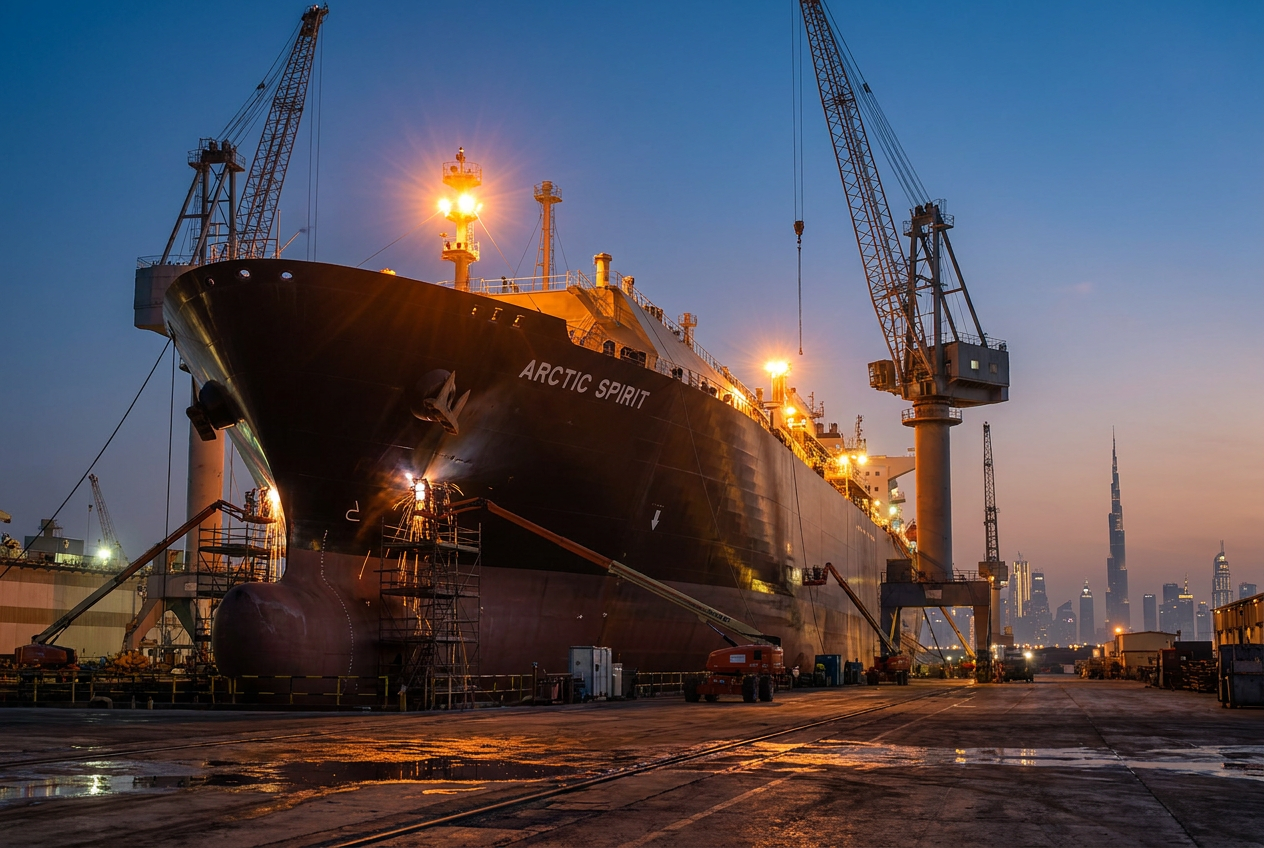
Lloyd's Register is delivering classification, plan approval, surveys and technical assurance for the conversion of the LNG carrier Bayelsa, temporarily renamed FSU LNG Cap Lopez, at Drydocks World Dubai. The unit is being converted for Dixstone Lower Gulf FZCO, affiliated with Perenco, and will serve an offshore gas project in Gabon. The scope includes structural steel work, piping modifications, boil-off gas system integration and broader life-extension measures intended to support gas utilisation and curb routine flaring.
What it means for owners
This project sits squarely at the intersection of LNG shipping cycles and upstream gas monetisation strategy. Converting an existing LNG carrier into an FSU can be materially cheaper and faster than commissioning a purpose-built floating storage asset, especially when the end use is stationary storage linked to offshore production rather than long-haul marine transport. For developers, the appeal is not only lower initial capex but also reduced execution risk, provided the chosen hull has sufficient remaining technical life and compatible cargo-containment characteristics. In markets where associated gas has historically been underutilised or flared, an FSU can become a practical bridge between field development and downstream demand, enabling gas capture, storage and phased infrastructure build-out. That broader logic is especially relevant for projects framed around energy efficiency and flare reduction, because the commercial case is strengthened when environmental compliance and resource recovery advance together.
The yard scope described here is more complex than the phrase conversion might initially suggest. Steel renewal and structural modifications indicate the vessel is being adapted not merely cosmetically but functionally for a different duty profile, likely with revised loading patterns, stationary mooring assumptions, fatigue considerations and updated safety cases. New piping systems and boil-off gas module integration are central to operational reliability, because stationary LNG storage requires stable cargo handling, vapour management and compatibility with whatever export or utilisation chain the offshore project adopts. Life-extension work is equally important. A successful FSU conversion is not just about making an older carrier usable on day one; it is about extending safe service over a commercially meaningful period while controlling maintenance exposure. That requires careful inspection, renewal prioritisation and a class-led framework for assessing hull condition, machinery suitability, containment system performance and regulatory compliance. Lloyd's Register's role in design review, survey activity and technical oversight is therefore not procedural window dressing but a core project-control function.
From a commercial standpoint, however, the economics are never one-dimensional. Off-hire during conversion can be significant, and timing matters greatly if the LNG carrier market is firm, because each month in dock represents foregone trading optionality. Owners and project sponsors must balance yard time, conversion cost, class requirements and future operating profile against the residual value of the asset in conventional LNG transport. Yard selection also becomes strategic. Complex LNG conversions require cryogenic handling knowledge, heavy modification capability, disciplined project management and strong interface coordination among class, owner, designers and module suppliers. Drydocks World Dubai's selection suggests the premium placed on established conversion capacity able to manage substantial structural and systems integration work. More broadly, the project supports the view that demand for FSUs is being driven by stranded gas commercialisation, import and export flexibility, tighter emissions expectations and the need for lower-cost floating infrastructure. At the same time, momentum behind LNG carrier conversions will remain sensitive to vessel age profiles, containment technology, charter-rate strength and whether developers value speed-to-market over bespoke optimisation.
MaritimeNG — critical view
The strategic rationale is persuasive, but LNG carrier-to-FSU conversions should not be romanticised as universally efficient. They can absorb substantial hidden cost through steel growth, interface redesign, containment-related remediation, ageing machinery issues and schedule creep once the vessel is opened up in dock. For projects justified partly on flare reduction and energy efficiency, the operational chain after conversion matters as much as the asset itself: boil-off management, uptime, mooring reliability and integration with offshore gas handling will determine whether the environmental promise translates into measurable performance.
There is also a broader market question. If interest in conversions continues to rise, the industry may begin bidding up suitable steam and TFDE candidates, narrowing the cost advantage versus purpose-built alternatives in some cases. That would force a more selective view of reuse economics. The winners will be projects where the field development schedule, hull condition, class strategy and local gas monetisation plan are tightly aligned; the losers may be those that treat conversion as an inherently cheaper shortcut rather than a technically demanding industrial retrofit.
Verdict
The Gabon FSU scheme is a credible example of how older LNG carriers can be redeployed to unlock gas value with lower capital intensity and faster delivery, but its success will depend on disciplined execution in dock and robust long-term operability offshore.
Fundamental basis
The economic mechanics behind the facts above, grounded in Martin Stopford’s Maritime Economics. Reference only — not investment advice.
Facing a similar situation on your vessel? Model the numbers before you commit.
Open the off-hire & deviation calculatorsSource Attribution
This analytical review is based on publicly available facts originally reported by Ship & Offshore. MaritimeNG does not claim authorship of the underlying facts. Read the original publication
© 2026 MaritimeNG — Independent analytical commentary. All analysis, opinions, and forward-looking assessments are original work by MaritimeNG Editorial and may differ from those of the parties mentioned or the cited source. Factual data is restated in our own words based on publicly available information. All trademarks and trade names belong to their respective owners. This content does not constitute legal, technical, or investment advice.