EU-Backed Ammonia Retrofits Signal a New Test Case for VLAC Decarbonisation
EU funding support for Maersk Tankers’ ammonia-retrofit plan moves alternative-fuel shipping from concept toward execution in a demanding deep-sea vessel segment. For owners and operators, the project matters less as a one-off grant win than as a live commercial test of retrofit timing, compliance economics and technical risk allocation.
What happened
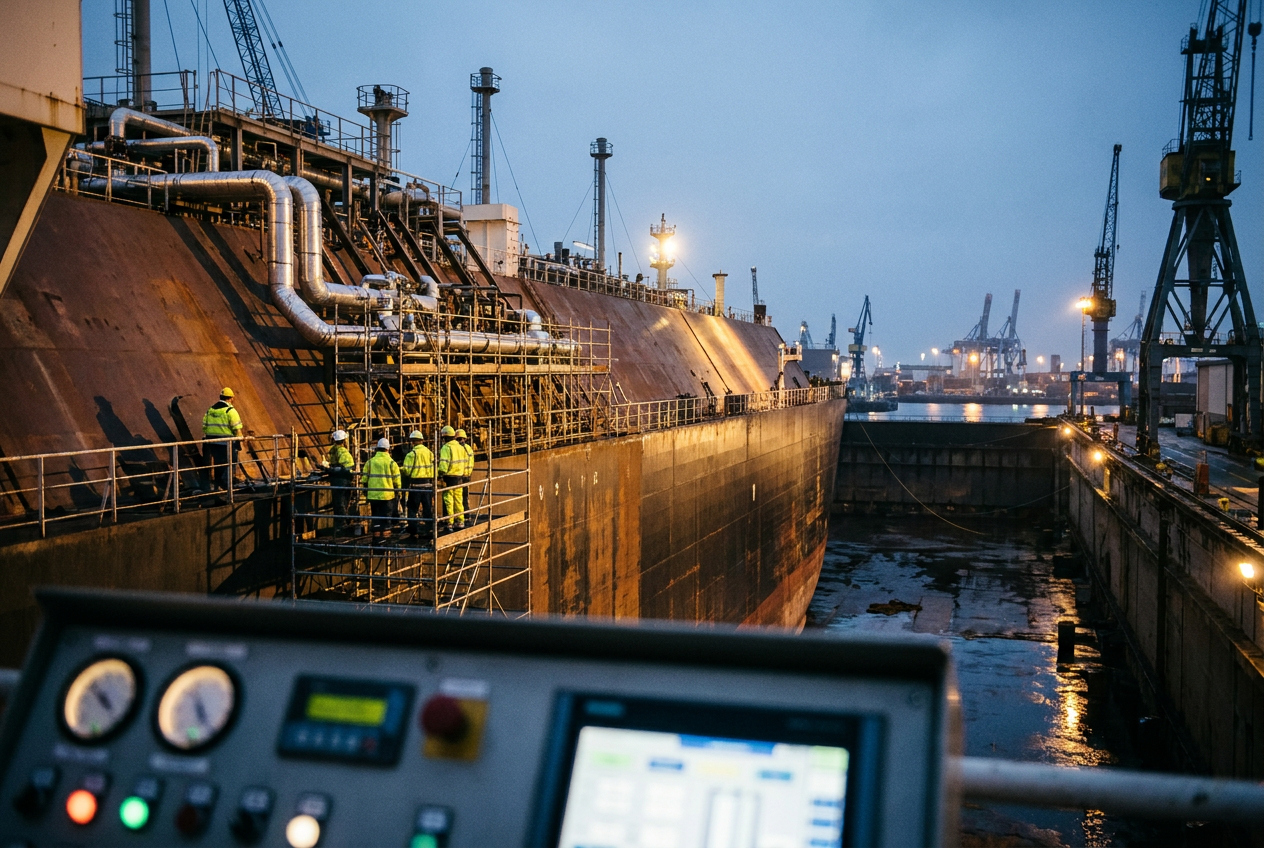
Maersk Tankers has secured support from the EU Innovation Fund for a program to convert four very large ammonia carriers to operate with ammonia-capable dual-fuel main engines. The project is positioned as an early European retrofit demonstration for ocean-going ships in this class, with the stated objective of proving that ammonia can be used in commercial service while reducing lifecycle greenhouse-gas exposure over the coming decade.
What it means for owners
For shipowners, the significance of this award lies in what it says about the next phase of decarbonisation: the industry is moving beyond ordering a small number of newbuild alternative-fuel vessels and toward testing whether existing assets can be economically converted. That distinction matters. Large owners are carrying fleets with useful remaining life, but they also face rising pressure from IMO carbon intensity metrics, charterer scrutiny and regional regulation. A successful ammonia retrofit pathway could extend asset life while improving CII performance, especially for trades where vessel speed and cargo systems already limit operational flexibility. If a retrofit can materially lower well-to-wake and tank-to-wake emissions exposure, it gives owners another lever besides slow steaming, voyage optimisation and partial technical upgrades.
The European policy context is equally important. EU ETS already imposes a direct cost on emissions for voyages touching Europe, and FuelEU Maritime adds a separate compliance burden based on greenhouse-gas intensity. Together, they are reshaping investment calculations. Owners now have to compare the capital cost and downtime of a major machinery conversion against a multi-year stream of carbon costs, possible penalties, and the commercial discount attached to weaker environmental performance. For some operators, especially in specialised segments such as ammonia carriers, the equation may increasingly favour deep retrofits if the vessels are young enough and their trade pattern exposes them materially to European regulation. Public funding can narrow the viability gap, but the larger takeaway is that regulatory certainty is beginning to unlock real engineering decisions.
That said, execution will determine whether projects like this scale. Retrofitting a large tanker or gas carrier for ammonia propulsion is not a routine engine swap. It brings redesign of fuel handling, storage, ventilation, safety systems, control architecture and crew procedures, all under class approval and likely with close flag-state scrutiny. Yard time is a major commercial variable: every additional week off-hire can erode the projected benefit, particularly in specialised tonnage where earnings can be cyclical and availability is tight. Yard capacity itself is another constraint. Many established repair yards are already balancing ballast water projects, scrubber work, life-extension programs and increasingly complex energy-efficiency retrofits. Owners considering ammonia conversions will need early slot booking, detailed prefabrication strategies and disciplined interface management between OEMs, class and yard teams.
There is also a portfolio-management angle. Demonstration projects give owners data on fuel consumption, maintenance impact, crew competency requirements and charterer acceptance. That information is strategically valuable because future fleet decisions will hinge not only on headline emissions reduction but on real operating reliability and claims exposure. If this project can show manageable off-hire, acceptable capex control and a clear compliance advantage under EU rules, it may influence retrofit pipelines well beyond the ammonia-carrier niche. If it struggles on those metrics, owners may conclude that efficiency upgrades, methanol pathways or waiting for newbuild replacement remain lower-risk choices.
MaritimeNG — critical view
The industry should avoid reading this funding decision as proof that ammonia retrofits are commercially settled. A grant reduces financing pressure, but it does not resolve the fundamental issues of fuel availability, delivered fuel cost, toxicity management, and the practical difficulty of building a dependable bunkering network at the ports that matter to trading patterns. In addition, the climate case for ammonia depends heavily on how the fuel is produced. If low-carbon supply remains scarce or expensive, the compliance story may look better on paper than in fleet-wide economics.
There is also a risk that first-mover projects receive disproportionate attention relative to their reproducibility. A technically sophisticated owner with policy support, access to top-tier engineering resources and relatively modern vessels operates under conditions that are not universal across the tanker market. Smaller owners may face a very different risk-return profile, especially if lenders, insurers and charterers remain cautious. The test is not whether one project can be made to work with public backing, but whether the model can survive normal commercial conditions.
Verdict
This is a strategically important pilot because it puts retrofit economics, not just decarbonisation ambition, under real-world scrutiny. If the project delivers credible compliance savings without excessive downtime or technical compromise, it will become a reference point for owners assessing major conversion options and for repair markets tracking where future high-value retrofit demand may emerge.
Fundamental basis
The economic mechanics behind the facts above, grounded in Martin Stopford’s Maritime Economics. Reference only — not investment advice.
Facing a similar situation on your vessel? Model the numbers before you commit.
Open the off-hire & deviation calculatorsSource Attribution
This analytical review is based on publicly available facts originally reported by The Maritime Executive. MaritimeNG does not claim authorship of the underlying facts. Read the original publication
© 2026 MaritimeNG — Independent analytical commentary. All analysis, opinions, and forward-looking assessments are original work by MaritimeNG Editorial and may differ from those of the parties mentioned or the cited source. Factual data is restated in our own words based on publicly available information. All trademarks and trade names belong to their respective owners. This content does not constitute legal, technical, or investment advice.