DNV Case Study Strengthens Retrofit Economics for Midlife 5,000-TEU Boxships
A DNV assessment of a 2013-built 5,000-TEU containership suggests that combining hull and propulsive upgrades can produce a compelling commercial return at the vessel’s next major drydocking. For owners facing efficiency regulation and volatile bunker costs, the study reinforces that hydrodynamic retrofits are increasingly a balance-sheet decision, not just a decarbonisation gesture.
What happened
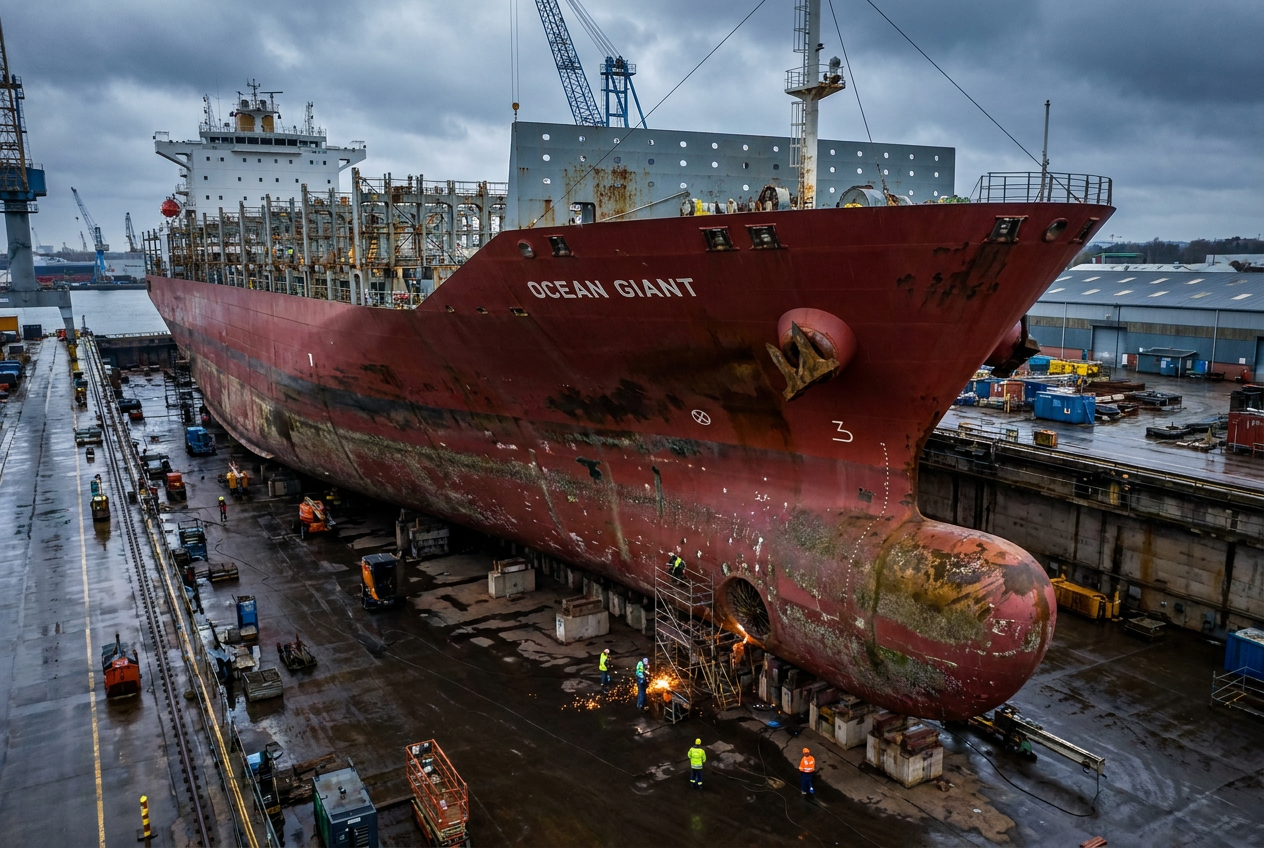
DNV examined a midlife 5,000-TEU container vessel and found that a package combining bow changes, a new propeller solution and a propeller boss cap fin could cut fuel use by roughly one-sixth. The estimated capital requirement was about USD 2.35 million, with the economics improving markedly if the work is executed during the ship’s scheduled 15-year docking in early 2028 so that no additional off-hire is created. Based on low-sulphur fuel price ranges seen in Singapore between early 2024 and April 2026, DNV calculated a return period of roughly one to four years and cumulative discounted fuel savings through 2038 of around USD 2 million to USD 10 million, assuming the vessel meets EEXI requirements after the retrofit. The work was presented within DNV’s Energy Transition Outlook.
What it means for owners
For containership owners, the central takeaway is that retrofit economics are shifting from marginal to strategic, especially for vessels entering their second half of life. A 16% reduction in fuel consumption on a 5,000-TEU ship is material in any freight market, but it becomes far more valuable under today’s layered cost regime. Lower fuel burn does not only reduce the bunker bill; it also cuts exposure to EU ETS allowance purchases on voyages touching Europe and reduces the compliance burden under FuelEU Maritime where greenhouse-gas intensity increasingly carries a financial consequence. Even for operators not primarily deployed in Europe, a vessel-level efficiency gain of this scale can support stronger CII outcomes, protect charter attractiveness and reduce the need to rely solely on speed reduction as the main compliance lever. That matters because slow steaming can preserve ratings but may erode network integrity, slot utilisation and schedule reliability in liner trades.
The timing element is just as important as the savings estimate. DNV’s finding that the package can be aligned with the 15-year drydock without adding off-hire is commercially significant. For many owners, off-hire is what kills otherwise rational retrofit projects. If a ship is already due for steel work, coatings, class surveys and machinery overhaul, adding hydrodynamic measures during that same yard window can transform the investment case. However, this requires procurement and engineering discipline well ahead of docking. A six-month lead time should be treated as a minimum rather than a comfort margin, especially where owners need model testing, detailed design approval, class review, propeller manufacturing slots and yard steelwork planning. With repair yard capacity still uneven across Asia, the Mediterranean and parts of the Middle East, late planning can lead to either premium pricing or compromised scope.
There is also a portfolio-management implication. A USD 2.35 million retrofit with a one- to four-year payback is likely to compare favourably with many alternative decarbonisation expenditures available to operators of conventionally fuelled midlife ships. Full alternative-fuel conversion for this size segment is still capital-intensive and operationally uncertain in many trades due to tank volume penalties, fuel availability and residual-value risk. By contrast, hydrodynamic and propulsion upgrades are technology-mature, class-familiar and immediately monetisable. Fleet managers should therefore view such projects not as isolated technical improvements but as capex filters: which ships have enough remaining employment visibility, route profile and charter potential to justify intervention, and which should instead be run with minimal capital until disposal? The answer will differ vessel by vessel, but DNV’s numbers indicate that for a 2013-built feeder or regional mainline asset with another decade of commercial life, retrofit screening should now be standard practice.
MaritimeNG — critical view
The business case is persuasive, but owners should be careful not to universalise one vessel study across an entire class or fleet. Actual savings from bow reshaping and propulsive upgrades depend heavily on draft profile, speed range, hull condition, weather routing, port congestion patterns and whether the vessel operates above or below its original design assumptions. A ship trading at persistently reduced speed may not capture the same return as one operating closer to a higher service-speed envelope. Equally, the headline fuel-price sensitivity cuts both ways: attractive payback under stronger bunker markets can lengthen sharply if fuel prices soften and carbon costs develop more slowly than expected on the ship’s trade lane.
Another underappreciated issue is execution risk. Structural modification at the bow is not a plug-and-play efficiency device; it requires sound engineering, yard workmanship, accurate baseline performance data and post-retrofit validation. Owners also need to weigh interaction effects with other planned investments such as energy-saving devices, air lubrication, engine derating or digital voyage optimisation. Poorly sequenced upgrades can dilute returns or complicate class approval and docking schedules. The wider industry sometimes focuses on technical savings percentages while underestimating data quality, retrofit integration and contract management, which are often the real determinants of whether projected value turns into bankable performance.
Verdict
DNV’s case study provides a credible signal that midlife containership retrofits can now clear both regulatory and financial hurdles when timed with mandatory docking windows. For owners willing to plan early and manage execution tightly, hydrodynamic upgrades look less like discretionary efficiency spending and more like disciplined asset optimisation; that is precisely where transparent yard and supplier evaluation becomes commercially important.
Fundamental basis
The economic mechanics behind the facts above, grounded in Martin Stopford’s Maritime Economics. Reference only — not investment advice.
Facing a similar situation on your vessel? Model the numbers before you commit.
Open the off-hire & deviation calculatorsSource Attribution
This analytical review is based on publicly available facts originally reported by Ship & Offshore. MaritimeNG does not claim authorship of the underlying facts. Read the original publication
© 2026 MaritimeNG — Independent analytical commentary. All analysis, opinions, and forward-looking assessments are original work by MaritimeNG Editorial and may differ from those of the parties mentioned or the cited source. Factual data is restated in our own words based on publicly available information. All trademarks and trade names belong to their respective owners. This content does not constitute legal, technical, or investment advice.