Damen’s Shipdock Deal Deepens Dutch Repair Capacity at a Critical Time
Damen’s purchase of Shipdock adds two Dutch yards to its repair and conversion network at a moment when owners face tighter environmental rules, expensive off-hire and limited dock availability. The deal matters less as a headline M&A event than as a signal that regional repair infrastructure is becoming strategically valuable again.
What happened
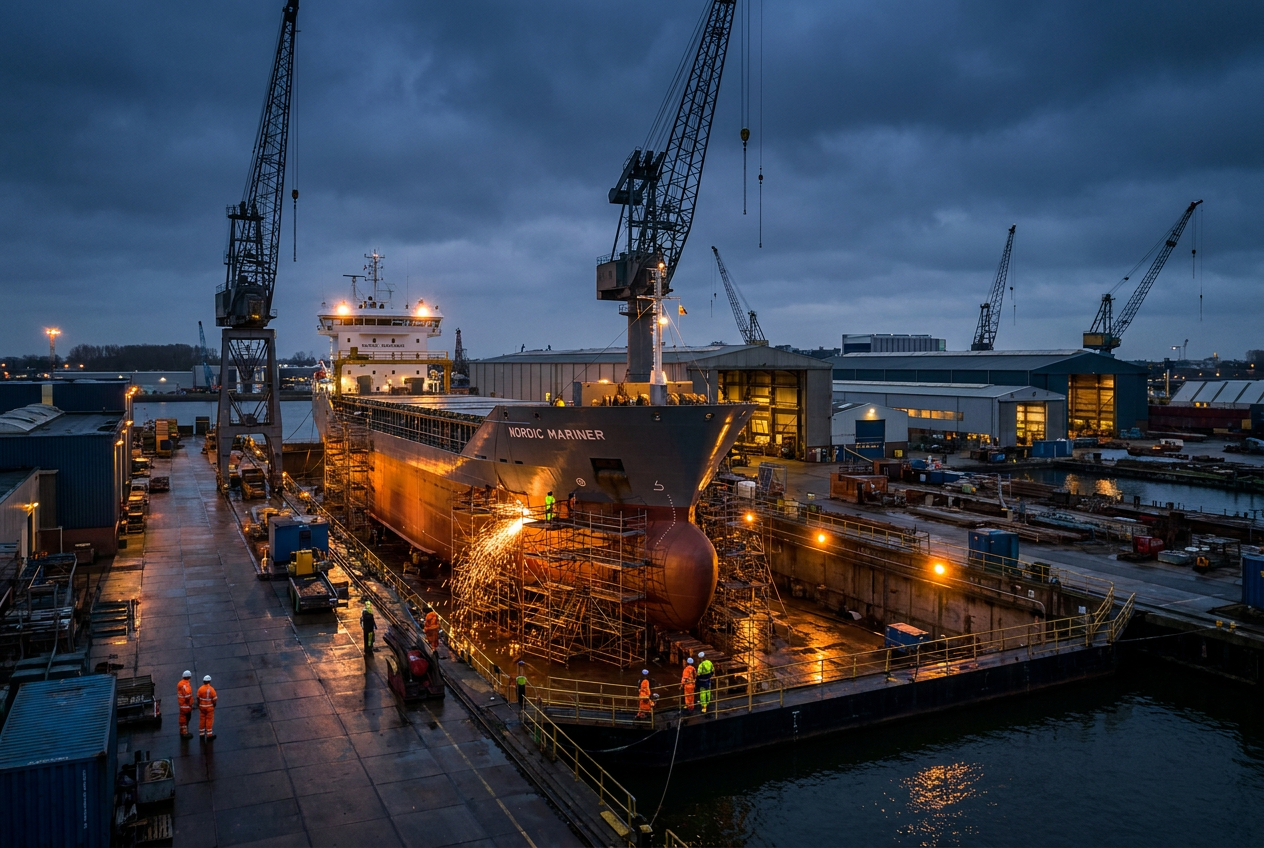
Damen Shipyards Group has taken over the Dutch repair and conversion company Shipdock, bringing the Amsterdam and Harlingen facilities into its wider repair business. Shipdock, a long-established yard operator, will remain under its current management and workforce, adding roughly 130 employees to Damen’s organisation. The two sites expand Damen’s domestic ability to handle maintenance, steelwork, conversions and repair work across a vessel-size range that stretches from smaller ships in Harlingen to larger units in Amsterdam.
What it means for owners
For shipowners and operators, the practical importance of this transaction lies in access, timing and execution risk rather than corporate branding. European repair slots have become more strategically important as operators try to align drydocking schedules with regulatory and commercial deadlines. CII performance pressure is pushing many fleets to consider efficiency upgrades during planned yard stays, while EU ETS and FuelEU Maritime are turning fuel consumption and voyage optimisation into direct cost items rather than abstract compliance targets. In that context, a yard is no longer just a place to complete statutory work; it is increasingly a platform for deciding whether to invest in energy-saving devices, hull and propeller optimisation, alternative fuel readiness, shore power interfaces or broader conversion packages. A larger, more integrated Dutch repair footprint may therefore appeal to owners who want to bundle class renewals, machinery work and emissions-related retrofits into one coordinated docking window.
The off-hire economics are equally important. A delayed repair period can erase the value of a technical upgrade if a vessel misses a favourable charter market or loses schedule integrity in liner or offshore support trades. By adding capacity in both Amsterdam and Harlingen, Damen improves its ability to offer location flexibility within the Netherlands, which could help reduce queue risk for some segments. That matters because many owners now face a difficult capex calculation: spend on retrofits to protect earnings and compliance, or defer investment and risk worsening CII scores, higher carbon costs and weaker charter attractiveness. The more predictable the yard slot and project management, the easier it becomes to justify retrofit spending. This is especially relevant for owners of mid-life tonnage that still has commercial runway but needs selective technical upgrades rather than full fleet renewal.
There is also a broader market signal here. Repair capacity in North-West Europe is not infinite, and demand is being reshaped by special survey cycles, ballast water system work, scrubber maintenance, steel renewal and decarbonisation retrofits. Owners have already seen that class-related work can become more complex when paired with emissions upgrades, electrical integration and supply-chain delays for specialist components. A group with multiple repair locations and central coordination may be better placed to sequence labour, engineering and procurement resources across projects. For operators, that could translate into fewer fragmented vendor interfaces and tighter control over docking duration. In a market where every additional day alongside has a measurable earnings impact, that operational discipline may prove more valuable than any headline about scale alone.
MaritimeNG — critical view
That said, acquisitions do not automatically solve the underlying constraints in European ship repair. Integration often looks straightforward on paper, especially when existing management remains in place, but the real test is whether commercial alignment, procurement systems, workforce planning and project governance improve without disrupting yard responsiveness. Owners will judge the outcome on docking lead times, change-order control, labour availability and redelivery reliability, not on the strategic narrative.
There is also a risk of overstating how much additional capacity this brings to the market. Two yards strengthen regional coverage, but they do not remove the structural pressures created by ageing fleets, complex retrofit scopes and a finite pool of skilled repair labour. Moreover, many owners are becoming more selective about retrofit capex because regulatory uncertainty remains around technology pathways and long-term fuel choices. If owners hesitate on major conversions, some anticipated repair and upgrade demand could shift from large transformation projects toward narrower compliance and life-extension work. In that scenario, the value of the deal will depend on execution flexibility across mixed project types, not simply on expanded physical footprint.
Verdict
This acquisition is best understood as a capacity and capability play in a repair market where time, compliance and engineering coordination increasingly shape vessel economics. For shipowners, the key question is not who owns the yard, but whether the added network can deliver faster, more reliable docking and retrofit outcomes in a tightening regulatory environment—a theme MaritimeNG will continue to track closely.
Fundamental basis
The economic mechanics behind the facts above, grounded in Martin Stopford’s Maritime Economics. Reference only — not investment advice.
Facing a similar situation on your vessel? Model the numbers before you commit.
Open the off-hire & deviation calculatorsSource Attribution
This analytical review is based on publicly available facts originally reported by Ship & Offshore. MaritimeNG does not claim authorship of the underlying facts. Read the original publication
© 2026 MaritimeNG — Independent analytical commentary. All analysis, opinions, and forward-looking assessments are original work by MaritimeNG Editorial and may differ from those of the parties mentioned or the cited source. Factual data is restated in our own words based on publicly available information. All trademarks and trade names belong to their respective owners. This content does not constitute legal, technical, or investment advice.