Colombo Dockyard’s Q2 rebound highlights repair-led recovery over shipbuilding
Colombo Dockyard moved back into profit in Q2 2026, driven primarily by a strong recovery in ship repair activity and tighter cost control. The result suggests improving operational discipline, although the underlying picture remains mixed because top-line growth is still absent and shipbuilding has not yet turned the corner.
What happened
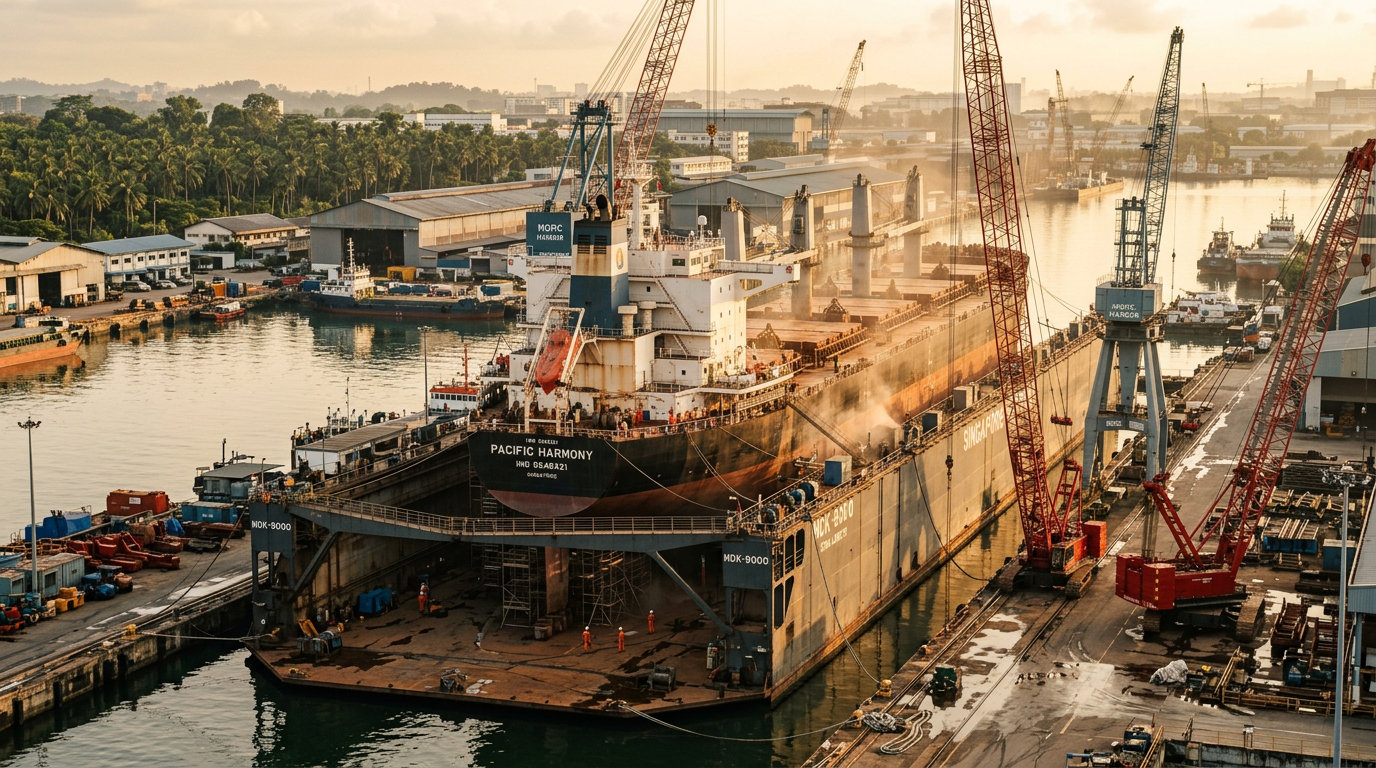
In the quarter ended in 2026, Colombo Dockyard reported profit after tax of LKR 80.2 million, reversing a heavy deficit of LKR 813.4 million recorded in the comparable period a year earlier. Turnover slipped 6.8% to LKR 5.84 billion, yet the company materially improved earnings because direct operating expenses were cut by 21.8%, lifting margins. Repair work was the clear driver: income from that segment rose 48.4% to LKR 3.95 billion and gross profit from repairs expanded sharply. The shipbuilding business remained in the red, but its loss was reduced from the previous year. Management said the company is concentrating on competitiveness and on collaboration with Mazagon Dock Shipbuilders, while ending the quarter with cash holdings of LKR 8.48 billion. The yard’s position along major Indian Ocean trade lanes remains one of its core structural advantages.
What it means for owners
The importance of this result lies less in the absolute size of the profit and more in what it reveals about where value is currently being created in South Asian shipyard markets. Colombo Dockyard’s recovery was repair-led, not volume-led. Revenue declined, but profitability improved because the mix shifted toward higher-contribution work and because costs were brought down aggressively. That is a familiar pattern across the regional repair industry: when yards are close to dense shipping lanes, they can generate better economics from short-cycle, technically focused repair and retrofit jobs than from lower-margin, longer-duration construction contracts. Colombo’s location near the main east-west Indian Ocean trunk route is therefore not just a geographic talking point; it is a monetizable operational advantage. For shipowners, every day of off-hire has a measurable earnings cost, especially for tankers, container ships and gas carriers trading on tight schedules. A yard that can reduce deviation distance, shorten waiting time and complete work within a predictable slot can win business even if its quoted price is not the lowest in Asia.
This matters in the current repair market because demand is no longer driven only by class renewals and emergency docking. Compliance-related work is becoming a structural source of yard demand. Carbon Intensity Indicator improvement measures, hull and propeller optimization, energy-saving device installation, ballast system follow-up work, and broader efficiency retrofits are all feeding repair pipelines across Asia. Colombo Dockyard appears well positioned to capture a portion of this market if it can combine its location with dependable slot availability and competent execution. The mention of cooperation with Mazagon Dock Shipbuilders is also strategically relevant: beyond any direct project flow, such a relationship could strengthen technical depth, procurement leverage and customer confidence, especially for defense-adjacent or specialized commercial work. Still, the persistence of losses in shipbuilding shows that capacity utilization and contract quality remain uneven across the broader business.
Competition, however, remains intense. Colombo is not competing in a vacuum; it faces established repair ecosystems in Singapore, Dubai, western India, and increasingly cost-competitive yards in China and parts of Southeast Asia. Singapore retains a premium for complex jobs and marine services density, while Indian yards are gaining relevance for regional fleets and Chinese yards benefit from industrial scale and integrated supply chains. That means Colombo’s comparative advantage must be sharpened around turnaround time, niche capability, and commercial reliability rather than headline dock capacity alone. If the yard can use its cash reserves to sustain working capital discipline, selectively upgrade repair infrastructure and deepen retrofit capability linked to emissions efficiency, the latest quarter may mark the start of a credible repositioning as an Indian Ocean repair hub. But if cost gains prove temporary or if yard congestion limits throughput, the recovery could remain fragile.
MaritimeNG — critical view
The market should be careful not to overstate this turnaround. A profit of LKR 80.2 million after a very weak comparative period is a meaningful improvement, but it is still modest relative to the company’s revenue base and does not yet prove that earnings quality has fundamentally normalized. The most encouraging feature is the strength in repair, yet the concern is that the overall top line still contracted. That implies the company has not fully solved the challenge of broad-based revenue growth, and it may still be relying on favorable segment mix and cost compression rather than on a fully rebuilt order and service pipeline. In cyclical yard businesses, cost reductions can quickly flatter one quarter and fade in the next if pricing pressure returns or if labor and material costs rise.
There is also a strategic question around capital allocation. Strong cash reserves are reassuring, but cash on the balance sheet is only valuable if it is deployed in ways that widen the yard’s moat. Colombo Dockyard must decide whether to prioritize repair capacity expansion, specialized retrofit capability, digital planning systems, or support for the weaker shipbuilding segment. Trying to defend all fronts at once would be risky given the competitive landscape. The partnership narrative with Mazagon Dock is promising, yet such cooperation needs to translate into concrete commercial outcomes, technical transfer, or procurement efficiencies to matter. Investors and industry watchers should therefore focus less on the headline swing to profit and more on whether the next few quarters show sustained repair margin resilience, improved slot utilization, and a clearer strategic separation between the economics of repair and shipbuilding.
Verdict
Colombo Dockyard’s quarter is best read as an operationally credible repair-market recovery rather than a full corporate reset. If execution holds and retrofit demand linked to fleet efficiency continues to rise, the yard could strengthen its place in the Indian Ocean service map, a trajectory MaritimeNG readers will recognize as increasingly important in regional yard competition.
Fundamental basis
The economic mechanics behind the facts above, grounded in Martin Stopford’s Maritime Economics. Reference only — not investment advice.
Facing a similar situation on your vessel? Model the numbers before you commit.
Open the off-hire & deviation calculatorsSource Attribution
This analytical review is based on publicly available facts originally reported by Ship & Offshore. MaritimeNG does not claim authorship of the underlying facts. Read the original publication
© 2026 MaritimeNG — Independent analytical commentary. All analysis, opinions, and forward-looking assessments are original work by MaritimeNG Editorial and may differ from those of the parties mentioned or the cited source. Factual data is restated in our own words based on publicly available information. All trademarks and trade names belong to their respective owners. This content does not constitute legal, technical, or investment advice.