Cochin’s Q2 shows how mixed yards can squeeze repair availability
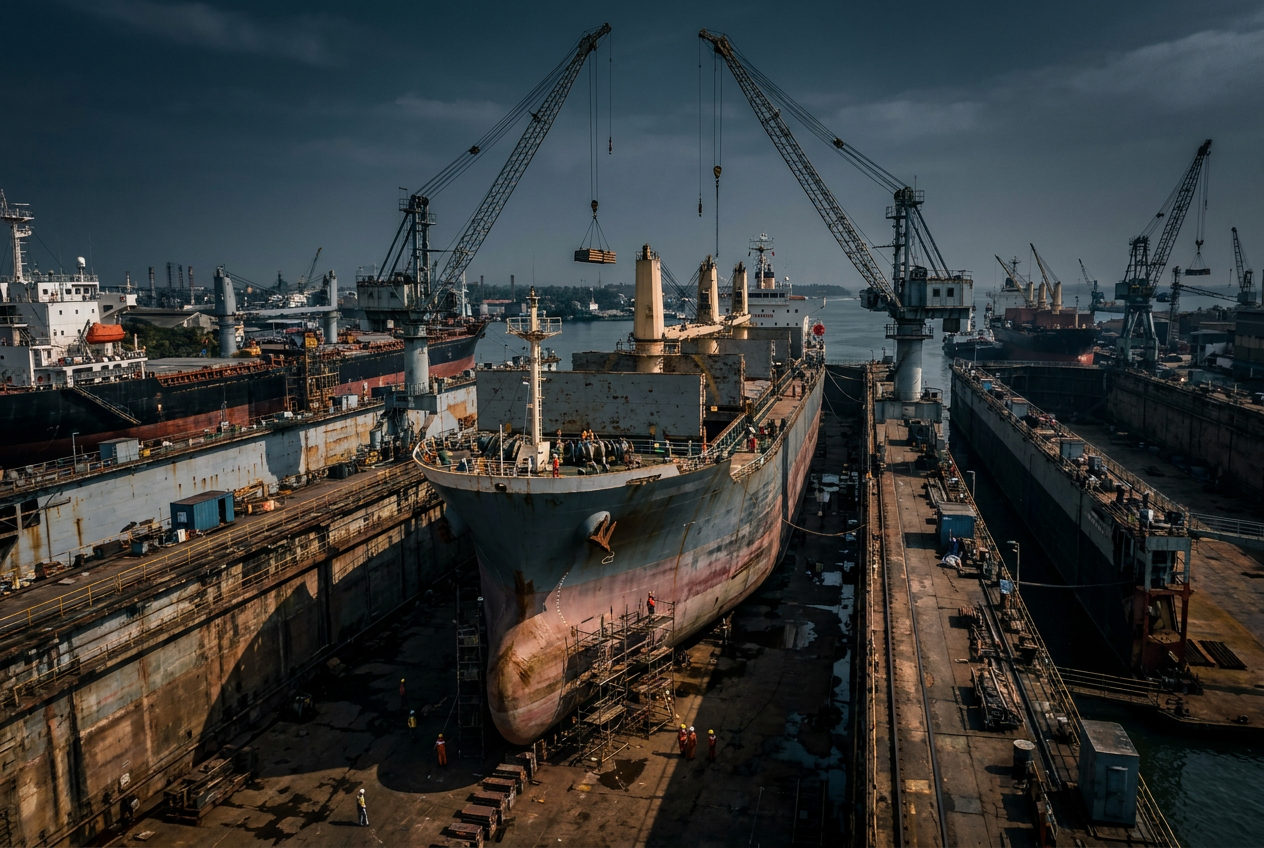
Cochin Shipyard’s latest quarterly figures underline a recurring issue in Asia-Pacific: when a yard serves both newbuilding and repair, repair throughput can weaken even if the wider business remains resilient. For shipowners, the result is a reminder that yard selection is increasingly about slot certainty, turnaround discipline and lifecycle compliance planning, not headline pricing alone.
What happened
For the quarter ended 30 June 2026, Cochin Shipyard reported earnings pressure despite a modest rise in overall operating income. Revenue edged up to INR 10.94 billion, but net profit slipped to INR 1.51 billion and EBITDA fell to INR 1.93 billion, reducing margin to 17.7%. The contrast between divisions was stark: shipbuilding expanded strongly, with revenue reaching INR 7.0 billion and profit rising to INR 638.9 million, while ship repair contracted sharply, with turnover dropping to INR 3.94 billion and segment profit declining to INR 1.35 billion. Total costs also moved higher to INR 9.59 billion, reflecting increased material and financing burdens.
What it means for owners
For owners and operators, the most important takeaway is not simply that one Indian yard had a weak repair quarter. It is that the economics of mixed yards remain structurally uneven. Newbuilding programs often consume berth space, engineering attention, procurement bandwidth and labor planning in ways that can crowd out repair work, particularly repairs requiring fast docking windows and flexible execution. When shipbuilding momentum strengthens, repair can become the balancing item in capacity allocation. That matters to operators because repair demand is typically time-sensitive: every additional day off-hire can outweigh any nominal discount secured on yard rates. In practical terms, a yard with rising shipbuilding utilization may still be technically capable of repairs, but less able to guarantee the schedule certainty that owners need for drydocking, steel renewal, machinery overhauls and retrofits.
India’s repair market has long sat in an interesting middle position within Asia-Pacific. It offers geographic relevance for vessels trading the Arabian Sea, Indian coast, Gulf routes and parts of East Africa, and it can be commercially attractive relative to some Northeast Asian options. But the market still competes against highly organized repair ecosystems in Singapore, the UAE, China and, for selected vessel classes, yards in Sri Lanka and elsewhere. The challenge is not just price; it is predictability. Operators increasingly choose repair locations based on end-to-end execution risk: pre-docking surveys, class coordination, spares logistics, workshop depth, subcontractor reliability and redelivery discipline. A quarter like this may prompt some owners to ask whether Indian yards can consistently ring-fence repair resources when higher-profile shipbuilding work is expanding.
There is also a regulatory dimension. CII-related efficiency measures, hull and propeller performance work, energy-saving device installations, ballast system upkeep and selective emissions-related modifications are all generating a more continuous stream of technical interventions between major drydockings. That should be supportive of regional repair demand overall, even if it does not appear evenly in every quarter. For operators, this means yard strategy must become more segmented. Routine docking and voyage-linked repairs may still fit well in India when trading patterns align, but projects with tight commercial exposure, major retrofit complexity or limited schedule tolerance may require yards with stronger evidence of dedicated repair capacity. The broader lesson is that repair procurement is becoming more strategic: owners should evaluate not only quote levels, but berth access, labor resilience, steel and equipment lead times, class interface quality and realistic redelivery performance under peak yard utilization.
MaritimeNG — critical view
A decline of more than a third in repair revenue is too large to dismiss as routine timing noise, even in a business where project recognition can be lumpy. It suggests either materially lower docking volume, weaker work content per vessel, execution delays, or a shift in yard mix toward activities that are less favorable for repair throughput. The simultaneous strength in shipbuilding strengthens the argument that internal prioritization may be part of the story. In mixed yards, repair customers are often exposed to an invisible risk: they buy a docking slot, but not always full protection from competing internal demands.
That said, it would be premature to treat this as proof of a broad collapse in Indian repair demand. Regional repair fundamentals remain supported by aging fleets, compliance-linked upgrades and the commercial need to reduce fuel penalties from poor hull condition. The more careful interpretation is that India’s opportunity is intact, but execution consistency remains decisive. For operators relying on Indian yards, the risk is less about technical capability and more about schedule assurance, supply-chain coordination and the possibility that repair programs become secondary when other yard segments outperform.
Verdict
Cochin’s quarter is a useful industry signal: in today’s market, repair demand may be structurally sound, but access to dependable repair capacity is not guaranteed where shipbuilding is accelerating. Owners calling at Indian yards should plan earlier, test slot credibility harder and compare total off-hire risk alongside headline yard cost.
Fundamental basis
The economic mechanics behind the facts above, grounded in Martin Stopford’s Maritime Economics. Reference only — not investment advice.
Facing a similar situation on your vessel? Model the numbers before you commit.
Open the off-hire & deviation calculatorsSource Attribution
This analytical review is based on publicly available facts originally reported by Ship & Offshore. MaritimeNG does not claim authorship of the underlying facts. Read the original publication
© 2026 MaritimeNG — Independent analytical commentary. All analysis, opinions, and forward-looking assessments are original work by MaritimeNG Editorial and may differ from those of the parties mentioned or the cited source. Factual data is restated in our own words based on publicly available information. All trademarks and trade names belong to their respective owners. This content does not constitute legal, technical, or investment advice.