Cochin-Synergy pact targets India’s next phase in commercial repair and conversion
Cochin Shipyard’s new cooperation agreement with Synergy Marine Group is more than a bilateral tie-up: it signals India’s intent to move deeper into commercially relevant repair, retrofit and complex conversion work. For shipowners, the development matters because yard access, retrofit timing and project execution quality are becoming core determinants of regulatory cost and fleet earnings.
What happened
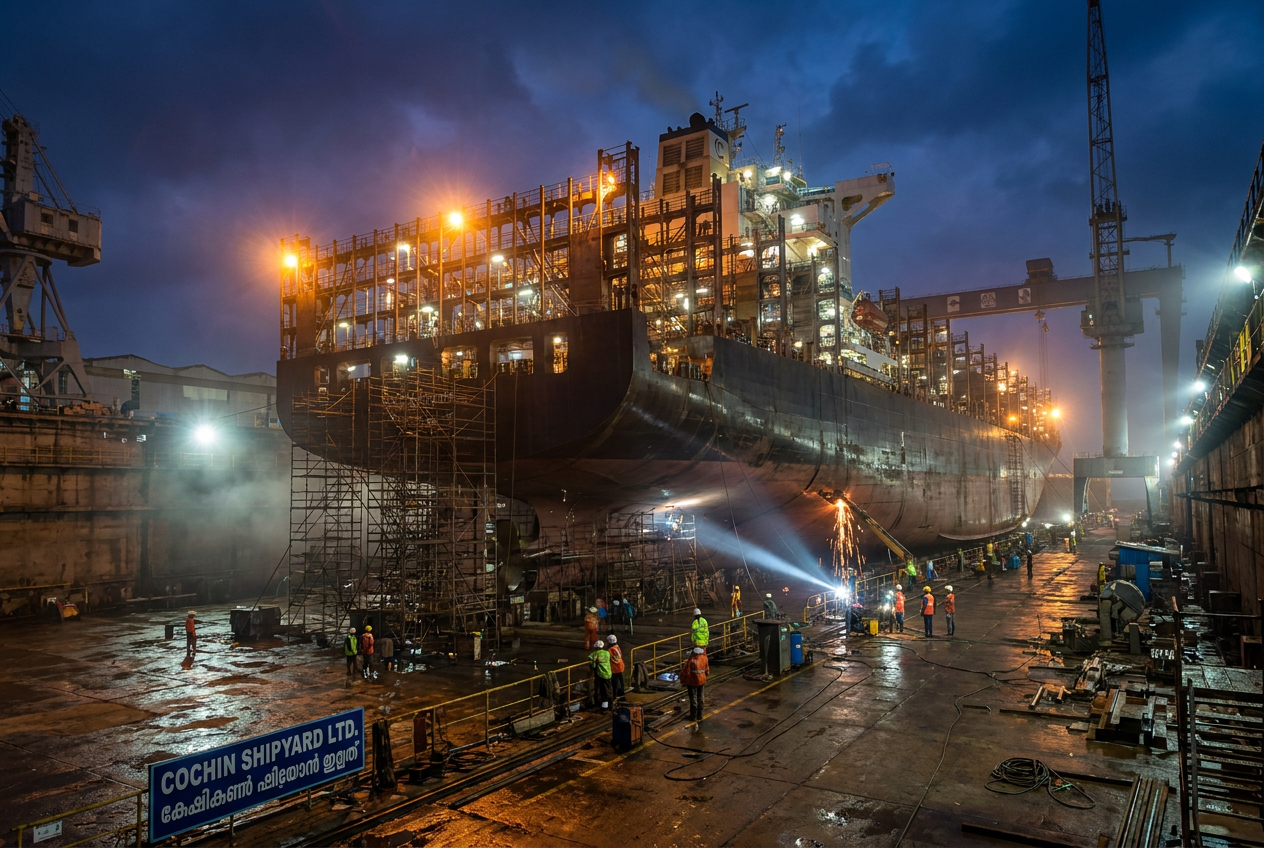
Cochin Shipyard Limited has entered into a memorandum of understanding with Synergy Marine Group to pursue commercial opportunities across vessel repair, conversion, new construction, fabrication work and selected energy-related projects in India. The arrangement also includes advisory input for Cochin’s shipbuilding programs, drawing on Synergy’s track record in newbuilding oversight and technically demanding projects such as floating regasification conversions, while Cochin continues broadening its commercial orderbook and international partnerships.
What it means for owners
For shipowners and operators, the significance of this agreement lies less in the signing itself than in what it suggests about India’s attempt to become a more credible alternative in the regional yard map. The commercial repair and conversion market is tightening under multiple pressures at once. Owners are no longer booking yard time solely for routine drydocking; they are increasingly combining statutory surveys with energy-efficiency retrofits, alternative-fuel readiness work, ballast water system optimization, shore power preparations, hull upgrades and digital performance installations. That changes the economics of yard selection. A repair yard now needs not only steel and dock capacity, but also engineering discipline, supply-chain reliability, class coordination and the ability to execute package retrofits within a narrow off-hire window. If the Cochin-Synergy partnership can improve project planning and execution confidence, it could make India more relevant for owners seeking another option beyond the heavily booked yards in China, Singapore and the Middle East.
That matters because regulatory cost exposure is now directly linked to technical downtime decisions. For many owners trading into Europe, EU ETS and FuelEU Maritime are turning fuel performance into a near-cash operating issue rather than a medium-term ESG discussion. A vessel with weaker carbon intensity or fuel compliance economics cannot simply wait indefinitely for an ideal retrofit slot. Delays to propeller upgrades, energy-saving devices, voyage optimization hardware, auxiliary system modifications or even major conversion decisions can translate into higher compliance cost, weaker charter appeal and poorer CII outcomes. On paper, adding another repair and conversion platform in India could relieve some of the bottleneck. In practice, owners will look for evidence that Cochin can absorb more sophisticated scopes without schedule slippage, variation-order disputes or prolonged commissioning periods that extend off-hire. In today’s freight markets, an extra week in yard can easily wipe out part of the projected savings from an efficiency retrofit.
There is also a strategic newbuilding angle. Synergy’s experience in owner-side supervision and multi-yard project management could be useful if Cochin aims to move from domestically significant output to more repeatable export-grade commercial production. Shipowners placing feeder, tanker or gas-adjacent orders increasingly scrutinize not just contract price, but yard learning curve, vendor ecosystem, QA culture and post-delivery defect response. Cochin’s earlier international feeder vessel breakthrough was important symbolically, but repeat business in export markets depends on whether India can prove predictable schedule adherence and quality consistency across series construction. The same applies to conversions. LNG-related modifications and FSRU work require integration capability, interface management and close class engagement; these are not activities that scale on infrastructure alone. If this tie-up helps Cochin build a stronger execution model around engineering control and owner communication, the commercial upside for operators could be meaningful: more optionality, potentially lower yard concentration risk, and another geography for combining regulatory retrofits with statutory docking plans.
MaritimeNG — critical view
The industry should still treat the agreement as an early-stage signal rather than a proven capacity addition. An MoU is not a committed orderbook, nor does it automatically solve the hardest parts of commercial yard development: specialist labor availability, vendor localization, equipment lead times, class-interface maturity and disciplined subcontractor management. Many yards can market conversion ambition; fewer can execute high-complexity retrofit packages on time when steel, electrical, automation and commissioning scopes overlap under real commercial pressure.
There is also a competitiveness question. India’s opportunity is real, but owners will benchmark Cochin against established Asian and Gulf yards that already offer scale, integrated repair clusters and strong procurement ecosystems. To shift owner behavior, Cochin will need to demonstrate not only cost competitiveness but also lower execution risk. The first few projects emerging from this cooperation will therefore matter more than the headline itself. If delivery performance is uneven, owners may continue to view India as promising but not yet core for time-sensitive commercial work.
Verdict
This partnership is strategically sensible because it links industrial capacity with owner-facing project experience at a time when repair and retrofit decisions are becoming central to fleet competitiveness. For shipowners, the real test will be whether Cochin can convert that framework into dependable delivery, because in the current compliance and earnings environment, optionality only has value if it is operationally credible.
Fundamental basis
The economic mechanics behind the facts above, grounded in Martin Stopford’s Maritime Economics. Reference only — not investment advice.
Facing a similar situation on your vessel? Model the numbers before you commit.
Open the off-hire & deviation calculatorsSource Attribution
This analytical review is based on publicly available facts originally reported by The Maritime Executive. MaritimeNG does not claim authorship of the underlying facts. Read the original publication
© 2026 MaritimeNG — Independent analytical commentary. All analysis, opinions, and forward-looking assessments are original work by MaritimeNG Editorial and may differ from those of the parties mentioned or the cited source. Factual data is restated in our own words based on publicly available information. All trademarks and trade names belong to their respective owners. This content does not constitute legal, technical, or investment advice.