Cochin-Drydocks JV Reshapes Mid-Sized Ship Repair Options in Kochi
Cochin Shipyard’s decision to place its Kochi repair complex into a jointly owned company with Drydocks World is more than a corporate transaction: it signals a deliberate bid to build a stronger Indian Ocean repair hub. For shipowners, the significance lies in whether Kochi can become a credible, lower-deviation alternative to Gulf and Southeast Asian yards for planned maintenance and short-cycle refit work.
What happened
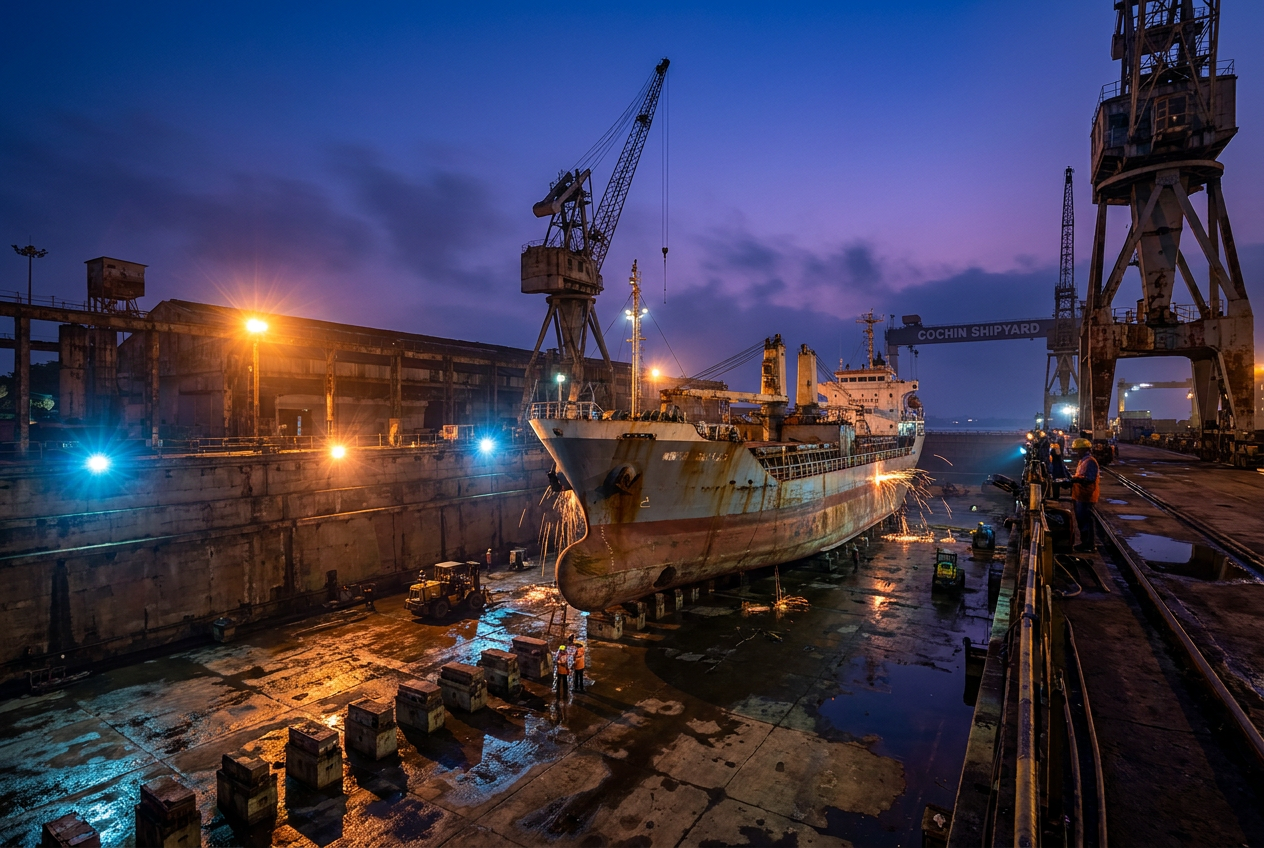
Cochin Shipyard has cleared the formation of an equally owned venture with Dubai-based Drydocks World to run the International Ship Repair Facility at Kochi. The new company will be controlled operationally by Drydocks World through board and executive appointments, while Cochin will transfer the Willingdon Island repair asset into the venture at a valuation of at least INR 18 billion, split between cash and equity. The facility, which began operating in 2024, currently has a 6,000-tonne lift, six repair positions and about 1,400 metres of berthage, is sized mainly for vessels up to 130 metres and 6,000 dwt, handled roughly 35 refits in FY2025-26, and is slated for a major expansion that would lift workstations from six to sixteen.
What it means for owners
For shipowners and technical managers, this move matters because geography is becoming as important as headline yard rates. Traffic patterns across the Arabian Sea, Indian west coast and wider Indian Ocean have increased the value of repair locations that can absorb routine drydocking, steel renewal, afloat repairs and machinery jobs without forcing a long diversion to Singapore or a tighter slot market in the Gulf. Kochi sits in a useful position for coastal operators, offshore support fleets, feeder tonnage, dredgers, naval auxiliaries and regional commercial vessels whose economics are highly sensitive to days lost in transit and queue time. A facility that can reliably process medium and smaller vessels close to operating zones can cut total repair cost even if nominal yard pricing is not the lowest, because off-hire, bunker burn, crew logistics and schedule disruption often outweigh workshop invoices.
The operating performance disclosed so far suggests both promise and headroom. A throughput of about 35 refits against a design intention far above that level indicates the facility is still in the market-building phase rather than operating at mature utilization. That is exactly where Drydocks World’s involvement could change the equation. Drydocks has long experience in commercial yard planning, project control, subcontractor management and customer acquisition across complex marine repair work. Its management control in the joint venture points to a model in which Cochin contributes strategic location and infrastructure while Drydocks supplies operating discipline, sales reach and process know-how. For owners, the practical question is whether this translates into shorter lead times, better estimation accuracy, stronger procurement and fewer overruns. If it does, Kochi could become a serious option for operators that currently default to Dubai, Oman or Singapore for certainty rather than convenience.
The vessel-size focus is also important. Facilities for very large tankers or ultra-large container ships attract attention, but a large share of regional repair demand comes from ships and craft below 130 metres and around 6,000 dwt or less. This is an underserved bracket in many major hubs because premium docks are often allocated to bigger, higher-revenue projects. Smaller owners frequently struggle to secure timely slots, especially during regulatory spikes tied to special surveys, ballast water retrofits, emission-related modifications or fleet-wide maintenance campaigns. If Kochi can offer dependable windows for this segment, it could win business from coastal shipping companies, harbor service operators, government fleets and niche offshore owners that value responsiveness over flagship-yard branding. The plan to add ten more workstations is therefore strategically sensible: not just bigger capacity, but potentially a better fit for parallel processing of multiple modest-sized projects.
There is also a wider competitive implication. Singapore remains strong on quality assurance, supply-chain depth and class coordination, while Gulf yards benefit from established owner relationships and integrated marine-industrial ecosystems. Kochi will not displace those centers outright. However, competition in ship repair rarely turns on a single factor. It is about the bundle: deviation, waiting time, labor productivity, workshop depth, spares access, class attendance and confidence in redelivery dates. By linking an Indian public-sector yard asset with a Gulf repair brand, the venture appears designed to create a hybrid proposition—lower geographic deviation for many Indian Ocean trades, potentially lower cost structures than some established hubs, and a more internationally recognizable operating model. In a market where owners increasingly optimize repair routing as tightly as voyage routing, that combination could prove commercially meaningful.
MaritimeNG — critical view
The structure of the venture raises legitimate governance questions. A 50:50 shareholding with one partner holding effective management control can work well when roles are clearly separated, but it can also create friction if strategic priorities diverge. Cochin is contributing the operating asset as a going concern, while Drydocks is taking the steering wheel through board majority and executive appointments. That may be exactly what is needed to accelerate commercialization, yet it also means performance accountability will need to be transparent. Owners will want evidence that decision-making on pricing, capex, procurement and slot allocation is fast and coherent rather than slowed by dual-parent interests.
There are also execution risks around scale-up and market positioning. Expanding from six to sixteen workstations is ambitious, but adding physical positions is easier than building a fully synchronized repair ecosystem around them. The real test will be availability of skilled labor, vendor depth, critical spares logistics, class surveyor access and consistent project management across simultaneous jobs. Another open question is whether the facility can sustain margins while targeting the smaller-vessel segment, which is often more price-sensitive and operationally fragmented than deep-sea blue-chip business. If Kochi aims to compete with both Gulf and Singapore alternatives, it must avoid being perceived as merely a lower-cost option without the schedule certainty owners prize most.
Verdict
This joint venture has the ingredients to strengthen Kochi’s role in regional ship repair, particularly for owners of smaller and mid-sized vessels seeking lower deviation and potentially better slot access. The opportunity is real, but the market will judge it on execution speed, turnaround reliability and whether expanded capacity becomes usable capacity—precisely the kind of operating detail that informed maritime service intelligence should keep tracking.
Fundamental basis
The economic mechanics behind the facts above, grounded in Martin Stopford’s Maritime Economics. Reference only — not investment advice.
Facing a similar situation on your vessel? Model the numbers before you commit.
Open the off-hire & deviation calculatorsSource Attribution
This analytical review is based on publicly available facts originally reported by Ship & Offshore. MaritimeNG does not claim authorship of the underlying facts. Read the original publication
© 2026 MaritimeNG — Independent analytical commentary. All analysis, opinions, and forward-looking assessments are original work by MaritimeNG Editorial and may differ from those of the parties mentioned or the cited source. Factual data is restated in our own words based on publicly available information. All trademarks and trade names belong to their respective owners. This content does not constitute legal, technical, or investment advice.