China’s Newbuild Surge Will Tighten Repair and Retrofit Planning
China’s command of the global orderbook, led by container vessel contracting, is becoming a material factor not only for newbuilding strategy but also for repair, retrofit, and drydock planning. For operators, the practical issue is no longer just where ships are built, but how yard congestion, timing risk, and compliance spending reshape maintenance economics.
What happened
Recent market data show a larger global newbuild pipeline, with total contracted tonnage measured in compensated gross tons rising year on year before easing slightly from a recent peak. Containerships are the main engine of that expansion, contributing a disproportionate share of recent orderbook growth, and Chinese builders now control the overwhelming majority of that segment as well as a dominant position in tankers, gas carriers, bulkers, ro/ro vessels, and the market overall. BIMCO’s assessment is that strong freight markets have fueled the ordering wave, while also cautioning that today’s intense yard loading could later give way to weaker utilization.
What it means for owners
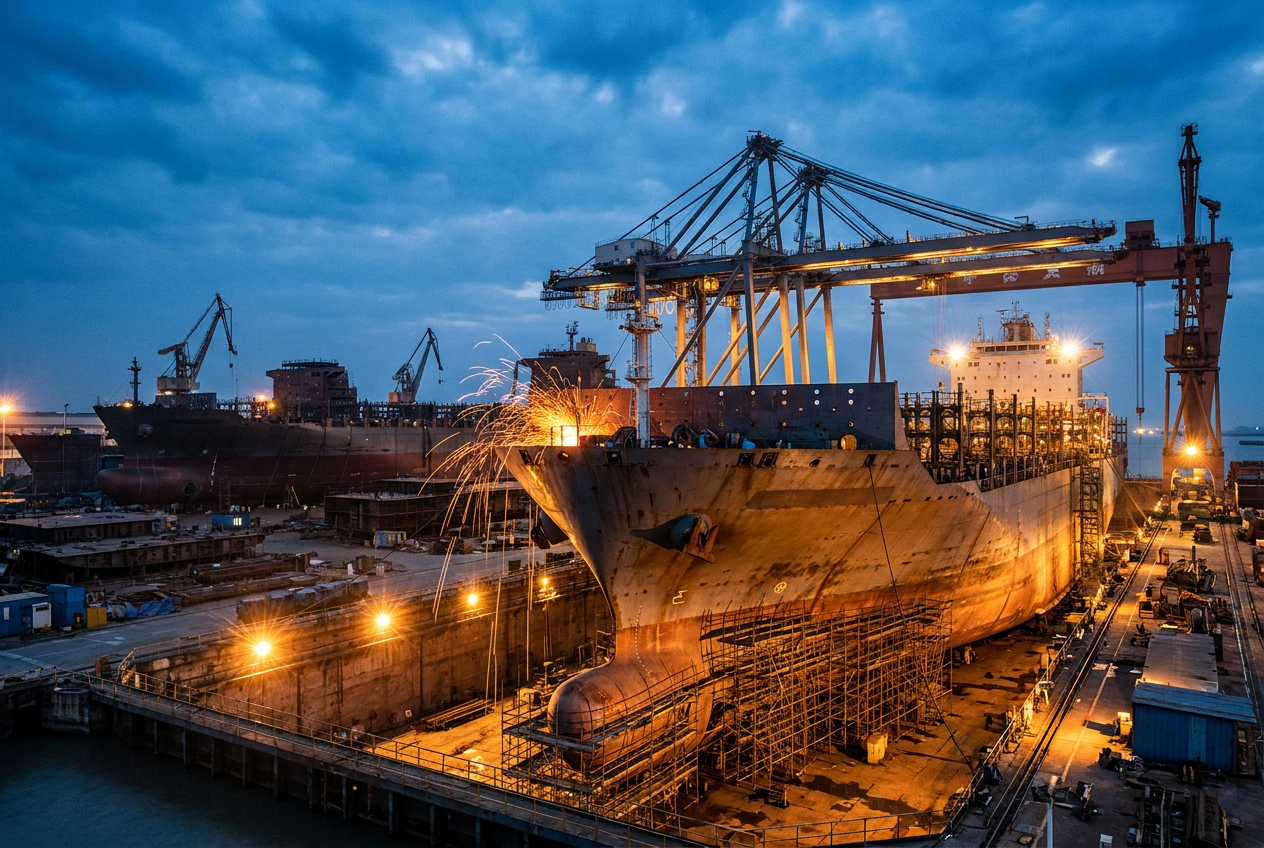
For shipowners and technical managers, the immediate implication is not abstract market concentration but physical access to steel, labor, and dock time. When one country’s yards hold such a large share of the global pipeline across nearly every mainstream vessel class, repair and retrofit work inevitably competes with newbuild execution for project managers, fabrication capacity, specialist subcontractors, and increasingly for delivery reliability. Even if repair docks are organizationally separated from newbuilding berths, the same ecosystems support both. That means a heavy newbuild cycle can lengthen lead times for ballast water treatment work, energy-saving device installation, shaft generator upgrades, cargo system modifications, and steel renewal packages. Operators that continue to book drydock windows late may face a double penalty: higher yard pricing and longer off-hire due to compressed schedules or deferred completion items.
This matters directly for compliance strategy. CII pressure has made operational efficiency improvements more time-sensitive, while EU ETS and FuelEU Maritime are pushing owners to reassess fuel consumption, voyage economics, and retrofit timing in a more integrated way. A vessel that misses a planned propeller upgrade, hull treatment, air lubrication installation, engine tuning package, or shore power preparation slot may not just lose efficiency gains; it may carry a higher emissions-cost burden on Europe-linked trades for another season. In that context, off-hire economics are changing. Owners are no longer comparing only the invoice cost of a retrofit against expected fuel savings; they are also comparing the cost of waiting, including carbon exposure, weaker CII trajectory, possible charter-party disadvantages, and the risk of being forced into a shorter, less optimal repair window. The market therefore favors earlier technical planning, bundled scopes, and tighter specification discipline to avoid rework and yard-side delays.
The newbuild-versus-retrofit decision is also becoming more nuanced. A strong orderbook can make modern tonnage appear attractive, especially if owners expect superior efficiency, alternative-fuel readiness, and better commercial positioning. But long delivery queues can narrow that advantage. If a new vessel will not arrive in time to materially improve near-term compliance performance or fleet economics, then extending the earning life of existing assets through selective retrofits becomes more rational. That is particularly true for owners with vessels that are commercially sound but technically suboptimal. In practice, many fleets will end up with a barbell strategy: commit to a limited number of newbuilds while accelerating retrofit decisions on core midlife ships. For repair and procurement teams, this raises the value of regional yard diversification beyond China, earlier vendor locking for long-lead equipment, and more rigorous drydock sequencing across the fleet.
MaritimeNG — critical view
There is, however, a risk of overstating a simple “China full, repairs delayed” narrative. Yard utilization is not uniform by province, ownership group, dock type, or technical specialty, and many repair projects can still be absorbed by facilities outside the main newbuild clusters. In addition, some owners may assume that paying a premium guarantees execution certainty; recent experience across industrial sectors suggests otherwise. Schedule risk often stems as much from incomplete engineering, late owner decisions, and equipment logistics as from yard crowding itself.
A second caution is strategic. The industry has a habit of treating orderbook expansion as proof of durable demand, yet shipping cycles remain unforgiving. If the current construction wave results in overcapacity in some trades, owners could later face weaker earnings at the same time they are carrying higher capital commitments and still needing to fund compliance retrofits on legacy ships. For the repair and retrofit market, that could produce a split outcome: short-term slot scarcity followed by more price-sensitive maintenance demand if freight markets soften. Procurement teams should therefore avoid making decisions based solely on today’s yard tightness and instead build scenarios around both congestion and a later cooling phase.
Verdict
China’s dominance in the orderbook is no longer just a shipbuilding statistic; it is a planning variable for maintenance, retrofit timing, and compliance execution. Owners that treat repair sourcing, decarbonization upgrades, and dock scheduling as a single portfolio decision will be better placed to protect availability and control total lifecycle cost; that is precisely the kind of market context procurement platforms such as MaritimeNG should help users navigate.
Fundamental basis
The economic mechanics behind the facts above, grounded in Martin Stopford’s Maritime Economics. Reference only — not investment advice.
Facing a similar situation on your vessel? Model the numbers before you commit.
Open the off-hire & deviation calculatorsSource Attribution
This analytical review is based on publicly available facts originally reported by The Maritime Executive. MaritimeNG does not claim authorship of the underlying facts. Read the original publication
© 2026 MaritimeNG — Independent analytical commentary. All analysis, opinions, and forward-looking assessments are original work by MaritimeNG Editorial and may differ from those of the parties mentioned or the cited source. Factual data is restated in our own words based on publicly available information. All trademarks and trade names belong to their respective owners. This content does not constitute legal, technical, or investment advice.