Carrier Overhaul Underscores Capacity and Contracting Pressures in Repair
The start of a multi-billion-dollar mid-life overhaul for USS Harry S. Truman is more than a naval milestone; it is a case study in how scarce yard capability, contract design and schedule risk shape the economics of major maintenance. For the wider ship repair market, it highlights the growing premium on planning, risk allocation and realistic downtime assumptions.
What happened
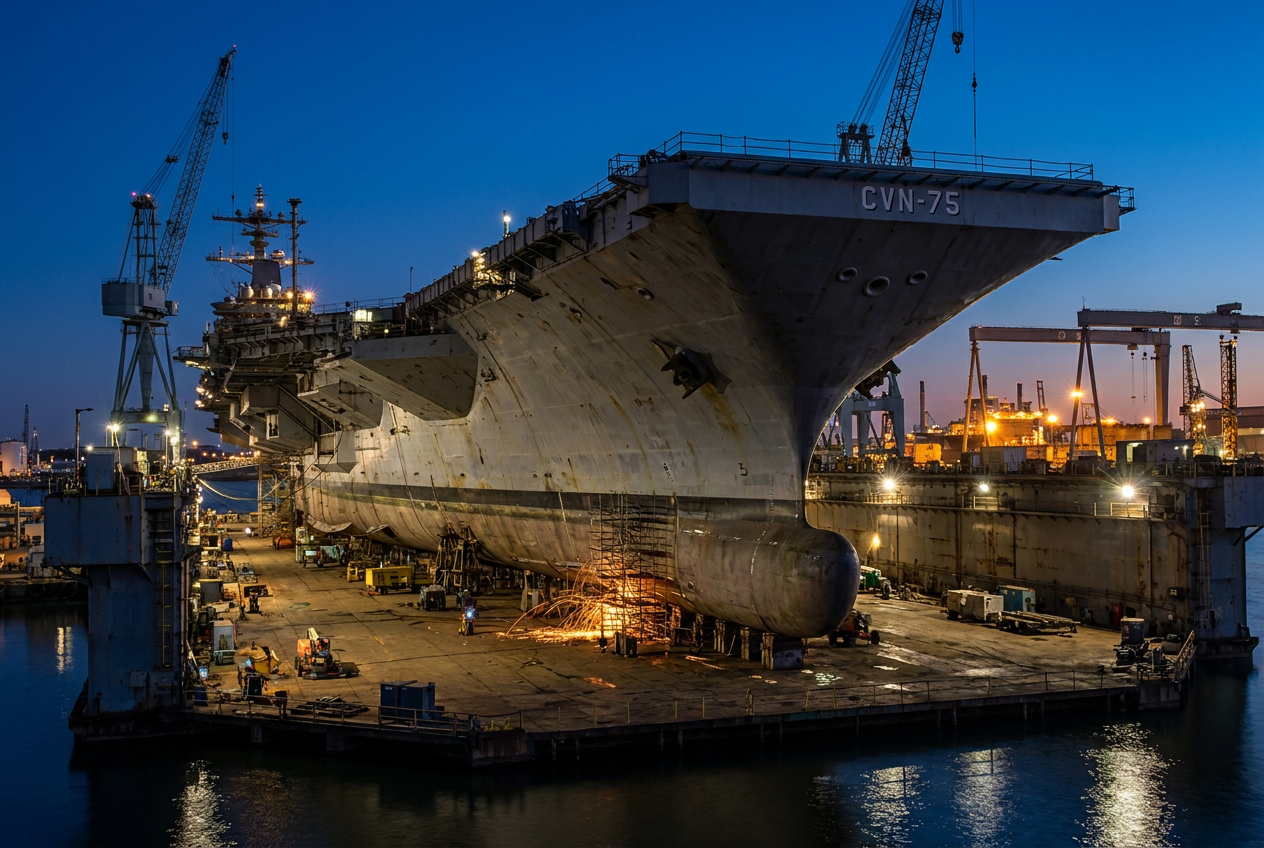
The U.S. Navy has sent the aircraft carrier USS Harry S. Truman, a late-1990s-built Nimitz-class vessel, to HII’s Newport News yard for its major mid-service refueling and modernization period. The package is valued at just over $5.09 billion, with additional options taking the total above $5.18 billion, and it follows advance preparation work that started in 2025. Newport News is the only American yard equipped for this type of nuclear carrier life-extension work and is undertaking it while still finishing a similar program on USS John C. Stennis.
What it means for owners
For the ship repair industry, the most important takeaway is not simply the headline value of the Truman package, but what it says about capacity concentration. A nuclear carrier refueling and overhaul absorbs exceptional amounts of skilled labor, berth space, engineering bandwidth, supply chain coordination and regulatory control. When one facility is handling two programs of this scale at the same time, that yard’s calendar effectively becomes a strategic national asset. Commercial shipping faces a less extreme version of the same problem. Whether the vessel is a VLCC, LNG carrier, offshore unit or aging bulk carrier, very large technical projects can dominate a repair yard’s capacity, displacing other work and amplifying waiting times. Owners that assume dock space will be available on demand are increasingly exposed to delay premiums, off-hire risk and cascading operational disruption.
The second lesson is economic rather than purely industrial: when does an expensive life-extension still make sense? In the naval context, there is no direct commercial substitute for a fleet carrier, so the comparison with a newbuild is imperfect. Still, the underlying capital allocation question is highly relevant for merchant owners. A major mid-life package becomes rational when the asset retains strategic utility, replacement lead times are long, and the upgraded vessel can deliver years of productive service that justify both the capex and the lost earning time. In commercial terms, this resembles the decision facing owners of tankers and bulkers around special survey windows: invest heavily in steel renewal, machinery modernization, ballast water treatment, emissions upgrades and digital systems, or exit the asset. The answer depends not only on the repair invoice, but also on freight market expectations, residual values, regulatory outlook and the opportunity cost of idle time. A technically successful overhaul can still destroy value if the vessel returns into a weak market or misses a favorable rate cycle.
The contract structure is also worth close attention. The Navy’s use of a fixed-ceiling incentive model reflects a pragmatic recognition that on long-duration, high-uncertainty projects, pure fixed-price contracting often leads either to inflated bids or later disputes, while fully cost-plus arrangements can dull cost discipline. Shared-risk frameworks are increasingly relevant in commercial repair, especially where scope uncertainty is high before opening up tanks, machinery spaces or structural areas. The right lesson for commercial operators is not to copy a naval contract format directly, but to borrow the logic: define baseline scope rigorously, identify uncertainty bands early, tie incentives to milestone performance and cost control, and create transparent change-order mechanisms before steel is cut. The cautionary note comes from schedule performance. Newport News is reportedly still working through a materially delayed Stennis overhaul, which underlines a hard truth familiar to every technical manager: complexity compounds. Once labor productivity slips, supplier lead times stretch, or emergent work exceeds assumptions, the schedule can unravel faster than the original budget model suggests. For owners of tankers, bulkers and offshore units, that means the real cost of a major dock period is not the repair line item alone, but the combined exposure of yard inflation, prolonged off-hire, financing drag and missed market windows.
MaritimeNG — critical view
There is an uncomfortable strategic issue embedded in this program: single-source dependence. If only one yard can perform this category of overhaul, the customer has limited leverage on price, timing and execution resilience. That may be unavoidable in the nuclear carrier segment, but monopoly capability always carries consequences. It narrows benchmarking, concentrates labor bottlenecks and leaves little room to recover when a project slips. In commercial shipping, owners should read this as a warning against overreliance on a single favored yard or region for highly specialized work, particularly when fleet schedules are tight.
The schedule overhang from the Stennis program also deserves more scrutiny than headline contract innovation. Incentive structures are useful, but they do not eliminate the physical realities of complex overhaul work: hidden condition issues, workforce scarcity, supplier delays and interface risk across multiple engineering packages. A fixed-ceiling incentive arrangement can encourage discipline, but it can also create pressure to defer difficult truths about scope growth or realistic completion dates if not paired with strong transparency. For commercial owners, the lesson is straightforward: risk transfer on paper is never complete. If a vessel is mission-critical, the owner still bears the economic damage of delay even when the contractor absorbs part of the direct overrun. The hidden cost in any major life-extension program is often not the final repair bill, but the duration uncertainty attached to it.
Verdict
Truman’s overhaul is a reminder that major life-extension work is ultimately a capacity, contracting and timing decision as much as an engineering one. Commercial owners planning heavy drydock programs should treat yard availability, scope uncertainty and schedule downside as core investment variables, not secondary execution details—a discipline MaritimeNG’s readership will recognize as essential in today’s tighter repair market.
Fundamental basis
The economic mechanics behind the facts above, grounded in Martin Stopford’s Maritime Economics. Reference only — not investment advice.
Facing a similar situation on your vessel? Model the numbers before you commit.
Open the off-hire & deviation calculatorsSource Attribution
This analytical review is based on publicly available facts originally reported by The Maritime Executive. MaritimeNG does not claim authorship of the underlying facts. Read the original publication
© 2026 MaritimeNG — Independent analytical commentary. All analysis, opinions, and forward-looking assessments are original work by MaritimeNG Editorial and may differ from those of the parties mentioned or the cited source. Factual data is restated in our own words based on publicly available information. All trademarks and trade names belong to their respective owners. This content does not constitute legal, technical, or investment advice.