Carnival’s robotic hull cleaning move raises the bar for cruise efficiency
Carnival Cruise Line’s adoption of robotic, service-based hull cleaning is more than a technical first for the cruise sector. It signals a shift toward continuous efficiency management as operators face tighter carbon rules, rising compliance costs, and growing scrutiny of biofouling risk.
What happened
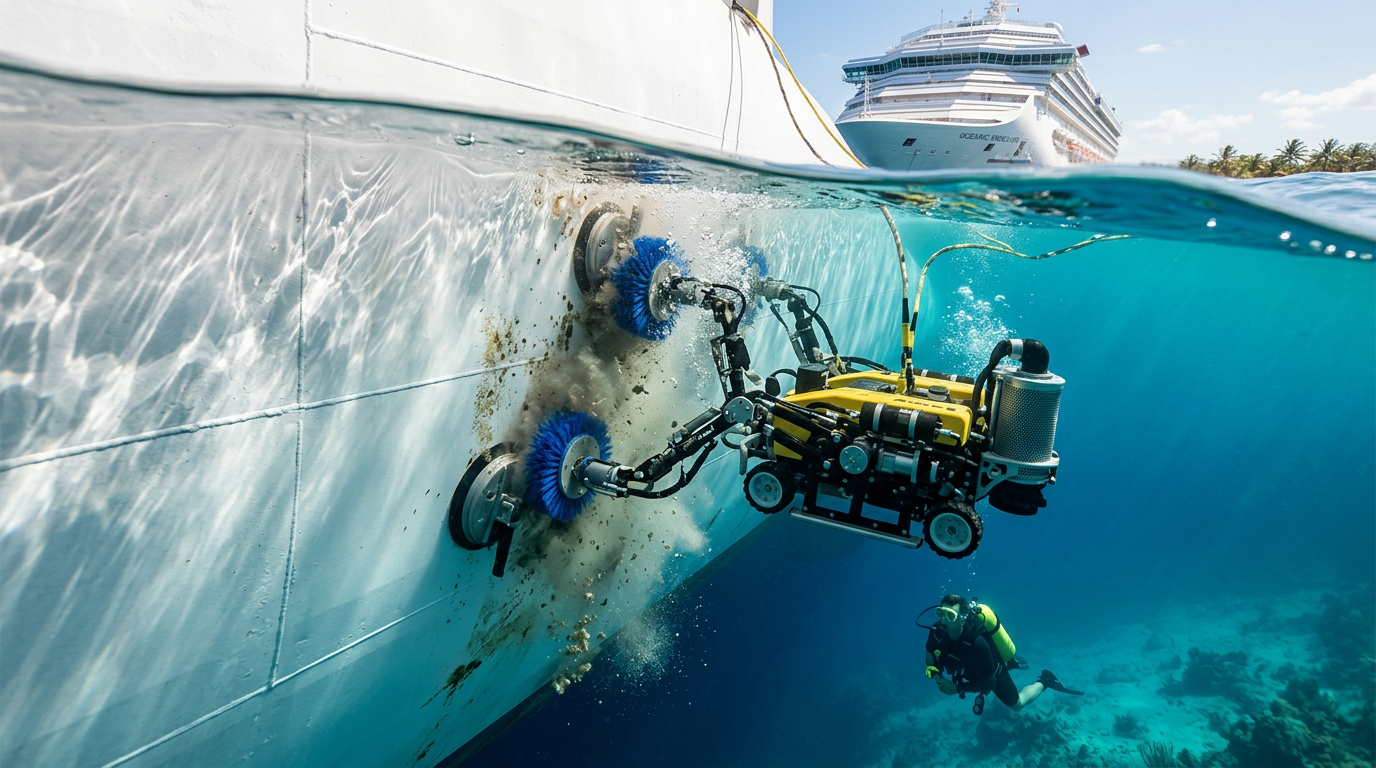
Carnival Cruise Line has become the first cruise company to take up Jotun’s Hull Skating Solution, with the initial installation tied to Carnival Pride. The arrangement combines a hull coating, routine cleaning by a remotely operated robot, condition monitoring, inspections, performance data, and a service commitment aimed at keeping the underwater hull consistently free of fouling; DNV has verified the concept’s ability to preserve this standard without observable speed penalty.
What it means for owners
For shipowners and operators, the significance lies less in the novelty of an underwater robot and more in the operating model behind it. Traditional hull maintenance has usually been periodic and corrective: vessels accumulate fouling, fuel consumption worsens, and cleaning is arranged once performance loss becomes material or a docking window appears. A proactive regime changes that logic. By intervening before biofouling becomes established, operators can preserve hydrodynamic efficiency with greater consistency, which matters directly for fuel burn, schedule reliability, and emissions intensity. In the cruise segment, where itineraries are fixed and hotel loads are high, even modest resistance increases can translate into meaningful cost leakage across a season. If a vessel can be cleaned between voyages instead of waiting for a drydock cycle or a major performance decline, the commercial value is obvious: lower fuel spend, less operational drift, and fewer compromises between speed, itinerary integrity, and bunker management.
That has become more important because hull condition now feeds into regulatory and financial exposure more directly than it did a few years ago. A fouled hull pushes up consumption and therefore worsens attained carbon intensity, making CII management harder, especially for older tonnage or ships already operating close to their efficiency threshold. The same effect compounds exposure under the EU ETS, since additional fuel use on relevant voyages means more emissions allowances to surrender. FuelEU Maritime adds another layer: when fuel consumption rises, the cost of achieving the required greenhouse-gas intensity outcome also rises, whether through cleaner fuels, pooling, or compliance balances. In that context, hull cleanliness is no longer merely a technical housekeeping issue; it is becoming a compliance lever with measurable monetary consequences. A service package that offers continuous inspection, digital performance reporting, and documented cleaning activity could also strengthen owners’ evidence base when linking technical interventions to emissions outcomes.
There is also a wider market implication. If the model proves reliable in cruise, it may accelerate a broader shift in the hull coating and maintenance market from product sales to performance contracts. Owners have long bought coatings on the promise of lower drag over time, but a monitored, guaranteed-clean-hull proposition moves commercial risk closer to the supplier and makes outcomes more transparent. That could reshape procurement discussions, especially for operators focused on total cost of ownership rather than dock-to-dock capex. It may also support drydock optimization: not by eliminating special surveys or coating renewal cycles, but by reducing the operational penalties that accumulate between dockings and potentially extending the period over which a coating remains commercially effective. Finally, the biosecurity angle should not be understated. As jurisdictions tighten biofouling controls to limit transfer of invasive aquatic species, routine cleaning and documented hull condition management may become as important for market access as they are for fuel savings. Owners that can demonstrate disciplined underwater husbandry will be better positioned as environmental compliance broadens beyond carbon alone.
MaritimeNG — critical view
That said, the commercial case is unlikely to be uniform across all fleets. Cruise ships are unusually well suited to frequent, planned intervention because they follow regular schedules, call often, and suffer tangible commercial pain from speed loss or itinerary disruption. The same service model may be less straightforward for deep-sea bulkers, tramp tankers, or vessels trading in regions where port permissions for in-water cleaning remain restrictive. Regulatory acceptance is a material variable: many ports remain cautious about underwater cleaning because of concerns over paint release and the spread of organisms, and local rules can differ sharply. A technically capable system still needs operational access.
Cost and execution risk also deserve scrutiny. A bundled solution with specialist equipment, compatible coating, monitoring, and reporting will not be cheap, and owners will want robust evidence that savings persist after service fees, port logistics, and any operational constraints are included. There are also practical questions around scalability, response times, and asset availability if adoption grows quickly. Much will depend on whether suppliers can deliver repeatable outcomes across ship types, trade patterns, and hull conditions rather than in carefully selected early deployments. The concept is promising, but the industry should avoid assuming that one successful cruise application automatically translates into a universal maintenance standard.
Verdict
Carnival’s move is strategically important because it treats hull performance as a continuously managed decarbonisation and compliance issue, not a periodic maintenance task. If the economics hold in service, robotic proactive cleaning could become a serious competitive tool for operators facing tighter carbon regulation and rising efficiency pressure.
Fundamental basis
The economic mechanics behind the facts above, grounded in Martin Stopford’s Maritime Economics. Reference only — not investment advice.
Facing a similar situation on your vessel? Model the numbers before you commit.
Open the off-hire & deviation calculatorsSource Attribution
This analytical review is based on publicly available facts originally reported by Ship & Offshore (SORJ). MaritimeNG does not claim authorship of the underlying facts. Read the original publication
© 2026 MaritimeNG — Independent analytical commentary. All analysis, opinions, and forward-looking assessments are original work by MaritimeNG Editorial and may differ from those of the parties mentioned or the cited source. Factual data is restated in our own words based on publicly available information. All trademarks and trade names belong to their respective owners. This content does not constitute legal, technical, or investment advice.