Carnival Freedom Refit Shows Access Can Be a Stronger Asset Than Height
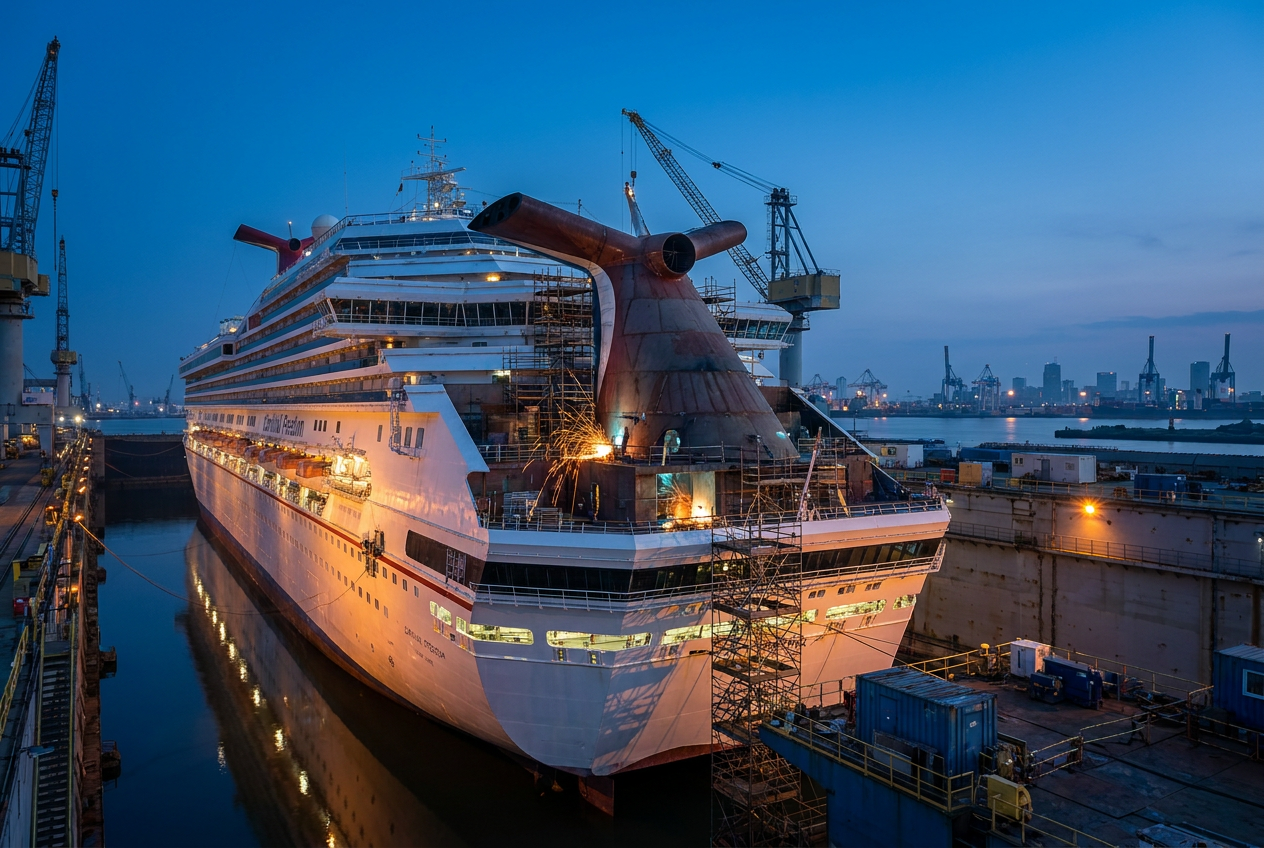
Carnival has altered the funnel profile of the 2007-built Carnival Freedom to lower the ship’s overall height and widen the range of ports it can serve. For operators managing older tonnage, the move highlights how targeted structural changes can unlock itinerary flexibility when regulatory and commercial pressures are tightening.
What happened
Carnival Freedom, a 110,000 GT Conquest-class cruise ship delivered by Fincantieri in 2007, has completed a refit in which its distinctive funnel structure was reduced in height. The ship previously stood at about 180 feet above the waterline at the funnel top, and the modification was made so the vessel can pass beneath more restrictive bridge clearances. The vessel, about 290 metres long and carrying roughly 3,700 passengers, has now returned to service after what appears to be an unusually direct physical alteration aimed at expanding trading options for a mature cruise asset.
What it means for owners
For shipowners and technical managers, the most important point is not the visual novelty of a shortened cruise funnel but the capital-allocation logic behind it. In today’s operating environment, older vessels are under pressure from several directions at once: carbon-intensity scrutiny, rising voyage-cost exposure under regimes such as the EU ETS and FuelEU Maritime, constrained drydock availability, and the persistent need to keep revenue days high. Against that background, a modification that broadens destination access can be commercially more powerful than a purely cosmetic or hotel-focused refit. If a vessel can reach ports previously excluded by bridge limitations, the operator gains schedule flexibility, potentially shorter repositionings, more seasonal optionality, and a stronger ability to optimize deployment around yield rather than around fixed physical constraints.
There is also a fleet-life extension angle that should not be underestimated. A 20-year-old cruise ship sits in the zone where operators must decide whether to continue investing, redeploy, or ultimately divest. Traditional life-extension spending often concentrates on compliance, interior modernization, and machinery reliability. What this case illustrates is a fourth category: geometric adaptation for market access. That matters because route economics increasingly interact with environmental economics. If a lower air draft allows a ship to serve closer-in embarkation ports or better-balanced itineraries, the benefit may show up indirectly in fuel burn, emissions exposure, and schedule resilience. Even where the emissions gain is modest, the commercial value of preserving utilization can be significant, especially when off-hire windows are expensive and yard slots are difficult to secure. A targeted steel-and-structure project completed during a planned docking may therefore produce a better return than a much larger refit that does little to improve deployment economics.
The project also speaks to how operators are rethinking classically “fixed” ship characteristics. For decades, a ship’s principal dimensions and air draft were treated as givens once delivered, with only limited appetite for changing external form unless driven by damage, major conversion, or regulation. That mindset is shifting. Owners are becoming more willing to re-engineer mature assets where the commercial case is credible. For procurement and technical teams, this has implications for early-stage feasibility work: structural redesign, exhaust-routing impacts, wind-load implications, weight distribution, class approval pathways, and any effect on hotel ventilation or branding elements all become relevant. In a tight capex environment, projects that create optionality rather than simply restore baseline condition may increasingly win internal approval.
MaritimeNG — critical view
That said, this type of intervention should not be romanticized as a universal template. Lowering a superstructure element is only worthwhile if restricted air draft has been a genuine limiter on deployment and if newly accessible ports can support profitable operations. The engineering may be straightforward relative to a major conversion, but it still introduces integration risks around exhaust systems, structural integrity, stability margins, and the practical behavior of the vessel under different wind conditions. On a branded cruise asset, there is also the softer but still relevant question of whether changing a signature silhouette has any marketing downside, however small.
More broadly, greater itinerary flexibility does not solve the deeper challenge facing older cruise tonnage: long-term competitiveness in an era of tightening emissions rules and customer expectations for newer hardware. A ship can gain access to more ports and still remain commercially disadvantaged if its energy performance, hotel systems, or lifecycle maintenance burden deteriorate relative to younger vessels. In other words, access-enhancing retrofits are most defensible when they sit within a coherent asset strategy, not when they substitute for one.
Verdict
Carnival Freedom’s funnel modification is a useful reminder that the most valuable refit is not always the most technologically ambitious; sometimes it is the one that removes a deployment constraint. For owners evaluating aging assets, the case reinforces the need to compare structural adaptation, compliance spending, and off-hire economics as one integrated decision set—an area where disciplined yard-market intelligence and retrofit benchmarking, of the kind tracked across MaritimeNG’s core sectors, can materially improve outcomes.
Fundamental basis
The economic mechanics behind the facts above, grounded in Martin Stopford’s Maritime Economics. Reference only — not investment advice.
Facing a similar situation on your vessel? Model the numbers before you commit.
Open the off-hire & deviation calculatorsSource Attribution
This analytical review is based on publicly available facts originally reported by The Maritime Executive. MaritimeNG does not claim authorship of the underlying facts. Read the original publication
© 2026 MaritimeNG — Independent analytical commentary. All analysis, opinions, and forward-looking assessments are original work by MaritimeNG Editorial and may differ from those of the parties mentioned or the cited source. Factual data is restated in our own words based on publicly available information. All trademarks and trade names belong to their respective owners. This content does not constitute legal, technical, or investment advice.