BLRT’s New Klaipėda Dock Signals a Hard Reset in Baltic Repair Capacity
BLRT Grupp’s progress on a new floating dock for Klaipėda is more than an internal yard upgrade. It points to how regional repair players are repositioning for tighter docking windows, higher compliance workload and sharper owner focus on off-hire economics.
What happened
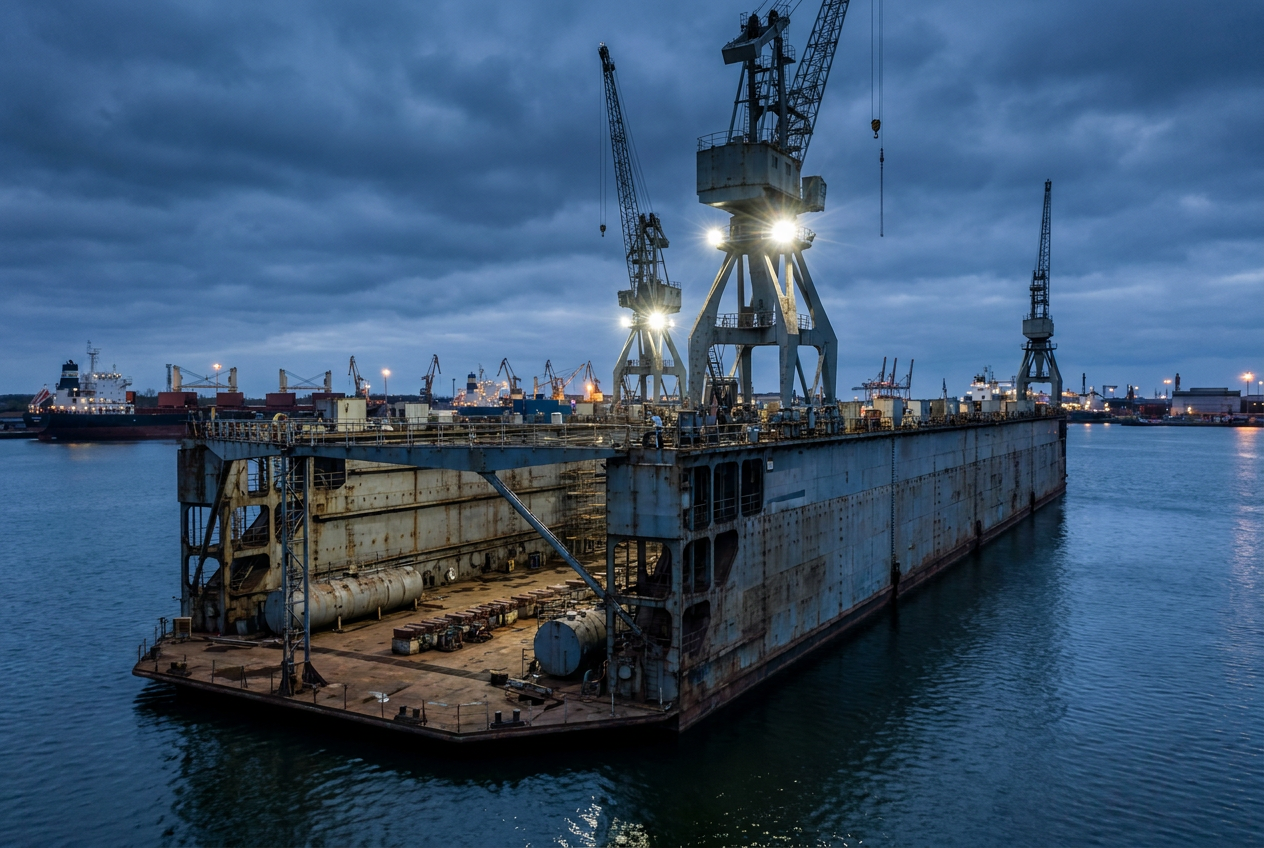
BLRT Grupp has moved forward with a replacement floating dock for its Western Shiprepair operation in Klaipėda. After steel work began earlier in 2026, the project reached keel-laying on 5 August at Hat-San Shipyard in Türkiye. The unit, identified as NB26, is planned at 200 metres by 35 metres with a 15,000-tonne lifting capability, and it will take the place of one of the existing docks at the Lithuanian yard. Officials from Türkiye and Lithuania attended the ceremony alongside the project teams.
What it means for owners
For shipowners and technical managers, the significance of this project lies less in ceremony and more in what it says about the Baltic repair market. A 200-metre, 15,000-tonne floating dock in Klaipėda suggests BLRT is aligning its asset base with the vessel segments that still require predictable regional docking access: short-sea cargo ships, ferries, offshore support tonnage, feeder container vessels and a wide range of workboats trading in Northern Europe. In a market where unscheduled repairs, steel renewals and statutory drydockings increasingly compete for the same slots, replacing older infrastructure can improve berth planning, turnaround reliability and job sequencing. That matters because owners are now making repair decisions under tighter operating margins, and every additional day off-hire can quickly erase the value of a cheaper yard quote.
The timing is also notable. Baltic and North European operators face a convergence of technical and regulatory pressures: class renewal cycles deferred during recent market disruption, more frequent energy-efficiency retrofits, and vessel condition work prompted by CII performance management. While CII itself does not force drydocking on a fixed timetable, it has changed the economics of technical downtime. Owners are increasingly bundling hull treatment, propulsion upgrades, appendage repairs, coatings and energy-saving modifications into planned yard stays rather than returning repeatedly for piecemeal work. A dock of this scale gives a regional yard a better chance of capturing that combined workload. For operators trading in and out of the Baltic, a capable dock in Klaipėda can reduce ballast deviation compared with sending ships farther west or south, which is now more important under the EU ETS regime. Extra steaming, waiting time and repositioning fuel have become more visible cost items, not just operational inconveniences.
There is a broader competitive angle as well. Northern European repair demand has not disappeared, but it has become more selective. Owners want certainty on delivery dates, class coordination, subcontractor availability and steelwork quality. Yard capacity constraints today are often not purely about the number of docks; they are about whether a facility can absorb labor-intensive projects without schedule slippage. If BLRT uses this dock replacement to improve workflow, crane interfaces, block handling and service integration across its Baltic yard network, then the investment could strengthen its position in a market where speed of execution is often more decisive than nominal day rates. In that sense, the dock is not only a physical asset. It is a statement that regional repair providers still see value in proximity, repeat customer relationships and lifecycle service capability, even as some owners continue to chase lower headline prices outside Europe.
MaritimeNG — critical view
That said, a new dock does not automatically solve the structural challenges facing European repair yards. The first question is whether the investment translates into materially better productivity rather than simply replacing ageing capacity one-for-one. If labor shortages, subcontractor bottlenecks, inflation in steel and energy, or class survey congestion remain unresolved, owners may see limited improvement in overall docking experience. In practice, the constraint at many yards is execution bandwidth, not dock steel alone.
There is also a demand-risk dimension. A 15,000-tonne lift and 200-metre envelope are commercially sensible for many regional vessel types, but they place the asset in a competitive middle ground. Larger and more specialized ships will still require other facilities, while smaller operators remain highly price sensitive. Much depends on whether Northern European owners continue to value reduced deviation, schedule certainty and EU-linked cost control enough to keep work in-region. If freight markets weaken or compliance spending is delayed, utilization assumptions behind this type of asset can come under pressure. The strategic logic is credible, but the payoff will depend on disciplined execution after delivery, not on milestone ceremonies.
Verdict
BLRT’s dock project looks less like a headline-grabbing expansion and more like a pragmatic response to how repair demand is changing in Europe: fewer wasted days, tighter planning and more work bundled into each docking. For owners and managers tracking regional yard options, it is a development worth watching closely in the same evidence-based way MaritimeNG follows capacity, turnaround and technical execution trends.
Fundamental basis
The economic mechanics behind the facts above, grounded in Martin Stopford’s Maritime Economics. Reference only — not investment advice.
Facing a similar situation on your vessel? Model the numbers before you commit.
Open the off-hire & deviation calculatorsSource Attribution
This analytical review is based on publicly available facts originally reported by Drydock Magazine. MaritimeNG does not claim authorship of the underlying facts. Read the original publication
© 2026 MaritimeNG — Independent analytical commentary. All analysis, opinions, and forward-looking assessments are original work by MaritimeNG Editorial and may differ from those of the parties mentioned or the cited source. Factual data is restated in our own words based on publicly available information. All trademarks and trade names belong to their respective owners. This content does not constitute legal, technical, or investment advice.