BLRT Expands Baltic Dock Capacity for Larger, Higher-Value Repair Work
BLRT Grupp’s latest floating dock project for Klaipėda signals a strategic push to move further into larger and more technically complex repair assignments. The investment matters because Baltic drydock access is tight, while compliance retrofits and efficiency upgrades are increasing demand for reliable repair windows.
What happened
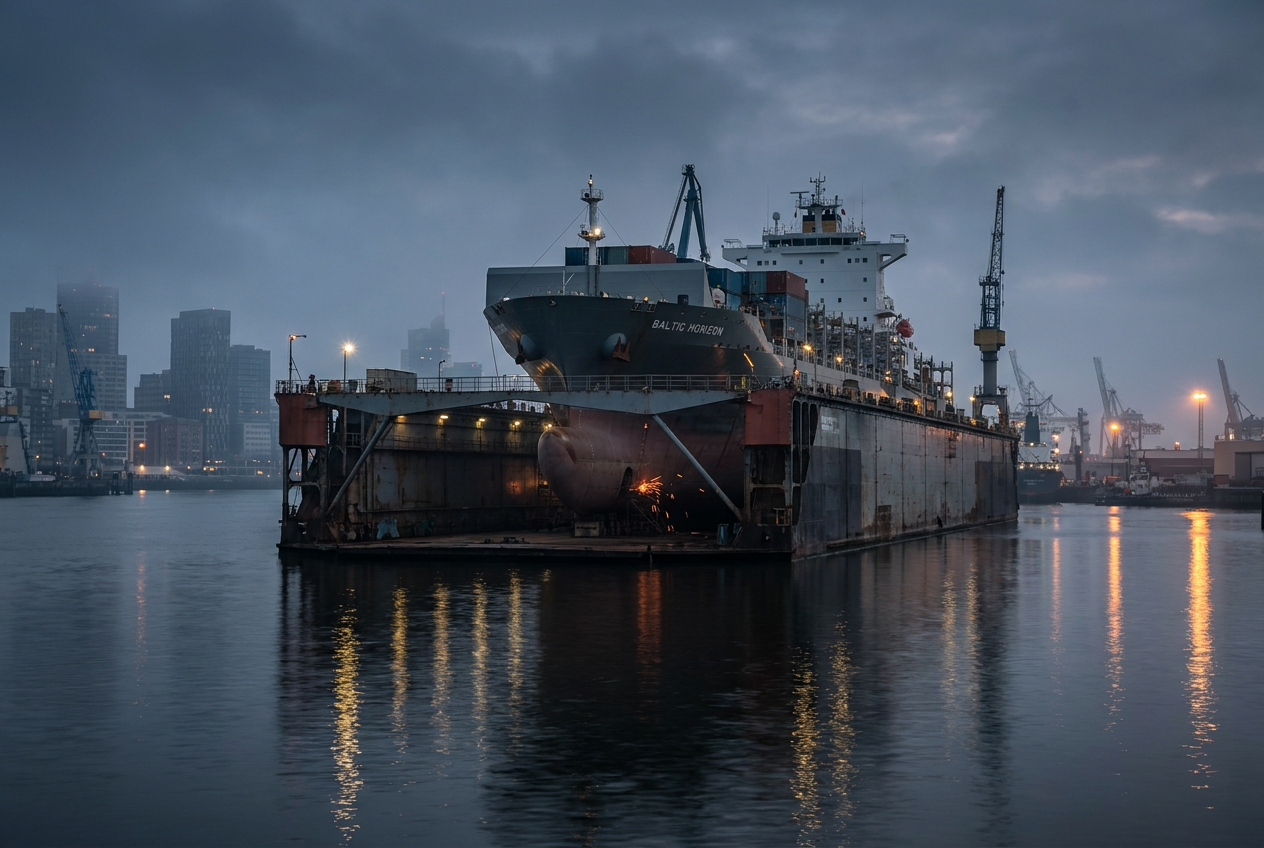
BLRT Grupp has marked the keel-laying stage of a new floating dock under construction at Hat-San in Yalova for deployment at its Western Shiprepair facility in Klaipėda. Following initial fabrication work earlier in 2026, the project has advanced on schedule toward a 200-metre by 35-metre dock rated to lift 15,000 tonnes. Once delivered, the unit will take the place of an older asset at the Lithuanian yard and broaden its ability to handle larger ships, including Panamax-size tonnage, within BLRT’s wider Baltic-Nordic repair network.
What it means for owners
For shipowners and technical managers trading in Northern Europe, the most immediate implication is simple: another meaningful drydock slot is being added in a region where repair access is often tighter than vessel operators would prefer. The Baltic repair market has long been shaped by seasonality, limited large-dock availability, and the practical need to align maintenance with short commercial windows. When a yard in Klaipėda upgrades from an older facility to a larger floating dock, it does more than add nominal capacity; it improves the probability that owners can secure a berth without excessive waiting time or a costly repositioning to more distant yards. That matters because off-hire economics remain unforgiving. A delayed special survey, steel renewal package, propulsion repair or ballast-water system intervention can quickly erase any savings gained from choosing a lower headline yard price elsewhere.
The timing is also notable in the context of regulatory and efficiency-driven yard demand. Carbon Intensity Indicator pressure is pushing owners toward more frequent hull and propeller attention, energy-saving device installation, and performance-oriented maintenance planning. On top of that, EU ETS and FuelEU Maritime are changing retrofit priorities for ships exposed to European trades. Owners are assessing shore-power readiness, fuel system modifications, efficiency packages, coating upgrades, and onboard technical changes that often require drydock access or, at minimum, a yard period with dependable engineering support. In that environment, a dock capable of accommodating Panamax-class ships gives BLRT a stronger position in capturing work that is no longer limited to routine class docking. The commercially attractive segment is increasingly the package job: docking, steel work, machinery overhaul, coatings, and emissions- or fuel-compliance upgrades combined into one off-hire event.
From a competitive standpoint, the project reflects a wider industry trend: regional repair groups are investing in larger and more capable dock infrastructure to defend market share and move up the value chain. Baltic owners and operators have alternatives in Poland, Germany, Scandinavia and, for some projects, Turkey, but geography still matters. A well-positioned dock in Klaipėda can be compelling for vessels operating in the Baltic, North Sea feeder network, short-sea bulk trades, and regional tanker and RoRo services. It reduces ballast time compared with sending a ship to the eastern Mediterranean and may offer scheduling flexibility versus more congested Western European facilities. For BLRT specifically, the strategic benefit is not just at yard level but at group level. With yards across Lithuania, Estonia and Finland, it can market a broader repair ecosystem and potentially direct jobs according to technical complexity, berth availability and customer urgency. If executed well, the new dock should help BLRT compete for larger, more sophisticated contracts rather than relying mainly on smaller or purely transactional repair work.
MaritimeNG — critical view
That said, the investment is not risk-free. New dock capacity only creates value if utilization is consistently strong and if the yard can convert hardware into margin-rich projects. The market case rests on continued demand for Panamax-capable repair and retrofit work in the Baltic catchment, but that demand can fluctuate with freight markets, vessel age profiles, and owners’ willingness to defer non-mandatory upgrades. There is also competitive pressure from Polish yards, which remain relevant on geography and price, and from Turkish yards, which often combine scale, aggressive commercial terms and broad subcontractor ecosystems. If delivery timing slips or commissioning takes longer than expected, BLRT could miss a favorable demand cycle.
There is also a legitimate question over whether a 15,000-tonne lifting threshold is the optimal long-term choice. It clearly widens the addressable market, but it does not place Western Shiprepair into the very largest vessel categories, so the investment sits in a middle ground: more ambitious than a pure replacement, but not transformational at the top end. In the Baltic context, that may be prudent rather than limiting, yet geopolitical uncertainty around regional shipping patterns, sanctions-related trade shifts, insurance constraints and security perceptions should temper any assumption of uninterrupted growth. Infrastructure helps, but execution, labor availability, and project-management discipline will determine whether the dock becomes a strategic advantage or merely a necessary modernization step.
Verdict
This is a sensible, strategically targeted capacity upgrade rather than an oversized headline project. If BLRT delivers the dock on time and pairs it with strong scheduling and retrofit execution, Western Shiprepair should be better placed in a Baltic market where drydock access, compliance work and off-hire control are becoming more valuable to owners and operators alike.
Fundamental basis
The economic mechanics behind the facts above, grounded in Martin Stopford’s Maritime Economics. Reference only — not investment advice.
Facing a similar situation on your vessel? Model the numbers before you commit.
Open the off-hire & deviation calculatorsSource Attribution
This analytical review is based on publicly available facts originally reported by Ship & Offshore. MaritimeNG does not claim authorship of the underlying facts. Read the original publication
© 2026 MaritimeNG — Independent analytical commentary. All analysis, opinions, and forward-looking assessments are original work by MaritimeNG Editorial and may differ from those of the parties mentioned or the cited source. Factual data is restated in our own words based on publicly available information. All trademarks and trade names belong to their respective owners. This content does not constitute legal, technical, or investment advice.