Argentia Floating Dock Plan Signals New Atlantic Repair Capacity
A proposed floating dry dock and repair complex at Argentia points to a potentially important addition to North Atlantic maintenance capacity. For shipowners, the significance lies less in the announcement itself than in whether it can materially shorten repair lead times, reduce deviation, and offer flexible docking for mixed fleets under growing regulatory and cost pressure.
What happened
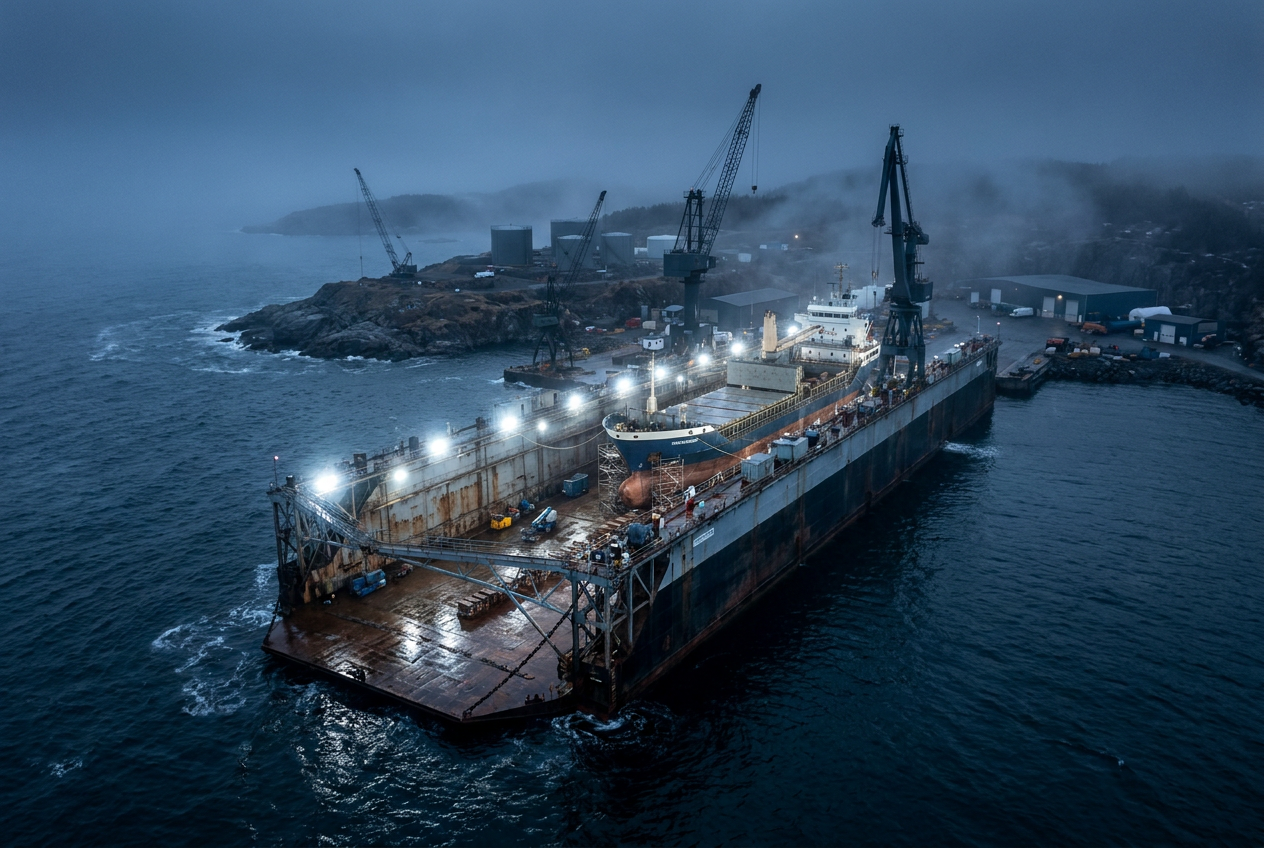
Mammoet Canada Eastern, Port of Argentia and Argentia Capital have agreed to pursue a marine repair development in Newfoundland and Labrador centered on a modular submersible floating dock concept. The plan would pair that system with Argentia’s port assets, including existing industrial waterfront facilities, to create added capability for vessel maintenance, repair and related heavy industrial work on Canada’s Atlantic coast.
What it means for owners
For vessel operators, the strategic value of this proposal is straightforward: accessible repair slots in the North Atlantic have become more commercially important as compliance costs rise and operational margins tighten. A docking location in Newfoundland can potentially reduce ballast legs and waiting time for ships trading between the U.S. East Coast, Canada, Northern Europe and parts of the Arctic supply chain. That matters because every extra day spent repositioning to a distant yard is no longer just a scheduling nuisance; it feeds directly into off-hire exposure, bunker consumption, charter-party friction and mounting emissions accountability. Owners managing Carbon Intensity Indicator performance are increasingly sensitive to non-revenue voyage days, especially where they involve slow-moving or partially loaded repositioning. Even though dry-docking is a planned maintenance event rather than a trading activity, the operational pattern around it still affects fuel burn, voyage efficiency and fleet utilization.
The timing also fits a broader structural issue in repair markets: constrained yard availability for routine survey work, steel renewal, retrofits and machinery overhauls. Across many regions, conventional dock capacity is being pulled in several directions at once. Class-driven special surveys continue on fixed cycles, while decarbonization adds new yard demand from energy-saving devices, propeller and hull upgrades, shaft generator installations, alternative fuel readiness work and emissions-related modifications. In Europe in particular, EU ETS cost exposure and FuelEU Maritime compliance pressure are sharpening the business case for efficiency upgrades during scheduled repair windows. The result is that owners increasingly need yards that can combine standard dry-dock tasks with technical retrofit scope, without forcing excessively long queue times. If Argentia can evolve beyond basic docking into a facility capable of integrated engineering, steel, coatings, mechanical and project-management execution, it could become commercially relevant well beyond the local market.
The floating dock angle is especially noteworthy because modular docking infrastructure can, in principle, expand more incrementally than a major fixed-dock build. That may appeal to operators of offshore support vessels, government fleets, ferries, fishing vessels, tugs, smaller tankers and general cargo ships that often struggle to secure cost-effective slots at larger yards focused on higher-value contracts. Flexibility in lift configuration could also be useful in a market where fleet mix changes over time. For owners, this creates a possible additional option for class renewals, underwater body work, propulsion repairs and life-extension projects without necessarily competing directly for capacity at the biggest established dry docks. If backed by reliable execution, it could improve resilience in Atlantic repair logistics by giving technical managers another node in the network when existing yards are congested or geographically inefficient.
There is also a risk-management dimension. Weather disruptions, labor bottlenecks and geopolitical trade shifts have made maintenance planning less predictable. A year-round Atlantic Canadian site with deepwater access could appeal to operators wanting another contingency location for unscheduled damage repair or survey work. In a market where repair decisions are increasingly shaped by total cost of downtime rather than headline yard rates alone, an additional regional facility can be valuable if it consistently reduces voyage deviation, waiting days and schedule uncertainty.
MaritimeNG — critical view
That said, an MOU is not operating capacity. The commercial test will be execution, not concept. Floating dock systems can offer useful flexibility, but owners and technical managers will judge the facility on practical questions: lift limits, berth productivity, crane access, workshop depth, subcontractor ecosystem, class acceptance, winter reliability, environmental permitting and the availability of skilled labor for steel, piping, coatings and machinery work. Without those elements, a new dock may handle straightforward projects but struggle to win more complex repair packages where owners need certainty on schedule and technical integration.
There is also a competitive reality. Established repair hubs in Eastern Canada and the U.S. Northeast already have customer relationships, supply chains and proven delivery records. To pull work away from incumbent yards, Argentia will need more than geographic logic; it will need bankable turnaround performance and a clear cost or timing advantage. The project’s promise is credible, but the market has seen many repair announcements that took longer than expected to become genuinely useful to fleet managers.
Verdict
If delivered at industrial scale, Argentia could become a meaningful addition to Atlantic repair capacity at a time when owners need more flexible docking options and tighter control over off-hire and compliance-related costs. The project is worth tracking closely, particularly for operators trading the North Atlantic, and MaritimeNG will be watching whether it develops from an interesting infrastructure plan into a dependable repair market option.
Fundamental basis
The economic mechanics behind the facts above, grounded in Martin Stopford’s Maritime Economics. Reference only — not investment advice.
Facing a similar situation on your vessel? Model the numbers before you commit.
Open the off-hire & deviation calculatorsSource Attribution
This analytical review is based on publicly available facts originally reported by MarineLink. MaritimeNG does not claim authorship of the underlying facts. Read the original publication
© 2026 MaritimeNG — Independent analytical commentary. All analysis, opinions, and forward-looking assessments are original work by MaritimeNG Editorial and may differ from those of the parties mentioned or the cited source. Factual data is restated in our own words based on publicly available information. All trademarks and trade names belong to their respective owners. This content does not constitute legal, technical, or investment advice.