Afloat Thruster Flange Repair Highlights Drydock Avoidance Economics
MarineShaft’s in-port repair of a damaged azimuth thruster flange in Denmark shows how portable machining can remove the need for a return docking when propulsion defects emerge after a planned yard stay. For owners facing scarce dock capacity and tighter operating margins, the case underlines the growing value of technically controlled afloat interventions.
What happened
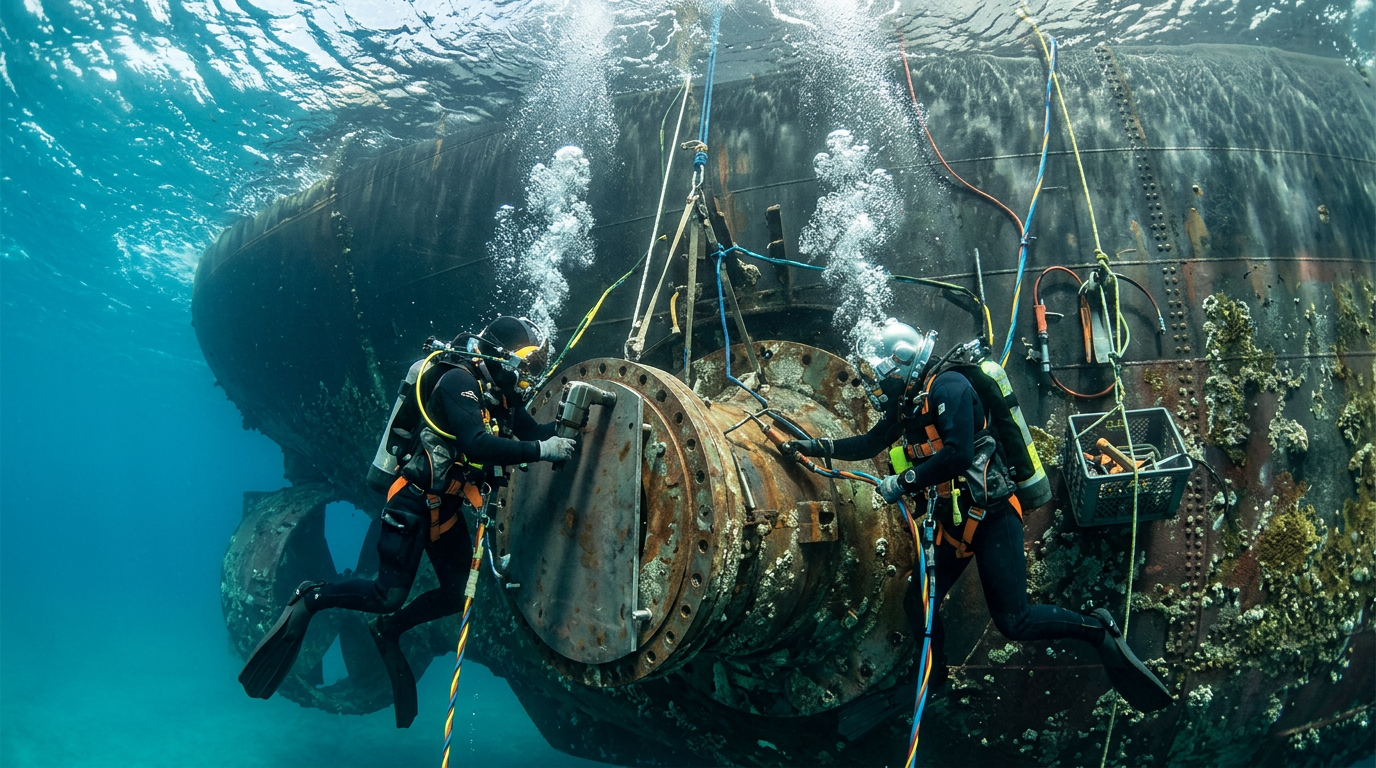
MarineShaft carried out an alongside repair in Skagen on an azimuth thruster whose sealing face had previously been found out of flat during a docking in Spain. The thruster OEM, Kongsberg, had recorded 7.1mm of distortion on the 2,580mm flange, creating a path for seawater ingress, but the vessel’s schedule did not allow the work to be completed in that yard period. Using portable milling equipment, MarineShaft machined the flange back into the maker’s permitted tolerances with limited material removal, re-cut the O-ring groove, and then completed laser alignment of the electric motor after reassembly. The company notes that its portable machining system can work on diameters up to 6,000mm, and in this case the vessel avoided another drydocking.
What it means for owners
For shipowners and technical managers, the most important feature of this case is not simply that a thruster flange was restored afloat, but that a defect identified in a previous docking was addressed later without forcing a second yard visit. That matters because the economics of off-hire have become harsher across multiple vessel classes. A return to dock after an apparently completed drydocking can trigger a chain of cost: lost charter revenue, deviation, tug and port charges, class attendance, vendor remobilisation, spare logistics, and the indirect disruption to commercial commitments. In an environment where drydock slots remain unevenly available and many operators are already advancing work scopes to secure yard windows, any repair method that safely removes the need for an extra docking has strategic value. The practical appeal is strongest where the defect is highly localised and the engineering tolerances can be restored on site under OEM or class acceptance.
There is also a fuel-efficiency and emissions-management angle that should not be overlooked. A thruster interface compromised by flange distortion and water ingress is not only a reliability concern; if left unresolved, it can escalate into bearing, sealing, or alignment issues that increase mechanical losses and reduce propulsion efficiency. At a time when operators are managing CII exposure voyage by voyage, even marginal deterioration in propulsion condition can matter, especially for vessels trading on constrained schedules where speed reduction options are limited. Restoring flange flatness and then verifying motor alignment points to a broader maintenance principle: precision repair work increasingly supports both availability and energy performance. Owners are under pressure to extract more service life from machinery while simultaneously documenting condition management to satisfy internal asset strategies, OEM recommendations, insurers, and where relevant, class expectations.
The case also illustrates the downside of deferred maintenance, even when deferral is commercially understandable. A 7.1mm deformation on a critical sealing face is not a trivial finding. Many operators have faced similar situations in which a defect is discovered late in a dock period but cannot be fully addressed because of time pressure, parts availability, or berth sequencing. Deferral may be rational in the moment, yet it stores future operational risk and often makes the eventual intervention more complex because the repair must be executed around a live trading schedule. The ability to bring portable machining to the vessel reduces that burden, but it does not eliminate the need for disciplined technical decision-making. Owners still need clear acceptance criteria, documented measurements, OEM engagement, and confidence that sufficient material remains after machining. In that sense, this repair is a good example of condition-led intervention, but also a reminder that compressed dock schedules can push critical work into a more operationally exposed phase of the vessel’s life.
MaritimeNG — critical view
This is a positive technical outcome, but it should not be read as proof that all thruster flange defects are suitable for afloat correction. Portable machining can restore geometry, yet the underlying cause of the deformation still deserves scrutiny. If the distortion resulted from installation stress, fastener load distribution, corrosion products, structural movement, or a broader issue within the thruster seating arrangement, machining the face solves the immediate symptom but may not fully prevent recurrence. Editorially, the more interesting question is whether owners are becoming too reliant on specialist afloat services to compensate for increasingly compressed drydock execution.
There is also a governance issue. Repairs on propulsion-critical interfaces require robust boundaries around tolerances, material removal, sealing integrity, and alignment verification. The fact that the work was brought within OEM-approved limits is reassuring, but such jobs depend heavily on measurement quality and on transparent sign-off between owner, maker, and where applicable class. Afloat repair can be highly effective, but it is not automatically the lower-risk option; it is simply the option that may best balance time, cost, and technical exposure when managed carefully.
Verdict
This case is a strong demonstration of how precision afloat machining can protect vessel availability when drydock re-entry would be commercially punitive. The broader lesson for operators is to pair such capabilities with stricter defect triage, OEM coordination, and lifecycle planning rather than treating afloat intervention as a universal substitute for yard-based repair.
Fundamental basis
The economic mechanics behind the facts above, grounded in Martin Stopford’s Maritime Economics. Reference only — not investment advice.
Facing a similar situation on your vessel? Model the numbers before you commit.
Open the off-hire & deviation calculatorsSource Attribution
This analytical review is based on publicly available facts originally reported by Drydock Magazine. MaritimeNG does not claim authorship of the underlying facts. Read the original publication
© 2026 MaritimeNG — Independent analytical commentary. All analysis, opinions, and forward-looking assessments are original work by MaritimeNG Editorial and may differ from those of the parties mentioned or the cited source. Factual data is restated in our own words based on publicly available information. All trademarks and trade names belong to their respective owners. This content does not constitute legal, technical, or investment advice.