Afloat Repairs Gain Strategic Weight as Yard Access Tightens
A recent multi-region run of underwater repair jobs underscores how afloat intervention is moving from a contingency measure to a strategic operating tool. For owners and operators, the shift matters because it directly affects off-hire exposure, emissions efficiency, repair timing and access to scarce drydock capacity.
What happened
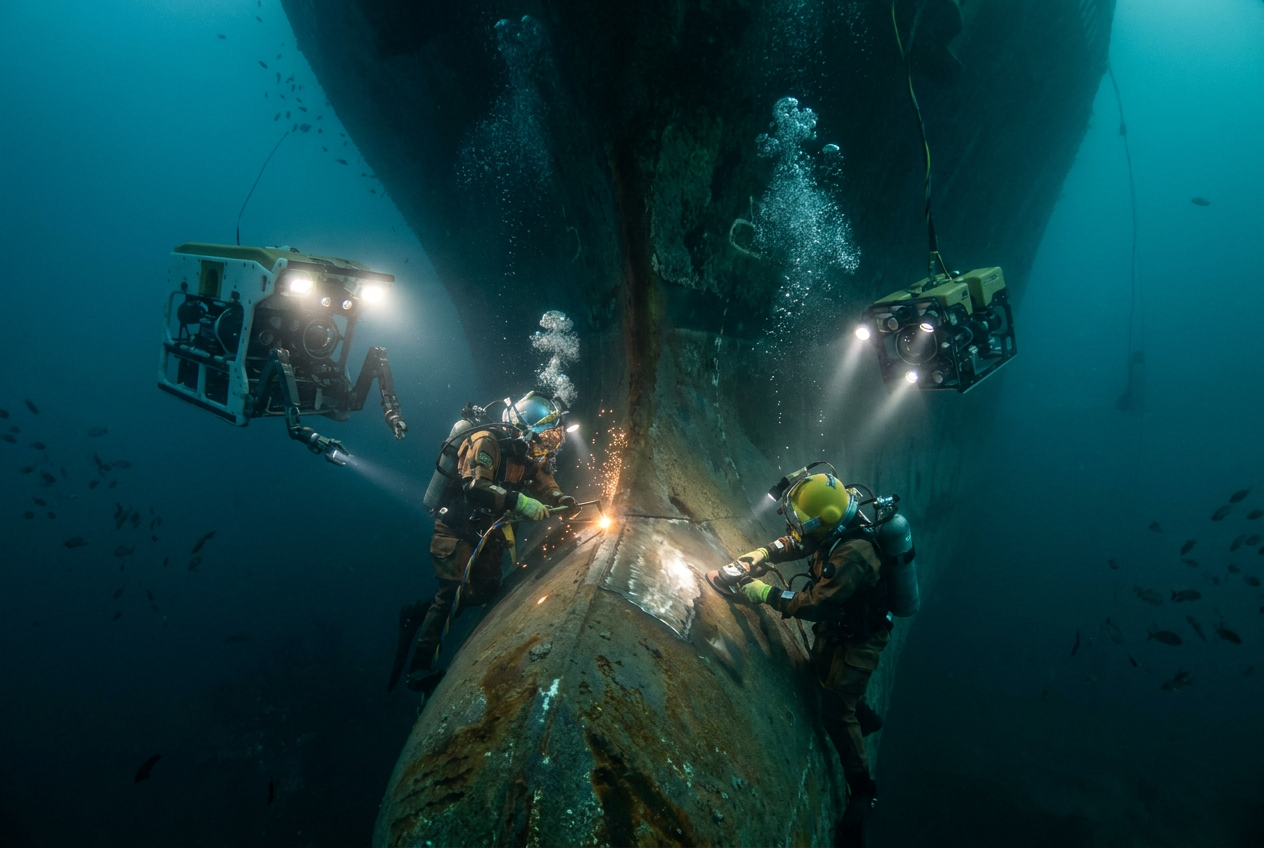
Hydrex recently carried out a wide spread of underwater repair assignments spanning ports and offshore locations in Africa, Europe, the Middle East, Asia and Central America. The work included structural steel renewals, propulsion-system interventions, seal and stern area repairs, appendage work and propeller restoration, with notable cases in West Africa, Northern Europe and elsewhere. Several jobs involved class-recognised permanent remedies, and the common denominator was that the vessels stayed afloat rather than entering drydock.
What it means for owners
For shipowners, the strongest signal in this development is economic rather than technical: afloat repair is increasingly being treated as a fleet availability strategy. Every unscheduled drydocking event carries a compound cost profile that extends well beyond the invoice from the yard. There is the obvious off-hire loss, but also tug arrangements, deviation, bunker consumption to reach the repair location, port charges, schedule disruption and knock-on charter consequences. In sectors with tight trading windows, a vessel unavailable for even a few extra days can lose a lucrative fixture or trigger contractual friction with cargo interests. Against that backdrop, the ability to complete structural, propulsion or sealing work alongside or at anchorage has become materially more valuable.
This is especially relevant in the current environment of constrained yard access. Drydock slots in several regions remain difficult to secure at short notice, particularly for emergency work that falls outside planned survey cycles. Owners therefore face a growing mismatch between the urgency of defects and the availability of conventional repair infrastructure. Afloat methods narrow that gap. They can stabilise a problem immediately, restore operational capability and, in some cases, deliver a class-accepted permanent solution without waiting for a yard window. That distinction matters commercially. Emergency repairs are usually the most expensive repairs because they combine damage response, schedule loss and procurement urgency. If underwater teams can convert what would have been a drydock emergency into an afloat intervention, the owner preserves optionality and can align any later yard visit with a scheduled special survey or broader capex package.
There is also a decarbonisation angle that is becoming harder to ignore. Extended idle time or unnecessary repositioning can worsen a ship's carbon performance profile, particularly where operational inefficiency lowers transport work over the reporting period. Although CII is a transport-efficiency metric rather than a simple measure of waiting time, prolonged off-hire and repair-related detours can still undermine annual performance by reducing effective voyage productivity. In parallel, vessels spending additional time in regulated trading patterns face wider cost implications under carbon pricing regimes such as the EU ETS. Even if the direct ETS impact varies by route and operational status, owners are increasingly sensitive to any disruption that adds fuel burn, idle days or avoidable port stays. Faster return to service therefore has both earnings and compliance value.
The technical significance is equally important. Underwater repair is no longer limited to crude stop-gap work. The industry has developed more sophisticated tooling, diving support procedures, cofferdam applications, precision measurement techniques and class-interface workflows that make permanent, class-approved afloat repairs more feasible than in the past. That does not eliminate scrutiny; on the contrary, permanent steel or propulsion repairs completed afloat require robust engineering justification, documented procedures and close engagement with classification societies. But the fact that such approvals are being obtained with greater regularity suggests a maturing service segment. For operators, the strategic takeaway is that repair planning now needs a wider lens: the decision is no longer simply drydock or defer, but increasingly whether a defect can be safely and economically resolved in the water with class acceptance and minimal trading interruption.
MaritimeNG — critical view
The case for afloat repair should not be overstated. Not every casualty is suitable for underwater intervention, and owners who treat it as a universal substitute for drydocking risk misjudging both technical limits and long-term asset integrity. Structural damage affecting broader hull condition, alignment-sensitive machinery issues, coatings renewal, extensive steel replacement or defects requiring comprehensive internal access may still be better handled in a controlled yard environment. Drydock remains the benchmark where full inspection, dimensional verification and integrated repair sequencing are required.
There is also a market-cycle question. Part of the current attraction of afloat repair is clearly linked to yard congestion and the high opportunity cost of taking ships out of service. If yard availability improves, some owners may revert to more conventional repair pathways for quality assurance and bundled maintenance efficiency. Class societies will continue to be the critical gatekeepers, and rightly so: as the commercial pressure to keep vessels trading increases, technical oversight must remain firm. The sustainable growth of this segment will depend not just on speed, but on repeatable repair quality, transparent documentation and disciplined risk management.
Verdict
The broader message is clear: afloat repair is becoming a strategic operations lever, not merely an emergency workaround. For owners navigating tighter margins, emissions accountability and repair-capacity bottlenecks, the ability to execute approved work in the water can protect both revenue days and compliance performance—an area MaritimeNG readers will recognise as increasingly central to modern vessel support planning.
Fundamental basis
The economic mechanics behind the facts above, grounded in Martin Stopford’s Maritime Economics. Reference only — not investment advice.
Facing a similar situation on your vessel? Model the numbers before you commit.
Open the off-hire & deviation calculatorsSource Attribution
This analytical review is based on publicly available facts originally reported by Ship & Offshore. MaritimeNG does not claim authorship of the underlying facts. Read the original publication
© 2026 MaritimeNG — Independent analytical commentary. All analysis, opinions, and forward-looking assessments are original work by MaritimeNG Editorial and may differ from those of the parties mentioned or the cited source. Factual data is restated in our own words based on publicly available information. All trademarks and trade names belong to their respective owners. This content does not constitute legal, technical, or investment advice.