AFDM 15 Signals a Practical Shift in US Repair Capacity
The launch of AFDM 15 is more than a yard milestone in Alabama: it is a tangible addition to US maritime maintenance infrastructure at a time when repair capacity has become a strategic constraint. For operators, the significance lies less in ceremony and more in whether floating dock capacity can reduce waiting time, off-hire exposure and dependence on overstretched fixed facilities.
What happened
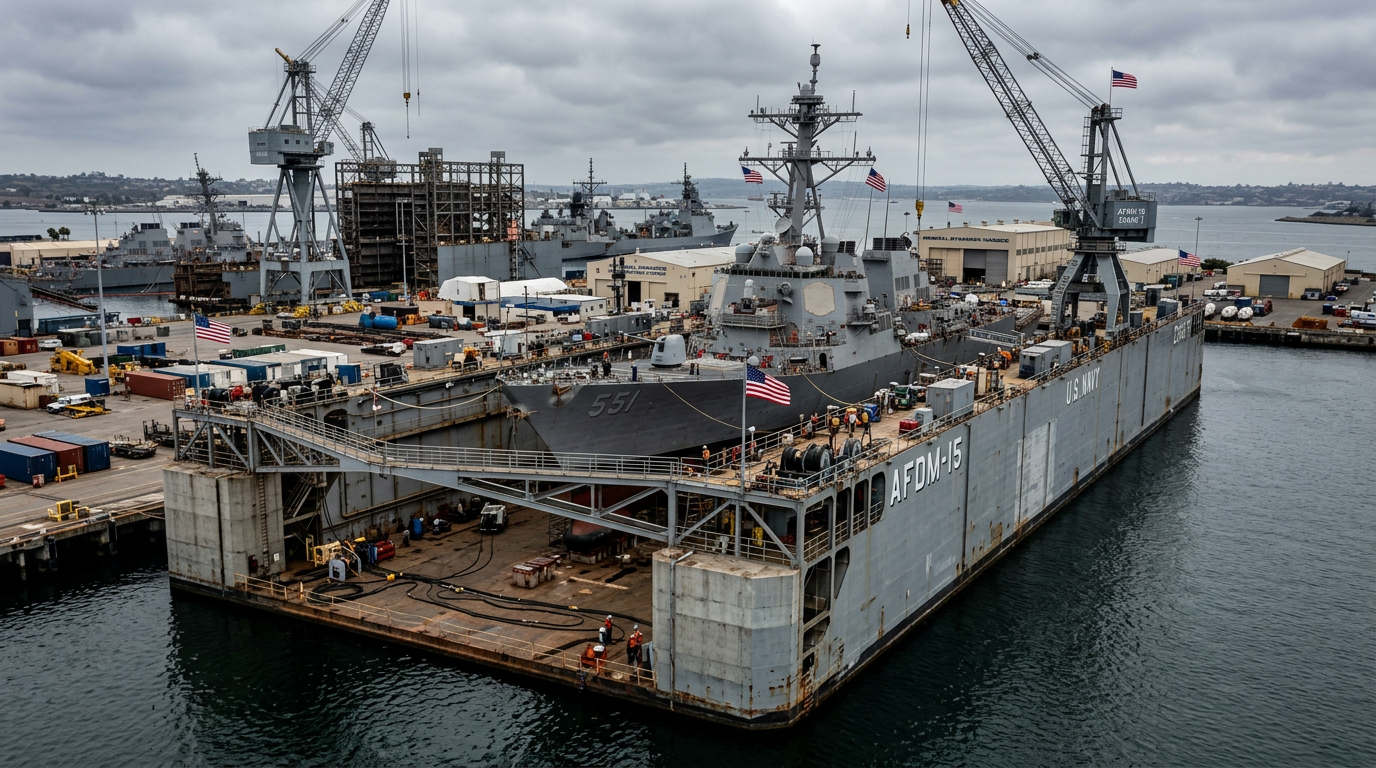
Austal USA and Alabama Shipyard have put AFDM 15 into the water, creating the first auxiliary floating drydock completed in the United States in roughly 40 years. At 211.53 metres and about 12,000 tonnes, it is the biggest structure ever launched in the Mobile area and the largest launch in Austal USA’s history. The dock is intended to support repair, maintenance and upgrade work where fixed drydock access is limited, with additional outfitting and commissioning still to come before service entry.
What it means for owners
For shipowners and operators, the immediate importance of AFDM 15 is not symbolic but operational. The US repair market has been dealing for years with a mismatch between vessel demand and yard availability, particularly for government tonnage but increasingly for commercial fleets that need predictable maintenance windows. When drydock slots are scarce, routine class work can become a commercial problem rather than a technical one: schedules slip, voyage planning becomes less flexible, and off-hire costs rise quickly. An auxiliary floating drydock does not solve every structural weakness in the US maritime industrial base, but it adds something the market badly needs: deployable lifting capacity that can be positioned where the work is, rather than forcing every vessel into a small number of congested fixed sites.
That has a direct economic relevance for operators in Jones Act and domestic coastal trades. US-flag tankers, articulated tug-barge units, ro-ros, offshore support tonnage and government-chartered vessels often have limited alternatives when domestic yard calendars tighten. In these segments, repair planning is shaped not only by steelwork and machinery scope, but also by crewing costs, cargo commitments, charter-party obligations and compliance deadlines. If AFDM 15 can help absorb some of the maintenance burden now concentrated at conventional yards, it could incrementally improve slot availability across the Gulf and adjacent regions. Even modest reductions in queue times matter in a high-cost operating environment where every additional day out of service can erode margins or disrupt contract performance. For owners, a more flexible drydocking ecosystem also improves negotiating leverage with yards, which has been weakened in recent years by capacity scarcity.
The wider significance is that this launch sits within a broader US policy push to rebuild maritime industrial resilience. Washington has become more explicit about the risks created by inadequate yard capacity, long naval repair backlogs and limited surge support for both military and commercial requirements. In that context, floating docks are one of the more practical tools available: they are faster to deploy than building entirely new permanent drydock complexes and can support maintenance closer to fleet concentrations or operational demand centers. That matters to naval MRO, but it also matters indirectly to commercial operators. When naval work overwhelms a finite yard base, commercial customers often experience the spillover in the form of deferred bookings, higher repair prices and reduced schedule certainty. Any asset that expands total lifting and repair throughput can therefore have a secondary benefit for the merchant fleet.
There is also a policy signal here for US shipbuilding revival efforts. A functional maritime industrial strategy cannot focus only on newbuilds; it must also strengthen the maintenance layer that keeps fleets trading and state assets available. Repair and modernization capability is where strategic ambition meets day-to-day execution. AFDM 15 suggests that industrial policy is beginning to acknowledge that reality. For the market, however, the key test will be whether this translates into sustained capability growth: trained labor, reliable subcontractor networks, equipment availability and a pipeline of follow-on projects. One large floating dock is valuable, but the larger issue is whether it becomes part of a repeatable capacity-expansion model rather than a one-off industrial headline.
MaritimeNG — critical view
Still, operators should be careful not to overstate what one asset can achieve. A floating drydock expands lifting capacity, but it does not automatically create the skilled workforce, supply-chain depth or project-management discipline required to complete repair periods on time and on budget. Many US yards remain constrained less by hardware than by labor availability, specialist trades and scheduling complexity. If those bottlenecks persist, the commercial impact of AFDM 15 could be narrower than early enthusiasm suggests.
There is also a strategic question about deployment priorities. In a capacity-constrained environment, government work will often command precedence, especially if policy objectives are tied to naval readiness and federal fleet support. That may be rational from a national perspective, but commercial owners will judge success by whether they actually see shorter waits and better access. Until the dock is fully commissioned and integrated into a dependable operating model, the market should treat this as an encouraging capacity addition rather than proof that the US repair shortage has been materially solved.
Verdict
AFDM 15 is a meaningful and practical addition to US maritime infrastructure, especially for a repair market strained by limited drydock access and rising schedule risk. Its real value will be measured not by launch records but by whether it improves throughput, reduces off-hire exposure and forms part of a broader, durable expansion of US MRO capability.
Fundamental basis
The economic mechanics behind the facts above, grounded in Martin Stopford’s Maritime Economics. Reference only — not investment advice.
Facing a similar situation on your vessel? Model the numbers before you commit.
Open the off-hire & deviation calculatorsSource Attribution
This analytical review is based on publicly available facts originally reported by Ship & Offshore (SORJ). MaritimeNG does not claim authorship of the underlying facts. Read the original publication
© 2026 MaritimeNG — Independent analytical commentary. All analysis, opinions, and forward-looking assessments are original work by MaritimeNG Editorial and may differ from those of the parties mentioned or the cited source. Factual data is restated in our own words based on publicly available information. All trademarks and trade names belong to their respective owners. This content does not constitute legal, technical, or investment advice.