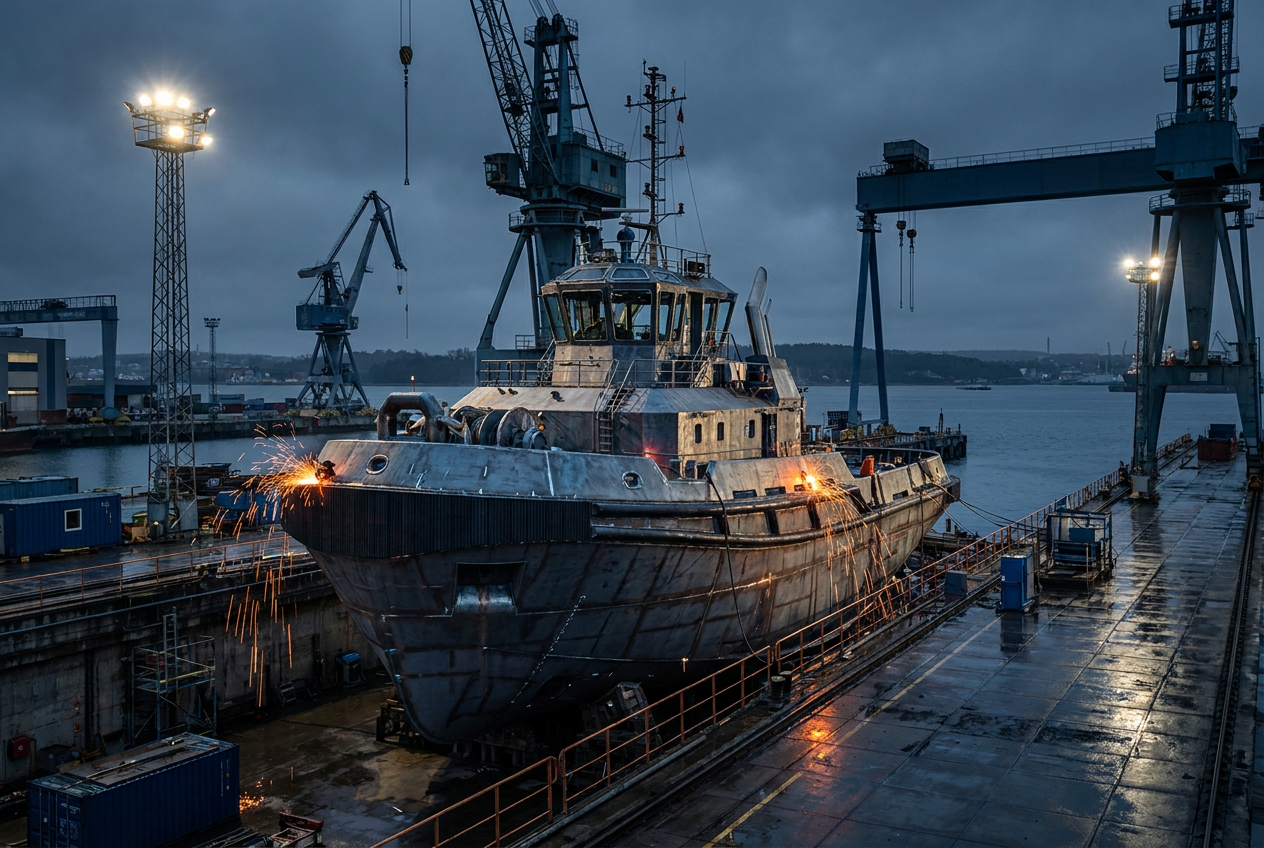
Global Tugboat Construction Market: Demand, Shipyard Competition, and the Next Fleet Renewal Cycle
This is Part 1 of our series on the tugboat construction market.
The tugboat construction market occupies a relatively small segment of global commercial shipbuilding by tonnage, but it has disproportionate operational importance across maritime logistics. Tugboats are mission-critical assets for ports, container terminals, energy terminals, offshore bases, coastal towage networks, and industrial waterways. They enable larger vessels to berth safely, support terminal throughput, and provide resilience where channel constraints, vessel scale, weather, and safety rules leave little room for operational failure. In that sense, the market should be understood not simply as a niche within workboat construction, but as a core enabling layer of the wider port and marine infrastructure system.
The source material frames this topic as a comprehensive analysis of the tugboat construction market and indicates that coverage should span the full value chain: demand, shipbuilding capacity, competition, and outlook. Building on that approach, this article examines the sector end to end: what defines the market, what drives newbuild demand, how shipyards position themselves, what technologies are reshaping specifications, and where the next fleet renewal cycle is likely to emerge.
1. Market Definition and Functional Role Across Maritime Infrastructure
Tugboat construction serves a set of overlapping end-markets rather than one uniform customer base. At the core are harbor and terminal tugs used for ship assist, escort, berthing, and unberthing. These vessels are central to modern ports handling larger container ships, LNG carriers, crude tankers, bulk carriers, and vehicle carriers. Beyond ports, tug construction also supports offshore logistics, coastal towing, salvage support, naval harbor operations, and specialized industrial applications.
This diversity matters because tug demand is derived demand: owners do not order vessels in isolation, but in response to cargo flows, terminal design, pilotage and safety standards, vessel mix, and concession economics. A container hub with larger beam vessels and tighter turnaround requirements needs a different tug profile than a regional bulk terminal or a coastal towing operator. As a result, the market is segmented by bollard pull class, propulsion layout, escort capability, deck equipment, fire-fighting notation, ice capability, and increasingly by emissions profile.
From an economic standpoint, tugboats sit at the intersection of infrastructure availability and service reliability. Unlike deep-sea ships, they are often procured against highly localized operating requirements. That gives the market a dual character: globally visible in shipbuilding capacity and design trends, but locally anchored in procurement logic. Standardized hull platforms exist, especially in azimuth stern drive and tractor tug categories, yet buyers still place high value on customization around maneuverability, draft, terminal interface, crew ergonomics, and class/regulatory compliance.
The result is a market that is less cyclical than some cargo vessel categories, but not immune to investment pauses. Tug ordering tends to lag major infrastructure announcements and follow clearer signals such as terminal commissioning schedules, concession awards, fleet age thresholds, and updated environmental rules. This makes the market comparatively defensive, though still sensitive to capital costs and public-private investment timing.
2. Core Demand Drivers: Port Growth, Aging Fleets, Regulation, and Terminal Specialization
The first structural demand driver is port expansion and the associated rise in ship-assist requirements. Global trade growth may be uneven by year and region, but investment in port capacity, dredging, berth extension, and terminal upgrades continues to create pockets of tug demand. Larger vessels require stronger and more maneuverable tugs; more complex terminal layouts often require redundancy in assist fleets; and higher berth productivity expectations raise the economic cost of tug unavailability. In practice, one infrastructure project can trigger multiple tug orders, not only for initial deployment but also for standby coverage and maintenance rotation.
The second driver is the replacement of aging fleets. In many markets, tug fleets include vessels that remain operational well beyond the age at which fuel efficiency, crew comfort, emissions performance, and maintenance economics are optimal. Operators may defer renewal because tug utilization is local and service contracts can be sticky, but this deferral has limits. Aging steel, machinery obsolescence, lower redundancy, and tougher inspection regimes gradually push owners toward replacement or major life-extension decisions. For shipyards, this replacement cycle is especially important because it supports baseline demand even when greenfield port projects slow.
A third major driver is tighter environmental regulation. The market is being reshaped by stricter emissions standards at the international, national, and especially port level. Even where formal zero-emission mandates remain limited, procurement standards are clearly moving toward lower-emission operations. This creates demand not just for conventional diesel newbuilds, but for hybrid tugs, battery-assisted configurations, LNG-fueled variants in selected markets, and designs prepared for future fuel conversion. Environmental compliance is therefore becoming both a replacement trigger and a competitive differentiator in tenders.
The fourth driver is terminal specialization. LNG, LPG, crude oil, chemicals, offshore wind marshalling, and high-throughput container terminals each impose distinct performance and safety requirements. Specialized terminals tend to demand higher escort ratings, more advanced fire-fighting capability, redundancy in propulsion and control systems, and stricter uptime expectations. This pushes the market toward more technically sophisticated vessels with higher unit values, even if total annual volumes remain modest compared with larger ship classes.
A fifth, often underappreciated driver is resilience and operational redundancy. Recent years have increased awareness of supply chain fragility and weather-related disruption. Port operators and marine service providers are more focused on maintaining service continuity under stress, which can support procurement of additional units, not merely replacement vessels. In that sense, tug demand is becoming linked not only to throughput growth but also to reliability metrics.
3. Supply Side: Shipyard Positioning, Competitive Factors, and Pricing Logic
On the supply side, the tugboat construction market combines standardized industrial capability with selective specialization. A broad range of shipyards can physically build tugs, but far fewer can compete consistently in high-specification segments where maneuvering performance, emissions integration, class compliance, and delivery certainty matter most. Shipyard positioning therefore depends on more than steelwork cost. It reflects design partnerships, engineering depth, procurement networks, track record in specific tug classes, and the ability to manage customization without schedule slippage.
Competition among yards typically centers on five factors.
First is proven design capability. Buyers place substantial weight on whether a yard can deliver a platform with known handling characteristics and reliable bollard pull performance under real-world operating conditions. Established designs reduce technical risk and support financing, insurance, and crew acceptance.
Second is delivery time. Tug procurement is often linked to terminal launch deadlines or expiring service contracts. Delays can have direct commercial consequences, so yards with predictable schedules may command a premium even when headline pricing is not the lowest.
Third is total lifecycle economics. Purchase price remains important, but operators increasingly evaluate fuel burn, maintenance intervals, spare-parts availability, and retrofit potential. In lower-utilization segments, capex discipline dominates; in intensive harbor service, operating efficiency can justify a higher upfront price.
Fourth is compliance capability. Emissions systems, noise constraints, escort notation, fire-fighting requirements, and local content rules all add complexity. Yards that can integrate these specifications smoothly gain a competitive advantage.
Fifth is aftersales and service support. Even in a relatively small vessel class, downtime is expensive. Buyers therefore value shipyards and design ecosystems able to support commissioning, warranty work, software updates, and technical troubleshooting.
Pricing in this market is best understood as specification-driven rather than commoditized. The spread between a standard harbor tug and a high-spec escort or hybrid unit can be substantial. Steel and machinery costs matter, but so do propulsion package choice, battery integration, automation architecture, classification requirements, and local labor conditions. This also explains why price comparisons across regions can be misleading without accounting for configuration. Two tugs with similar dimensions may sit in very different economic categories.
A constraint on supply is that tug construction competes internally for yard capacity with other workboats, patrol craft, ferries, and small specialized vessels. In periods of strong demand across these categories, smaller and mid-sized yards can become bottlenecks. Component availability—especially engines, azimuth thrusters, electrical systems, and batteries—can also extend lead times. Thus, the practical supply curve is tighter than simple hull-building capacity might suggest.
4. Technology and Design Shifts Reshaping the Orderbook
The most visible technology shift in tugboat construction is the move toward lower-emission propulsion. Conventional diesel remains dominant globally, but the center of gravity is moving toward cleaner and more flexible architectures. Hybrid propulsion has gained strategic relevance because it offers a practical compromise: lower fuel consumption and emissions in variable duty cycles without the full infrastructure burden of pure electric operation. Battery-electric tugs are increasingly viable in specific port environments with short duty cycles, strong charging access, and policy support, while methanol and other future-fuel pathways are under active consideration in design studies and pilot deployments.
A second key trend is design optimization around efficiency rather than raw power alone. Owners still require high bollard pull, but they increasingly want it delivered with lower fuel burn, reduced maintenance load, and improved escort performance. Hull form refinement, thruster optimization, digital monitoring, and energy management systems are therefore becoming standard elements of modern specifications.
Third, automation is progressing incrementally rather than through immediate full autonomy. The near-term market emphasis is on decision support, remote diagnostics, predictive maintenance, and safer bridge interfaces. For tug operations, where close-quarters maneuvering remains highly dependent on crew judgment, full autonomy is a longer-horizon prospect. However, digitalization already improves uptime, training, fuel management, and fault response.
Fourth, crew and safety considerations are receiving more design attention. Better visibility, shock mitigation, accommodation quality, and ergonomic bridge layouts are increasingly part of procurement criteria. This reflects labor realities as much as regulation: attracting and retaining skilled tug crews is easier on vessels designed for safer and more comfortable operations.
Taken together, these shifts are changing the orderbook mix. The market is no longer defined only by replacing like for like. It is increasingly about replacing older units with more efficient, compliant, and operationally adaptable assets. That raises average technical complexity and supports higher value per vessel, even if the market remains moderate in unit volumes.
5. Outlook: Risks, Momentum, and Strategic Implications
The medium-term outlook for tugboat construction is constructive, though not without friction. Orderbook momentum should be supported by three overlapping forces: replacement of older fleets, continued investment in port and terminal capability, and progressive environmental tightening. These drivers do not advance at the same speed in every region, but together they provide a durable baseline for demand.
The principal risks are familiar. High interest rates or tighter credit conditions can delay owner investment. Public infrastructure projects may slip. Yard slots can become constrained. New propulsion choices may create procurement hesitation if owners fear technology lock-in or uncertain residual values. In some markets, operators may also extend existing assets longer than technically optimal if charter visibility is weak.
Still, the strategic direction is becoming clearer. Owners need to think in portfolio terms: not simply whether to replace a tug, but which segments justify premium low-emission or hybrid assets first. Shipyards need to position themselves around repeatable platforms with configurable technology layers rather than bespoke engineering on every project. Investors should view the sector as a specialized marine infrastructure play, where demand is tied less to headline shipbuilding cycles than to the operating modernization of ports and terminals.
The key conclusion is that the next fleet renewal cycle is unlikely to be a simple volume story. It will be a quality and capability story. Demand will increasingly favor vessels that combine operational power, compliance readiness, lifecycle efficiency, and digital support. That shift should reward shipyards with credible execution and owners able to align procurement with long-term port service economics.
Conclusion
The tugboat construction market is best understood as a strategically important, specification-driven segment of maritime industry infrastructure. Its demand base is anchored in port growth, fleet replacement, environmental compliance, and terminal specialization; its supply side is shaped by engineering capability, delivery reliability, and component access; and its technological trajectory points toward cleaner, smarter, and more efficient vessels. As a result, the sector enters the next renewal phase with solid structural support, but also with sharper competition over technology choices and capital allocation.
This article is the final part of the series.