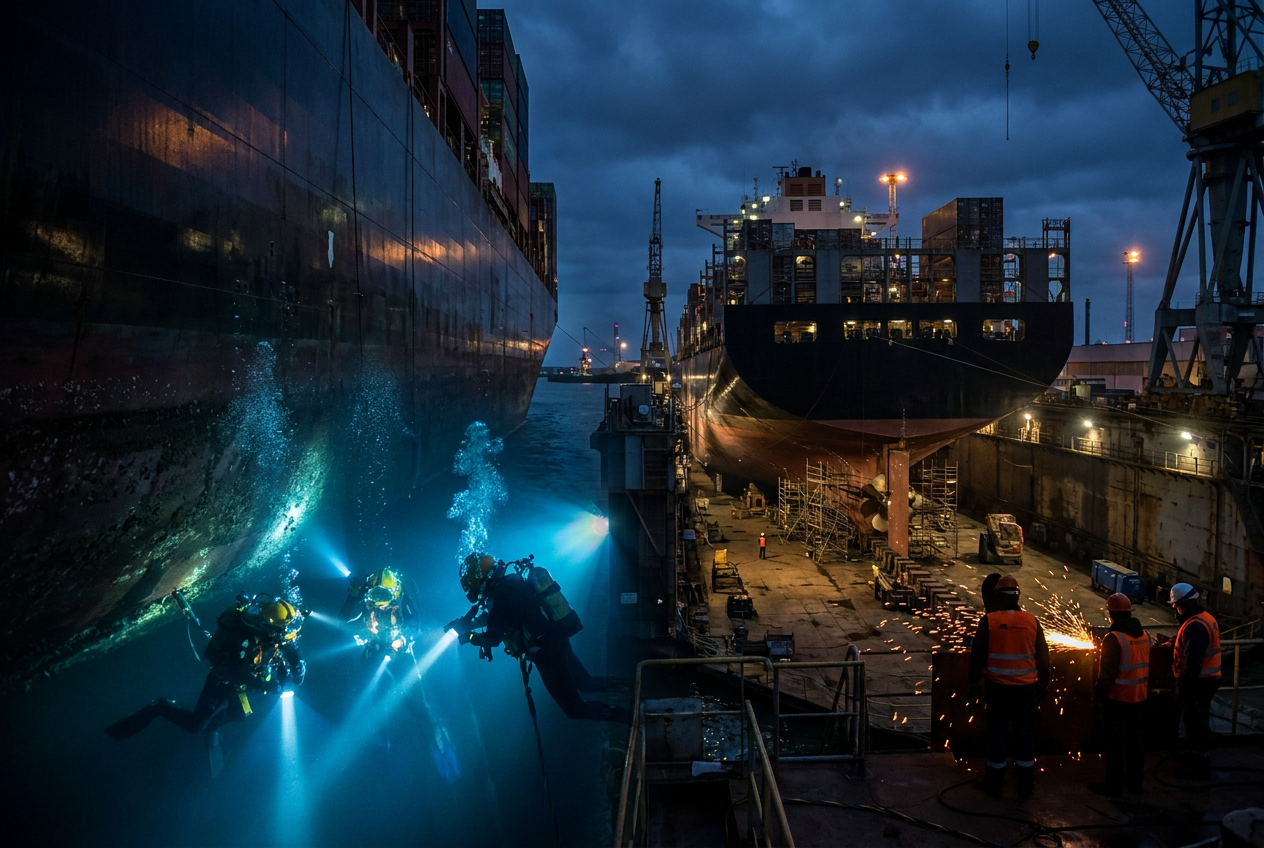
Afloat Repair or Drydock? A Practical Decision Framework for Ship Operators
Start with regulatory and technical feasibility, not headline price. Afloat work fits a scope that can be reached, completed, inspected and accepted without exposing the underwater hull. Choose drydock when dry access, major structural intervention or a mandatory out-of-water examination is required.
An in-water survey does not automatically authorize an afloat repair or necessarily satisfy a scheduled bottom survey. Survey credit, repair approval and execution planning are separate decisions.
Decision Matrix
| Decision condition | Prefer afloat repair | Prefer drydock |
|---|---|---|
| Class and flag position | Written acceptance obtained for the proposed survey and repair | Approval is unavailable, conditional or requires out-of-water examination |
| Physical access | Work area can be reached, prepared and inspected afloat | Full hull exposure or dry access is necessary |
| Repair scope | Limited, clearly defined work with an accepted inspection method | Major underwater steel renewal, tailshaft withdrawal or significant rudder work |
| Survey evidence | Diver or ROV can provide equivalent, surveyor-acceptable information | Visibility, fouling or geometry prevents a meaningful examination |
| Schedule | Suitable berth or sheltered-water window aligns with operations | A scheduled survey creates an opportunity to bundle work |
| Execution risk | Weather, currents, port permission and specialist availability are controlled | Conditions could interrupt work or invalidate inspection evidence |
If a mandatory compliance gate points to drydock, projected cost savings cannot override it.
Compare Total Cost, Not Contractor Price
Afloat repair may avoid docking fees, tug and pilotage movements, yard deviation and part of the vessel’s off-hire exposure. Work may also fit an anchorage or berth call. Those advantages depend on port permission, a suitable location, qualified personnel and available survey attendance.
A fair comparison should include:
- berth, anchorage and port-service costs;
- mobilization of divers, ROVs, riding squads and inspection equipment;
- class surveyor attendance and flag-state coordination;
- hull cleaning needed for a meaningful inspection;
- weather delays and remobilization;
- temporary access or isolation arrangements;
- deviation, off-hire and schedule recovery;
- the possibility that findings will require drydocking.
An inexpensive afloat quotation can become the costlier option if evidence is inconclusive or defects exceed the accepted scope. Repair-cost estimation tools, including maritimeng.net, can help normalize scoped quotations, but they cannot determine class or flag acceptance.
Where Afloat Repair Reaches Its Limits
Afloat work is best suited to a bounded scope that does not require complete external access. Above-waterline structural work, piping and internal or topside maintenance may be feasible when the specification, personnel and inspection arrangements are accepted.
Below the waterline, major structural renewals, tailshaft withdrawal, substantial rudder or pintle work, and full-scale hull blasting and recoating normally require drydock access. Significant damage, abnormal deterioration or a condition affecting fitness to proceed may also lead the surveyor to require docking.
Inspection must not be confused with permission to perform every repair discovered. A diver or ROV may document damage that cannot be prepared, measured, repaired or verified satisfactorily underwater. Operators should agree the inspection procedure, evidence standard and limits of possible afloat work before mobilization.
Apply IMO and IACS Requirements Correctly
Under IMO Harmonized System of Survey and Certification guidance, cargo ships generally require at least two inspections of the outside of the bottom during a five-year certificate period. The interval between consecutive inspections must not exceed 36 months. An Administration may accept an in-water survey instead of a drydock examination when the technical provisions are satisfactory, with the objective of retaining at least one drydock examination during the five-year period.
IACS Unified Requirement Z3 addresses periodical surveys of the outside of a ship’s bottom. An in-water alternative may be considered when proposed to the classification society in advance and capable of providing information equivalent to a docking survey. The work requires suitable sheltered water, adequate visibility, sufficient hull cleanliness and an approved service supplier. Ships subject to the Enhanced Survey Programme that are 15 years old or older must undergo the relevant bottom examination in drydock.
IACS UR Z7.1 is not the universal UWILD rule and should not be presented as the general ESP requirement for bulk carriers and oil tankers. Its stated scope covers hull surveys of self-propelled general dry cargo ships of 500 gross tonnage and above. The regulatory chain should remain clear: IMO HSSC guidance provides the statutory framework, UR Z3 addresses bottom surveys, and ship-type requirements apply only within their stated scope.
Class Society and Flag-State Gates
Approval is vessel-specific. The flag Administration determines statutory acceptance, while the recognized classification society assesses its own rule requirements and controls or attends the survey.
Lloyd’s Register may accept an in-water examination for eligible ships when it provides information equivalent to a drydock survey. Relevant conditions include an approved diver or ROV provider, sheltered water, adequate cleanliness and visibility, reliable two-way communication, and visual presentation satisfactory to the surveyor.
DNV applies UWILD through relevant class notations and vessel or offshore-unit rules. Its published material for offshore and stationary assets emphasizes an approved inspection plan, surveyor supervision, reporting and flag-state acceptance. These arrangements should not be generalized to a vessel outside the applicable notation or rule scope.
ABS offers an optional UWILD notation for vessels designed to facilitate underwater examination. Its framework calls for prior approval, hull markings and access arrangements, an approved external specialist, and surveyor oversight. For ESP vessels aged 15 years or more, UWILD is generally unavailable as a drydocking alternative. Significant damage or deterioration may also lead ABS to require physical drydocking.
No Bureau Veritas requirement should be inferred from another society’s notation. A Bureau Veritas-classed operator should obtain written confirmation under its current rules, together with the relevant flag Administration’s acceptance, before committing to an afloat plan.
Manage Weather, Port and Inspection Risk
In-water work depends on sheltered water, manageable currents, adequate visibility and a sufficiently clean hull. Seasonal turbidity, pollution, traffic and changing port conditions can make a previously suitable site unusable. Severe weather can restrict port operations or require vessels to leave.
Divers provide direct access and support tactile or complex tasks, but expose personnel to underwater hazards and remain limited by visibility and operating conditions. ROVs reduce human exposure and can provide video or carry inspection sensors, but acceptance depends on image quality, positioning, communication and provider capability. Neither method compensates for inaccessible or heavily fouled areas.
Choose afloat repair only when scope, evidence, location and approvals are controlled. Choose drydock when any of those elements depends on optimistic assumptions.